



Physical pain is essential for survival, as it allows animals to detect when they are injured or unwell, seek shelter and address their ailments. Yet when it becomes chronic, pain can also become highly distressing and debilitating.
While there are now several therapeutic strategies for managing chronic pain, an emerging one that has been found to be particularly promising is vagus nerve stimulation (VNS). VNS entails the delivery of mild electrical pulses to the nerve that connects the brain to organs throughout the body.
Past studies suggest that VNS-based therapy can reduce the pain associated with various medical conditions, including chronic headaches, fibromyalgia and joint inflammation. The neural processes by which it can ease pain, however, are still poorly understood.
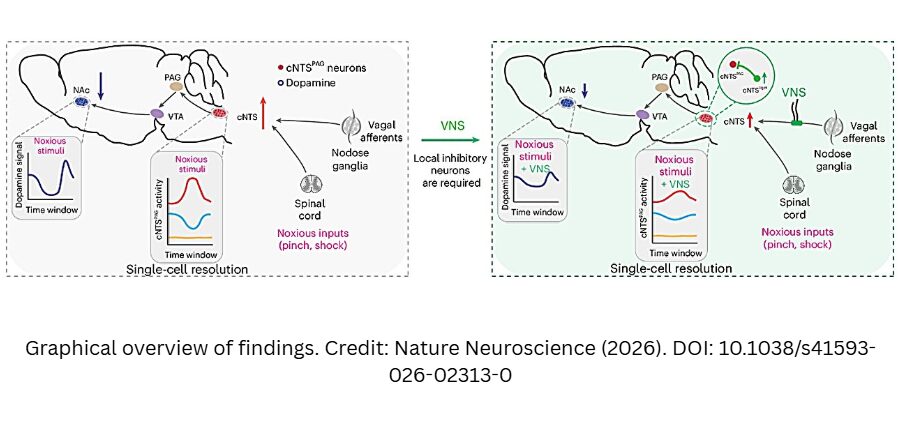
Researchers at Fudan University carried out a study aimed at better understanding how VNS acts on pain, specifically focusing on neurons in the brainstem, a stalk-like structure at the base of the brain. Their findings, published in Nature Neuroscience, suggest that VNS-based therapy acts on a previously unknown neural pathway involved in the processing of pain.
“VNS has been used clinically for several neurological and psychiatric conditions, and growing evidence suggests that it can also help relieve pain,” Hanfei Deng, senior author of the paper, told Medical Xpress.
“However, we still know relatively little about how stimulation of a peripheral nerve can influence pain-related processing inside the brain. This study was inspired by a simple question: How does the vagus nerve communicate with brain circuits that process pain and negative emotions?
“Because the nucleus of the solitary tract is the first major brainstem target of vagal sensory input and also receives pain-related signals, we asked whether it could serve as a key entry point for VNS to modulate pain.”
Identifying brainstem circuits that shape VNS-related pain relief
The main objective of the study was to identify specific populations of neurons and neural pathways that play a role in the effects of VNS on the sensory perception and emotional processing of pain. To achieve this, the researchers carried out a series of experiments involving adult mice.
Initially, the team examined the roles of different groups of neurons in a part of the brainstem known as the caudal nucleus of the solitary tract (cNTS). This allowed them to identify a specific set of neurons that appeared to play a role in pain-related perceptions and behaviors.
The neurons they identified had axons (i.e., long fiber-like extensions) that reached the periaqueductal gray (PAG). The PAG is a small, almond-shaped segment of the midbrain known to play a role in intense emotional experiences, pain modulation and fight-or-flight responses.
“We then focused on these neurons, selectively activating or inhibiting them while measuring pain-related behaviors,” Deng said. “We also recorded their neural activity while the animals experienced painful stimuli or received VNS. Finally, we traced the anatomical connections linking the spinal cord, the nucleus of the solitary tract, the periaqueductal gray, and downstream dopamine circuits.”
Using various techniques to activate specific neurons, trace their connections and record neural activity, Deng and her colleagues were able to identify neurons that responded most strongly to pain. When they then exposed the mice to VNS, they could determine whether this intervention acted on these neurons and modified their activity.
“We identified a specific brainstem pathway, from the caudal nucleus of the solitary tract to the periaqueductal gray, that converts pain signals into behavioral and emotional responses,” Deng said.
“Activating this pathway produced pain-like behaviors, while inhibiting it reduced pain behavior. We also found that this pathway influences dopamine signals in the nucleus accumbens, suggesting a circuit mechanism through which VNS may affect both the sensory and emotional components of pain.”
Guiding future pain relief interventions
The results of this study offer valuable new insight into the neural processes by which VNS eases chronic pain. Other research teams could soon draw inspiration from these findings and try to determine whether they also apply to other animal models, including humans.
In the future, the recent efforts by Deng and her colleagues could help paint a clearer picture of the neural circuits involved in chronic pain and how VNS targets these circuits. Eventually, this could help researchers devise effective VNS-based interventions that successfully reduce the pain associated with various conditions.
“If we know which brain circuits are most relevant, future therapies may be optimized to more precisely target the neural processes that contribute to pain and pain-related negative effects,” Deng added.
“Pain is not only a sensory experience; it also strongly affects emotional state, motivation, learning and decision-making. In the future, we hope to understand how VNS influences these broader brain processes, and whether this knowledge can help guide more precise neuromodulation strategies.” https://medicalxpress.com/news/2026-06-vagus-nerve-quiet-pain-newly.html



Recent Comments