fMRI tagged posts

Your brain doesn’t forget when you forgive—it does something far more surprising with those painful memories

Forgive Update
Credit: Image generated by the editorial team using AI for illustrative purposes.

Forgiving someone might not erase painful memories, but it can subtly update them, making past hurts feel less upsetting. It’s less “forgive and forget,” and more “forgive and update.”

Psychologists have long known that forgiveness is crucial for healing rifts and keeping social bonds strong. Folk wisdom even advises us to “forgive and forget” after a wrong, implying that saying you forgive someone should make the bad memory vanish.

But forgiving doesn’t actually make you forget, notes Duke neuroscientist Felipe de Brigard: “When you forgive someone for a wrongdoing, you don’t forget the event. But once you forgive, the memory doesn’t hurt as much...

Read More
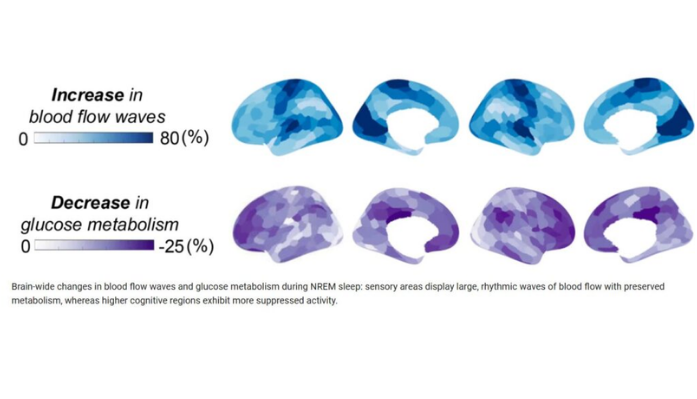
How the brain’s activity, energy use and blood flow change as people fall asleep

A new study by investigators from Mass General Brigham has used next-generation imaging technology to discover that when the brain is falling asleep, it shows a coordinated shift in activity.

The researchers found that during NREM (non-rapid eye movement) sleep, parts of the brain that handle movement and sensory input stay active and keep using energy, while areas involved in thinking, memory and daydreaming quiet down and use less energy. Their results are published in Nature Communications.

“This research helps explain how the brain stays responsive to the outside world even as awareness fades during sleep,” said corresponding author Jingyuan Chen, Ph.D., an assistant investigator at the Athinoula A. Martinos Center for Biomedical Imaging at Massachusetts General Hospital.

...Read More

Finding Love: Study reveals Where Love Lives in the Brain

The brain in love: the image shows brain areas that activate in association with the most intensely felt forms of interpersonal
The brain in love: the image shows brain areas that activate in association with the most intensely felt forms of interpersonal love. Picture: Juha Lahnakoski.

Researchers have taken looking for love to a whole new level, revealing that different types of love light up different parts of the brain. We use the word ‘love’ in a bewildering range of contexts – from sexual adoration to parental love or the love of nature. Now, more comprehensive imaging of the brain may shed light on why we use the same word for such a diverse collection of human experiences.

‘You see your newborn child for the first time. The baby is soft, healthy and hearty – your life’s greatest wonder. You feel love for the little one.’

The above statement was one of many simple scenarios presented to fifty-five ...

Read More

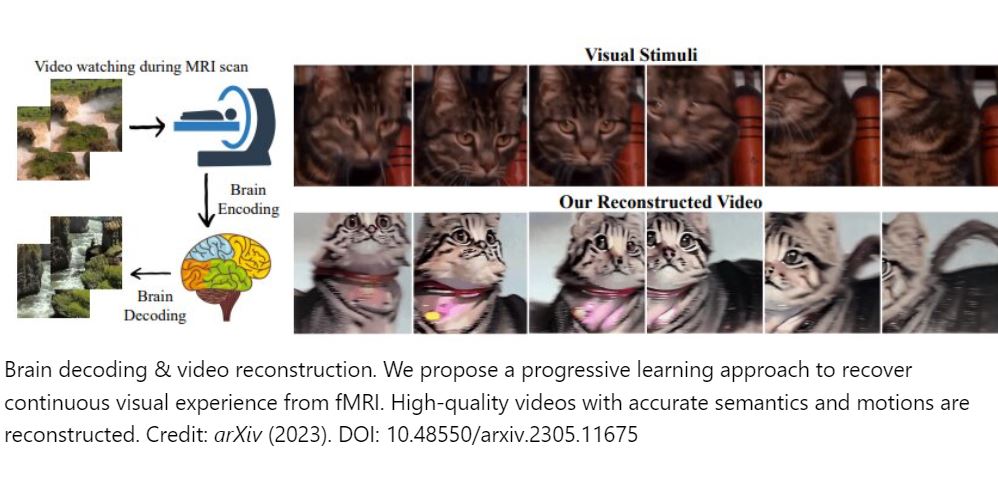
AI Tool Generates Video from Brain Activity

“Alexa, play back that dream I had about Kirsten last week.” That’s a command that may not be too far off in the future, as researchers close in on technology that can tap into our minds and retrieve the imagery of our thoughts.

Researchers at the National University of Singapore and the Chinese University of Hong Kong reported last week that they have developed a process capable of generating video from brain scans. The research is published on the arXiv preprint server.

Using a process called functional magnetic resonance imaging (fMRI), researchers Jiaxin Qing, Zijiao Chen and Juan Helen Zhou coupled data retrieved through imaging with the deep learning model Stable Diffusion to create smooth, high quality videos.

Successful recreations of still imagery gleaned from brain ...

Read More