Hot Jupiters tagged posts

Saturn-sized exoplanet with Earth-like temperature reveals methane-rich atmosphere

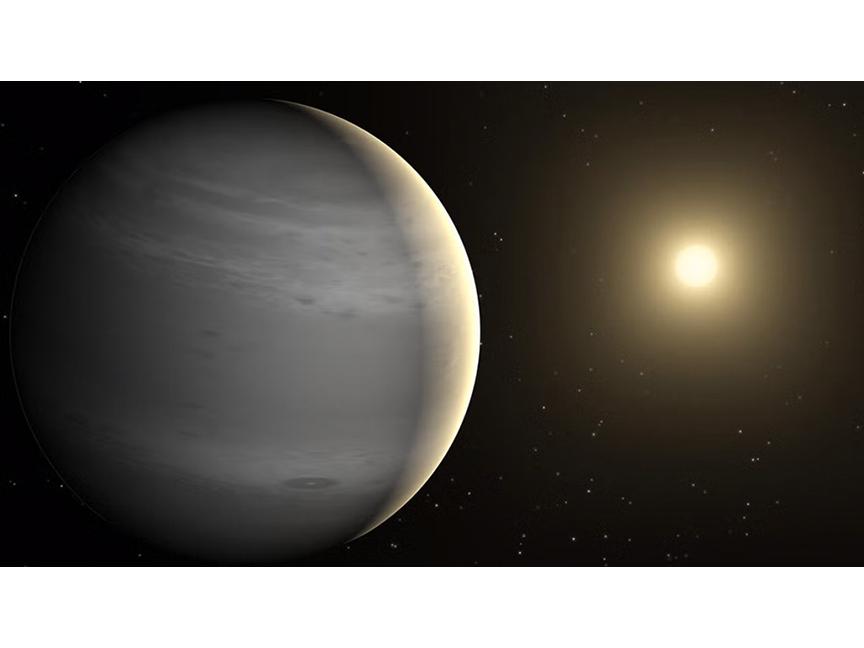
Grey planet with host star in background
Artist’s impression of a gas giant planet orbiting its distant host star. New research, led by astronomers at Penn State and the Jet Propulsion Laboratory, used NASA’s James Webb Space Telescope to analyze the atmosphere of a gas giant planet about the size of Saturn but with Earth-like temperatures and found it to be rich in methane. Credit: NASA/JPL-Caltech. All Rights Reserved.

A planet that is about the size of Saturn, but with a temperature more like Earth’s, has an atmosphere rich in methane, according to a new study using NASA’s James Webb Space Telescope (JWST).

Unlike the gas giant planets—Jupiter and Saturn—in Earth’s solar system, which are distant from the sun and therefore extremely cold, and so-called “hot Jupiters”—giant planets beyond the solar system that are s...

Read More

Webb Cracks Case of Inflated Exoplanet

Graphic titled “Hot Gas-Giant Exoplanet WASP-107 b Transmission Spectrum: Hubble WFC3 Grism Spectroscopy; Webb NIRCam Grism Spectroscopy; Webb MIRI Low-Resolution Spectroscopy” has 3 sets of data points with error bars and a best-fit model on a graph of Amount of Light Blocked on the y-axis versus Wavelength of Light in microns on the x-axis. Y-axis ranges from less light blocked at bottom to more light blocked at top. X-axis ranges from 0.8 to 12 microns. Data are identified in a legend. Hubble WFC3: 30 green data points ranging from 0.9 to 1.6 microns; Webb NIRCam: 177 orange data points ranging from 2.5 to 5 microns; Webb MIRI: 46 pink data points ranging from 5 to 12 microns. Best-fit model is a gray line with numerous peaks and valleys. The model and data are closely aligned. Ten features on the graph are labeled: Water H2O; Water H2O and Carbon Dioxide CO2; Ammonia NH3; Methane CH4; Sulfur Dioxide SO2; Carbon Dioxide CO2; Carbon Monoxide CO; Water H2O; Sulfur Dioxide SO2; and Ammonia NH3.
Warm Gas-Giant Exoplanet WASP-107 b Transmission Spectrum (Hubble WFC3, Webb NIRCam, Webb MIRI)

Why is the warm gas-giant exoplanet WASP-107 b so puffy? Two independent teams of researchers have an answer.

Data collected using NASA’s James Webb Space Telescope, combined with prior observations from NASA’s Hubble Space Telescope, show surprisingly little methane (CH4) in the planet’s atmosphere, indicating that the interior of WASP-107 b must be significantly hotter and the core much more massive than previously estimated.

The unexpectedly high temperature is thought to be a result of tidal heating caused by the planet’s slightly non-circular orbit, and can explain how WASP-107 b can be so inflated without resorting to extreme theories of how it formed.

The results, which were ...

Read More

14-inch Spacecraft delivers new Details about ‘Hot Jupiters’

The Colorado Ultraviolet Transit Experiment (CUTE) spacecraft is about the size of a cereal box. It has also recorded incredibly detailed measurements of the atmospheres of planets hundreds of light-years from Earth.

A spacecraft the size of a cereal box has collected precise measurements of the atmospheres of large and puffy planets called “hot Jupiters.” The findings, led by a team from the University of Colorado Boulder, could help reveal how the atmospheres around these and a host of other worlds are escaping into space.

The diminutive spacecraft, which measures just 14 inches in length, may be cute, but its scientific findings are anything but...

Read More

How Planets can be an Anti-Aging Formula for Stars

The team examined systems containing a star orbited by a hot Jupiter, accompanied by a star without such a planet.

Planets can force their host stars to act younger than their age, according to a new study of multiple systems using NASA’s Chandra X-ray Observatory. This may be the best evidence to date that some planets apparently slow down the aging process for their host stars.

While the anti-aging property of “hot Jupiters” (that is, gas giant exoplanets that orbit a star at Mercury’s distance or closer) has been seen before, this result is the first time it has been systematically documented, providing the strongest test yet of this exotic phenomenon.

“In medicine, you need a lot of patients enrolled in a study to know if the effects are real or some sort of outlier,” said Ni...

Read More