These are Hubble Space Telescope images of two massive clusters of galaxies named MOO J1014+0038 (left panel) and SPT-CL J2106-5844 (right panel). The artificially added blue color is translated from Hubble data that captured a phenomenon called intracluster light. This extremely faint glow traces a smooth distribution of light from wandering stars scattered across the cluster. Billions of years ago the stars were shed from their parent galaxies and now drift through intergalactic space. Credits: NASA, ESA, STScI, James Jee (Yonsei University); Image Processing: Joseph DePasquale (STScI)
In giant clusters of hundreds or thousands of galaxies, innumerable stars wander among the galaxies like lost souls, emitting a ghostly haze of light...
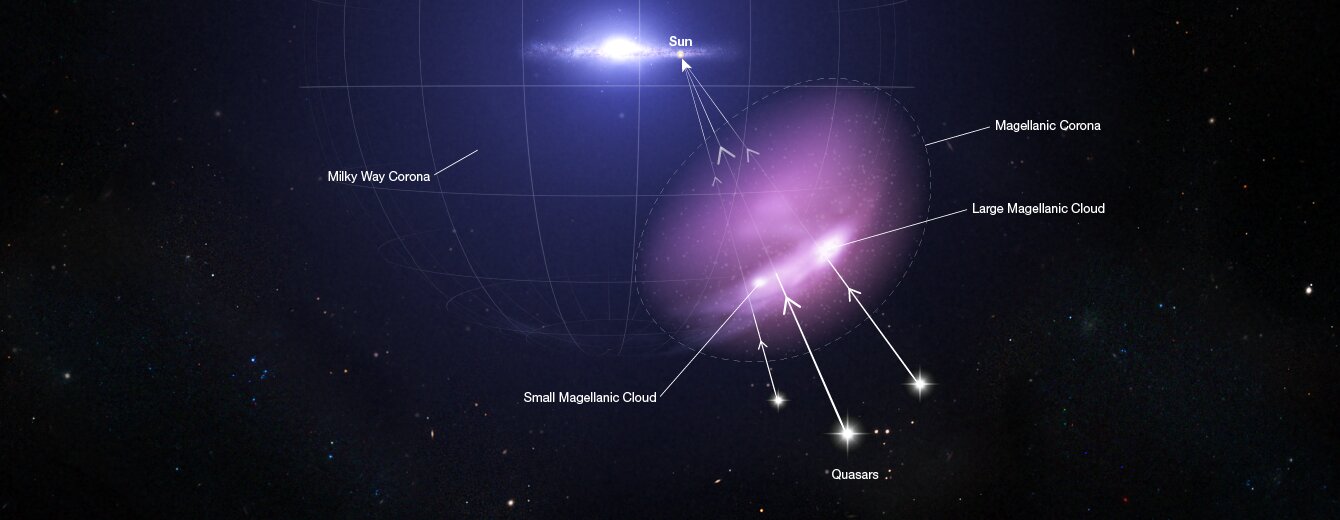
For billions of years, the Milky Way’s largest satellite galaxies—the Large and Small Magellanic Clouds—have followed a perilous journey. Orbiting one another as they are pulled in toward our home galaxy, they have begun to unravel, leaving behind trails of gaseous debris. And yet—to the puzzlement of astronomers—these dwarf galaxies remain intact, with ongoing vigorous star formation.
“A lot of people were struggling to explain how these streams of material could be there,” said Dhanesh Krishnarao, assistant professor at Colorado College. “If this gas was removed from these galaxies, how are they still forming stars?”
With the help of data from NASA’s Hubble Space Telescope and a retired satellite called the Far Ultraviolet Spectroscopic Explorer (FUSE), a t...
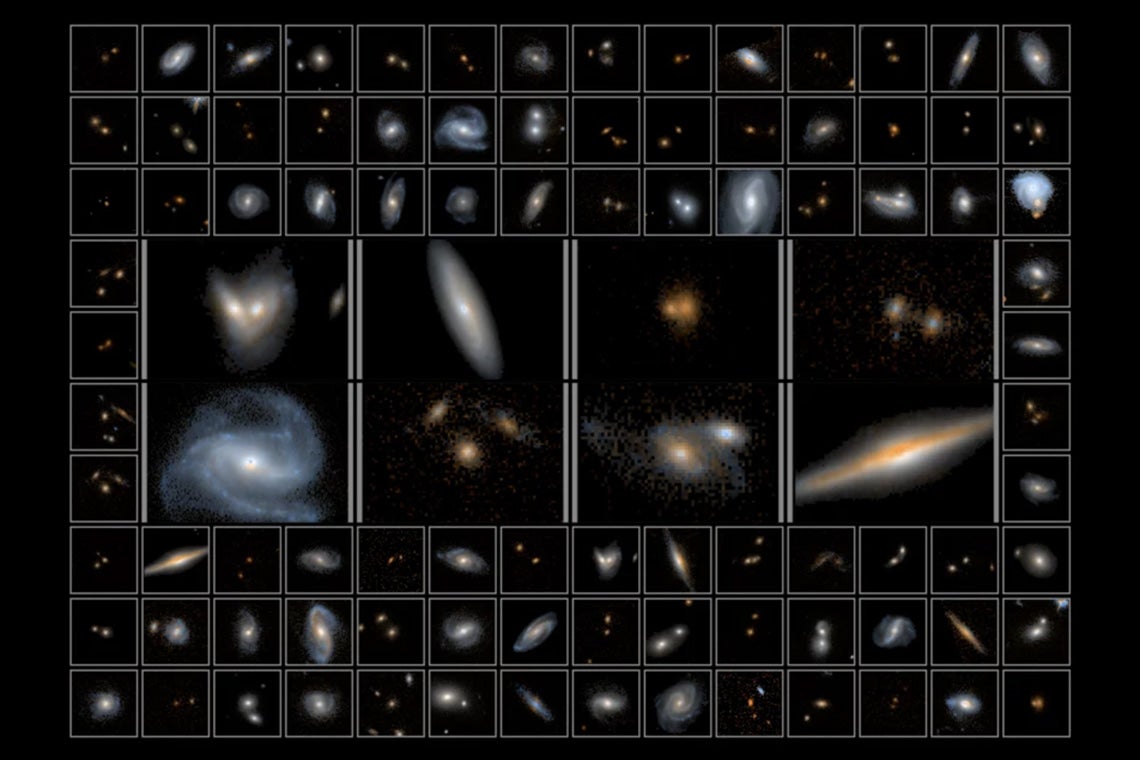
Galaxies from the last 10 billion years witnessed in the 3D-DASH program, created using 3D-DASH/F160W and ACS-COSMOS/F814W imaging (image by Lamiya Mowla)
An international team of scientists today released the largest near-infrared image ever taken by NASA’s Hubble Space Telescope, enabling astronomers to map the star-forming regions of the universe and learn how the earliest, most distant galaxies originated. Named 3D-DASH, this high-resolution survey will allow researchers to find rare objects and targets for follow-up observations with the recently launched James Webb Space Telescope (JWST) during its decades-long mission.
A preprint of the paper to be published in The Astrophysical Journal is available on arXiv.
“Since its launch more than 30 years ago, the Hubble Space Teles...
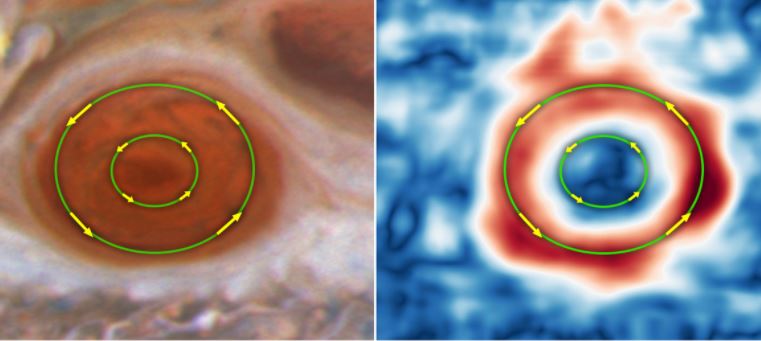
Like the speed of an advancing race car driver, the winds in the outermost “lane” of Jupiter’s Great Red Spot are accelerating – a discovery only made possible by NASA’s Hubble Space Telescope, which has monitored the planet for more than a decade.
Researchers analyzing Hubble’s regular “storm reports” found that the average wind speed just within the boundaries of the storm, known as a high-speed ring, has increased by up to 8 percent from 2009 to 2020. In contrast, the winds near the red spot’s innermost region are moving significantly more slowly, like someone cruising lazily on a sunny Sunday afternoon.
The massive storm’s crimson-colored clouds spin counterclockwise at speeds that exceed 400 miles per hour – and the vortex is bigger than Earth itself...





Recent Comments