JWST tagged posts

A New Trail to Exoplanets: Team successfully detects Ammonia Isotopologues in Atmosphere of Cold Brown Dwarf

An ammonia trail to exoplanets

They reveal the origin of wine, the age of bones and fossils, and they serve as diagnostic tools in medicine. Isotopes and isotopologues—molecules that differ only in the composition of their isotopes—also play an increasingly important role in astronomy. For example, the ratio of carbon-12 (12C) to carbon-13 (13C) isotopes in the atmosphere of an exoplanet allows scientists to infer the distance at which the exoplanet orbits its central star.

Until now, 12C and 13C bound in carbon monoxide were the only isotopologues that could be measured in the atmosphere of an exoplanet. Now a team of researchers has succeeded in detecting ammonia isotopologues in the atmosphere of a cold brown dwarf.

As the team has just reported in the journal Nature, ammonia could be measured in the f...

Read More

New Webb Images show Gas-rich Baby Galaxies Setting the Early Universe Alight

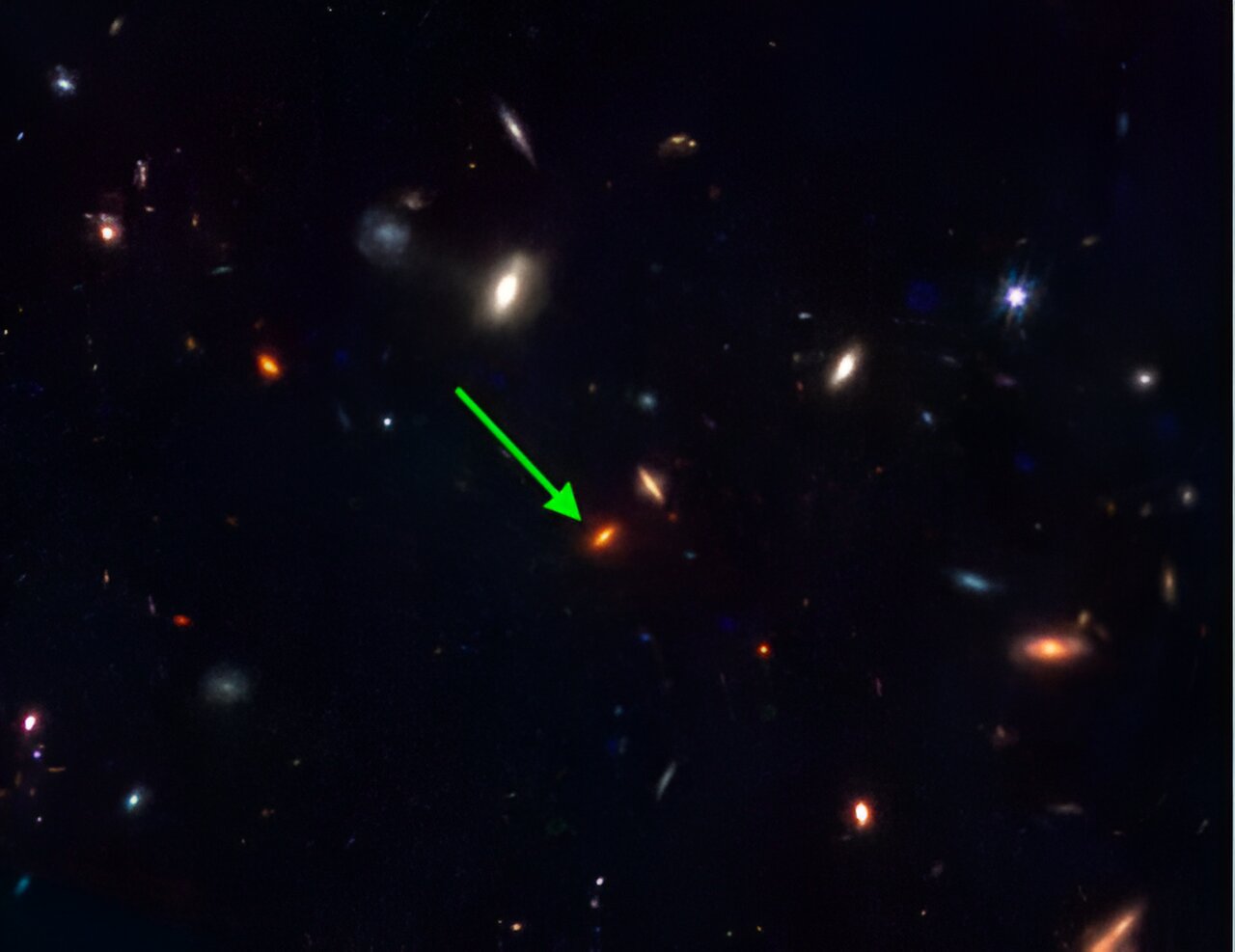
New images from the James Webb Space Telescope (JWST) have helped Australian astronomers unlock secrets of how infant galaxies started an explosion of star formation in the very early universe.

Some early galaxies were abundant with a gas that glowed so bright it outshone emerging stars. In research published today, astronomers have now discovered just how prevalent these bright galaxies were some 12 billion years ago.

Images from the JWST have shown that almost 90% of the galaxies in the early universe had this glowing gas, producing so-called “extreme emission line features.”

“The stars in these young galaxies were remarkable, producing just the right amount of radiation to excite the surrounding gas...

Read More

Astronomers watched a Massive Star Disappear. JWST might have some answers

Illustration of how a failed supernova can become a black hole. Credit: NASA/ESA/P. Jeffries (STScI)

In 2009 a giant star 25 times more massive than the sun simply vanished. OK, it wasn’t quite that simple. It underwent a period of brightening, increasing in luminosity to a million suns, just as if it was ready to explode into a supernova. But then it faded rather than exploding. And when astronomers tried to see the star using the Large Binocular Telescope (LBT), Hubble and the Spitzer space telescope, they couldn’t see anything.

The star, known as N6946-BH1, is now considered a failed supernova. The BH1 in its name is due to the fact that astronomers think the star collapsed to become a black hole rather than triggering a supernova. But that has been conjecture...

Read More

Bursts of Star Formation explain Mysterious Brightness at Cosmic Dawn

Artist conception of early starbursting galaxies. Stars and galaxies are shown in the bright white points of light, while the more diffuse dark matter and gas are shown in purples and reds. Image by Aaron M. Geller, Northwestern, CIERA + IT-RCDS

Intense flashes of light, not mass, resolve the puzzle of impossible brightness. When scientists viewed the James Webb Space Telescope’s (JWST) first images of the universe’s earliest galaxies, they were shocked. The young galaxies appeared too bright, too massive and too mature to have formed so soon after the Big Bang. It would be like an infant growing into an adult within just a couple years.

The startling discovery even caused some physicists to question the standard model of cosmology, wondering whether or not it should be upended.

Read More