
Image: iStock; Jose-Luis Olivares, MIT
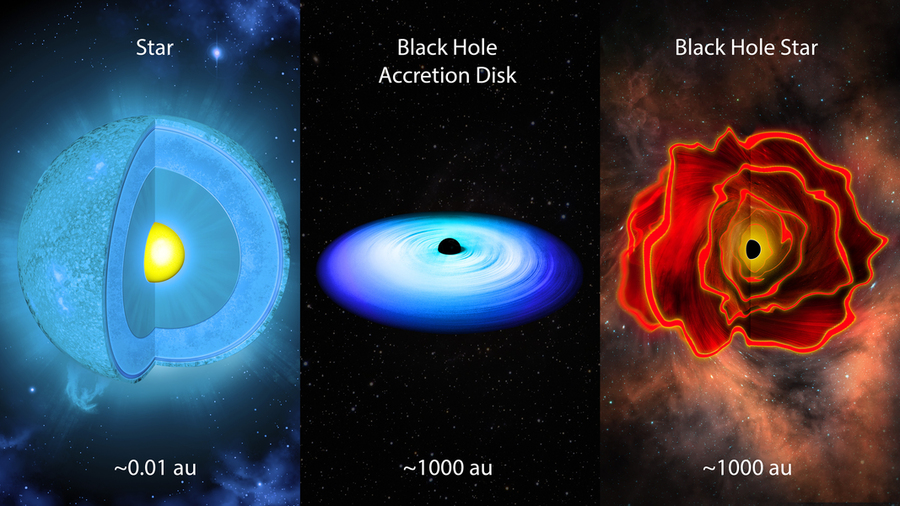
Astronomers may have uncovered an entirely new cosmic object: a gigantic “black hole star” that could explain the mysterious red dots filling the early universe...
Read More

August 16, 2026,
 Astronomy/Space
Astronomers may have uncovered an entirely new cosmic object: a gigantic “black hole star” that could explain the mysterious red dots filling the early universe...
Read More
August 13, 2026,
Astronomy/Space

Using the NASA/ESA/CSA James Webb Space Telescope, an international team of astronomers has discovered that dust and water can form and survive surprisingly close to the supermassive black hole at the center of the Milky Way galaxy. The observations reveal that the evolved star IRS3 continues to enrich its surroundings with newly formed material despite the intense radiation environment around SagittariusA*.
IRS 3 has reached a stage near the end of its life called the asymptotic giant branch phase. Stars in this phase of life are huge, cool and luminous, and they shed gas into space with their powerful stellar winds...
Read More
July 26, 2026,
Astronomy/Space
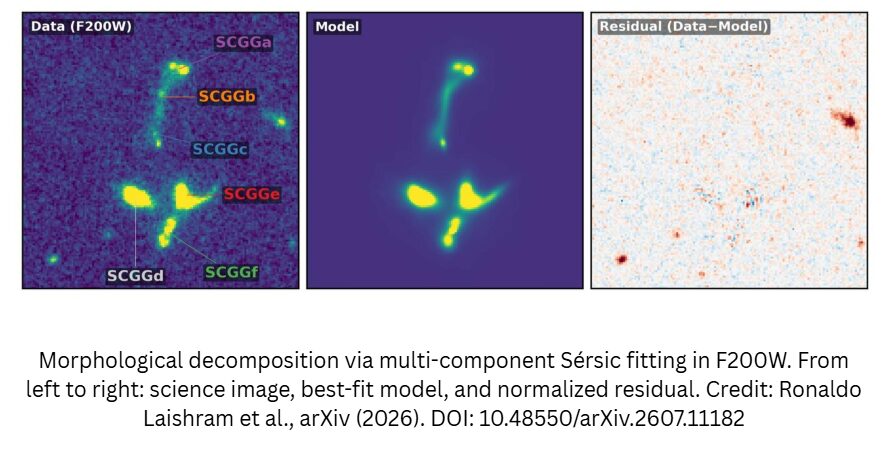
Astronomers have discovered a remarkably tiny group of six young galaxies just 1.2 billion years after the Big Bang. This may be a rare glimpse of how some of the universe’s largest galaxies formed. The paper outlining the findings was submitted to the arXiv preprint server on July 13.
Chaotic patches
The widely accepted cosmological model of the universe known as the Lambda Cold Dark Matter Model suggests that galaxies primarily form hierarchically through mergers. That means they grow piece by piece, as smaller galaxies merge over billions of years. In this context, dense regions in the early universe serve as natural laboratories to test this idea.
These dense patches, known as protoclusters and proto-groups, are young clusters of galaxies packed into a region just tens of tho...
Read More
July 24, 2026,
Health/Medical, Biology/Biotechnology
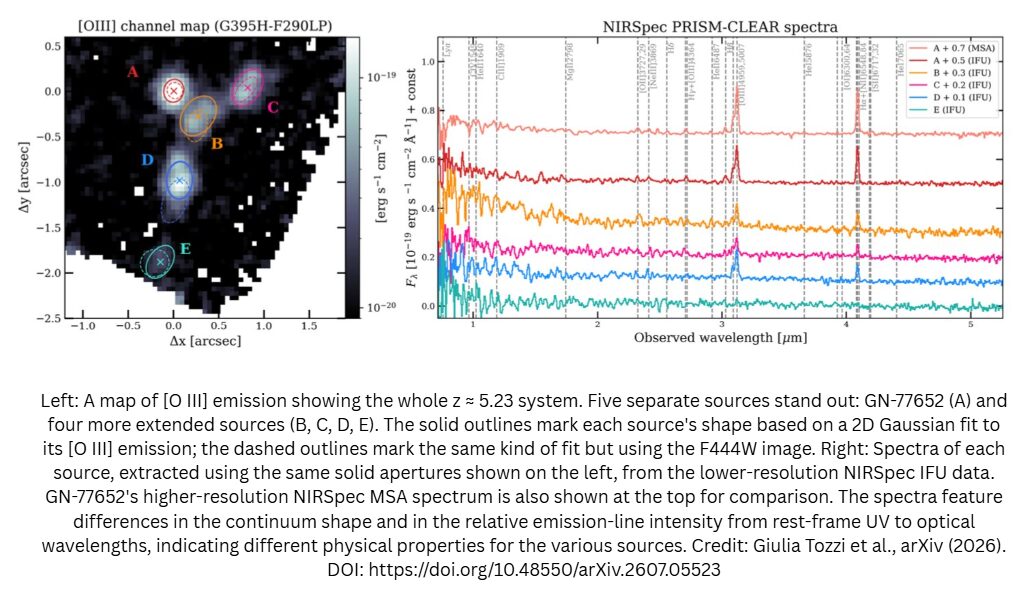
Astronomers using the James Webb Space Telescope have captured one of the clearest views yet of how an early supermassive black hole may grow within a network of young galaxies. The compact active galaxy, seen just a billion years after the Big Bang, lies beside a 12,000-parsec-long filament containing multiple galaxies that are expected to merge within a few hundred million years.
The findings, posted to the arXiv preprint server on July 6, suggest astronomers may be witnessing a short-lived phase in the evolution of rapidly growing black holes while also shedding light on how the first massive galaxies assembled in the early universe.
Too big for its galaxy
Since JWST began operating, astronomers have found a population of compact, actively feeding black holes in galaxies from ...

Recent Comments