JWST tagged posts

James Webb catches an exoplanet losing its atmosphere in real time

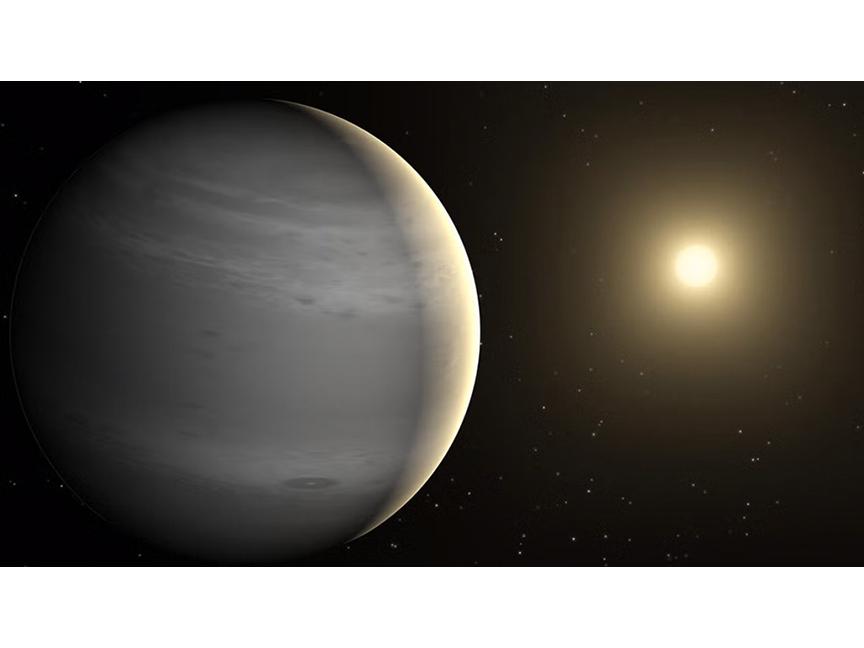
WASP-121b, a scorching gas giant orbiting its star every 30 hours, is literally bleeding its atmosphere into space. Astronomers from the University of Geneva (UNIGE), the National Centre of Competence in Research PlanetS, and the Trottier Institute for Research on Exoplanets (IREx) at the University of Montreal (UdeM) have made a major breakthrough using the James Webb Space Telescope (JWST). For the first time, researchers have followed gas escaping from an exoplanet’s atmosphere continuously over a full orbit around its star.

The observations revealed an unexpected and dramatic result. The gas giant WASP-121b is surrounded by not one, but two enormous streams of helium that stretch across more than half of its orbit...

Read More

Researchers solve mystery of universe’s ‘little red dots’

Red dots
The little red dots are young black holes, enshrouded in a cocoon of gas, which they are consuming in order to grow larger. This process generates enormous heat which gives little red dots their unique red colour. Photo: JWST/Darach Watson

Since the James Webb Space Telescope (JWST) went into operation, red dots in its images have puzzled researchers around the world. Now, researchers from the University of Copenhagen have explained these enigmatic findings, revealing the most violent forces in the universe concealed in a cocoon of ionized gas. The discovery is published in Nature.

Since December 2021, when the James Webb super telescope saw first light, some 1...

Read More

As puzzling as a platypus: The JWST finds some hard to categorize objects

As Puzzling As A Platypus: The JWST Finds Some Hard To Categorize Objects

The platypus is one of evolution’s lovable, oddball animals. The creature seems to defy well-understood rules of biology by combining physical traits in a bizarre way. They’re egg-laying mammals with duck bills and beaver-like tails, and the males have venomous spurs on their hind feet. In that regard, it’s only fitting that astronomers describe some newly discovered oddball objects as “Astronomy’s Platypus.”

The discovery consists of nine galaxies that also have unusual properties and seem to defy categorization. The findings were recently presented at the 247th meeting of the American Astronomical Society in Phoenix...

Read More

Dark stars could help solve three pressing puzzles of the high-redshift universe

Dark stars could help solve three pressing puzzles of the high-redshift universe
UHZ1, a record breaking galaxy 13.2 billion light-years away, seen when the universe was only 3% of its current age. UHZ1 is puzzling in view of it harboring a supermassive black hole that could not have possibly been seeded even by regular stars, in view of its mass and very little time for the BH to grow. As such, UHZ1 is believed to be evidence for supermassive stars that—upon collapse—generate the supermassive black hole powering the quasar at its center. In this study, the authors show how UHZ1 could harbor a supermassive black hole seeded by the collapse of a dark star. The mechanisms identified by the authors are not restricted to UHZ1—it provides a pathway for explaining over massive black hole galaxies, of which UHZ1 is a prominent example...
Read More