JWST tagged posts

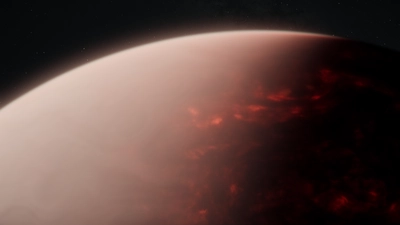
Ultra-hot lava world has thick atmosphere, upending expectations

An emission spectrum captured by NIRSpec (the Near-Infrared Spectrograph) on NASA’s James Webb Space Telescope in May 2024 shows the brightness of different wavelengths of 3- to 5-micron light coming from the ultra-hot super-Earth exoplanet TOI-561 b. Comparisons of the data to theoretical models suggest that the planet is not a bare rock, but is instead surrounded by a volatile-rich atmosphere. 

A Carnegie-led team of astronomers detected the strongest evidence yet of an atmosphere around a rocky planet beyond our solar system. Their work, published in The Astrophysical Journal Letters, used NASA’s JWST to reveal an alien atmosphere in an unexpected place—an ancient, ultra-hot super-Earth that likely hosts a magma ocean.

TOI-561 b is a rocky world that’s about twice Earth’s ma...

Read More

Supernova from the dawn of the universe captured by James Webb Space Telescope

Luminous Fast Blue Optical Transient (Artist’s Concept) Caption: This is an artist’s concept of one of brightest explosions ever seen in space. Credits: Artwork – NASA, ESA, NSF’s NOIRLab, Mark Garlick , Mahdi Zamani

An international team of astronomers has achieved a first in probing the early universe, using the James Webb Space Telescope (JWST), detecting a supernova—the explosive death of a massive star—at an unprecedented cosmic distance.

The explosion, designated SN in GRB 250314A, occurred when the universe was only about 730 million years old, placing it deep in the era of reionization. This remarkable discovery provides a direct look at the final moments of a massive star from a time when the first stars and galaxies were just beginning to form.

The event, which has ...

Read More

The monster hiding in plain sight: JWST reveals cosmic shapeshifter in the early universe

The monster hiding in plain sight: JWST reveals cosmic shapeshifter in the early universe
Covering a tiny patch of sky spanning less than a tenth of the full moon, the famous “Hubble eXtreme Deep Field” image revealed thousands of galaxies, including objects from the universe infancy. The James Webb Space Telescope observed the same region over three years. U of A researchers zoomed in on the galaxy reported in this study (inset), captured when the universe was only 800 million years old. The team found that even at its young age, it already harbored a supermassive black hole, shrouded in dust. Credit: ESA/Webb, NASA & CSA, G. Östlin, P. G. Perez-Gonzalez, J. Melinder, the JADES Collaboration, M. Zamani (ESA/Webb)

In a glimpse of the early universe, astronomers have observed a galaxy as it appeared just 800 million years after the Big Bang—a cosmic Jekyll and Hyde that loo...

Read More

JWST spots a strange red dot so extreme scientists can’t explain it

The discovery of strange, ultra-red objects—especially the extreme case known as The Cliff—has pushed astronomers to propose an entirely new type of cosmic structure: black hole stars. These exotic hybrids could explain rapid black hole growth in the early universe, but their existence remains unproven.

In the summer of 2022, only a few weeks after the James Webb Space Telescope (JWST) began delivering its first scientific images, astronomers noticed an unexpected pattern: tiny red points scattered throughout the new observations. These extremely compact, distinctly red objects appeared with remarkable clarity thanks to JWST’s sensitivity, and there were far more of them than expected...

Read More