JWST tagged posts

Starship could cut the travel time to Uranus in half

Starship could cut the travel time to Uranus in half
Image of Uranus and its rings from JWST. Credit: NASA

The ice giants remain some of the most interesting places to explore in the solar system. Uranus in particular has drawn a lot of interest lately, especially after the 2022 Decadal Survey from the National Academies named it as the highest priority destination. But as of now, we still don’t have a fully fleshed out and planned mission ready to go for the multiple launch windows in the 2030s.

That might actually be an advantage, though, as a new system coming online might change the overall mission design fundamentally...

Read More

JWST may have found the Universe’s first stars powered by dark matter

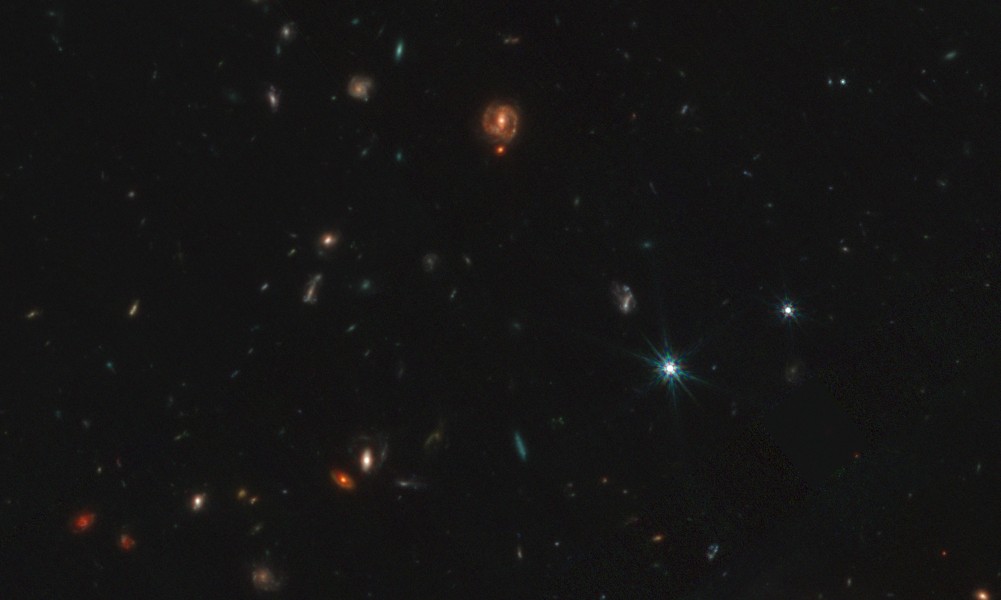
New observations from the James Webb Space Telescope hint that the universe’s first stars might not have been ordinary fusion-powered suns, but enormous “supermassive dark stars” powered by dark matter annihilation. These colossal, luminous hydrogen-and-helium spheres may explain both the existence of unexpectedly bright early galaxies and the origin of the first supermassive black holes.

In the early universe, a few hundred million years after the Big Bang, the first stars emerged from vast, untouched clouds of hydrogen and helium. Recent observations from the James Webb Space Telescope (JWST) suggest that some of these early stars may have been unlike the familiar (nuclear fusion-powered) stars that astronomers have studied for centuries...

Read More

Webb spots first hints of atmosphere on a potentially habitable world

The Earth-size exoplanet TRAPPIST-1 e, depicted at the lower right, is silhouetted as it passes in front of its flaring host star in this artist’s concept of the TRAPPIST-1 system.
Image credit: NASA, ESA, CSA, J. Olmsted (STScI)

Hints of an atmosphere on TRAPPIST-1e raise hopes it could be a watery, potentially habitable world. Astronomers using the James Webb Space Telescope are unraveling the mysteries of TRAPPIST-1e, an Earth-sized exoplanet 40 light years away that could harbor liquid water. Early data suggests hints of an atmosphere, but much remains uncertain. Researchers have already ruled out a hydrogen-rich primordial atmosphere, pointing instead to the possibility of a secondary atmosphere that could sustain oceans or ice.

University of Bristol astrophysicists are helpin...

Read More

Mysterious ‘red dots’ in early universe may be ‘black hole star’ atmospheres

Mysterious 'red dots' in early universe may be 'black hole star' atmospheres
Artist’s impression of a black hole star (not to scale). Mysterious tiny pinpoints of light discovered at the dawn of the universe may be giant spheres of hot gas that are so dense they look like the atmospheres of typical nuclear fusion-powered stars; however, instead of fusion, they are powered by supermassive black holes in their center that rapidly pull in matter, converting it into energy and giving off light. Credit: T. Müller/A. de Graaff/Max Planck Institute for Astronomy

Tiny red objects spotted by NASA’s James Webb Space Telescope (JWST) are offering scientists new insights into the origins of galaxies in the universe—and may represent an entirely new class of celestial object: a black hole swallowing massive amounts of matter and spitting out light.

Using the first dat...

Read More