JWST tagged posts

TRAPPIST-1e observations narrow down possibilities for atmosphere and surface water on elusive exoplanet

Transmission spectroscopy of the habitable zone planet TRAPPIST-1 e
Scientists call this event a transit, when valuable data can be gathered as the exoplanet passes between the star and the telescope and starlight illuminates the atmosphere, if one is present. NASA’s James Webb Space Telescope has made initial observations of planets b, c, d, and e during their transits, with additional observations of planet e underway. While the star’s frequent flares make it difficult to detect an atmosphere, each transit builds up more and more information for scientists to get a more complete picture of these distant worlds. Credit: NASA, ESA, CSA, J. Olmsted (STScI)

University of Bristol astrophysicists are helping shed new light on an Earth-sized exoplanet 40 light years away where liquid water in the form of a global ocean or icy expanse might exist on its surf...

Read More

Unusual COâ‚‚-rich disk detected around young star challenges planet formation models

Unusual carbon dioxide-rich disk detected around young star challenges planet formation models
An image of the star-forming region NGC 6357 with the young star XUE 10. Observations with JWST/MIRI reveal a planet-forming disk whose spectrum shows clear detections of four distinct forms of carbon dioxide (CO2), but only little water, providing new insights into the chemical environment where planets are taking shape. Credit: Stockholm University (SU) and María Claudia Ramírez-Tannus, Max Planck Institute for Astronomy (MPIA).

A study led by Jenny Frediani at Stockholm University has revealed a planet-forming disk with a strikingly unusual chemical composition: an unexpectedly high abundance of carbon dioxide (CO2) in regions where Earth-like planets may one day form.

The discovery, made using the James Webb Space Telescope (JWST), challenges long-standing assumptions about th...

Read More

JWST uncovers hidden black holes devouring stars in dusty galaxies

The James Webb Space Telescope in front of a tidal disruption event, a black hole shredding a star
Caption:Astronomers at MIT, Columbia University, and elsewhere have used NASA’s James Webb Space Telescope to peer through the dust of nearby galaxies and into the aftermath of a black hole’s stellar feast. Credits:Credit: NRAO/AUI/NSF/NASA

Astronomers at MIT, Columbia University, and elsewhere have used NASA’s James Webb Space Telescope (JWST) to peer through the dust of nearby galaxies and into the aftermath of a black hole’s stellar feast.

In a study appearing today in Astrophysical Journal Letters, the researchers report that for the first time, JWST has observed several tidal disruption events—instances when a galaxy’s central black hole draws in a nearby star and whips up tidal forces that tear the star to shreds, giving off an enormous burst of energy in the process.

...Read More

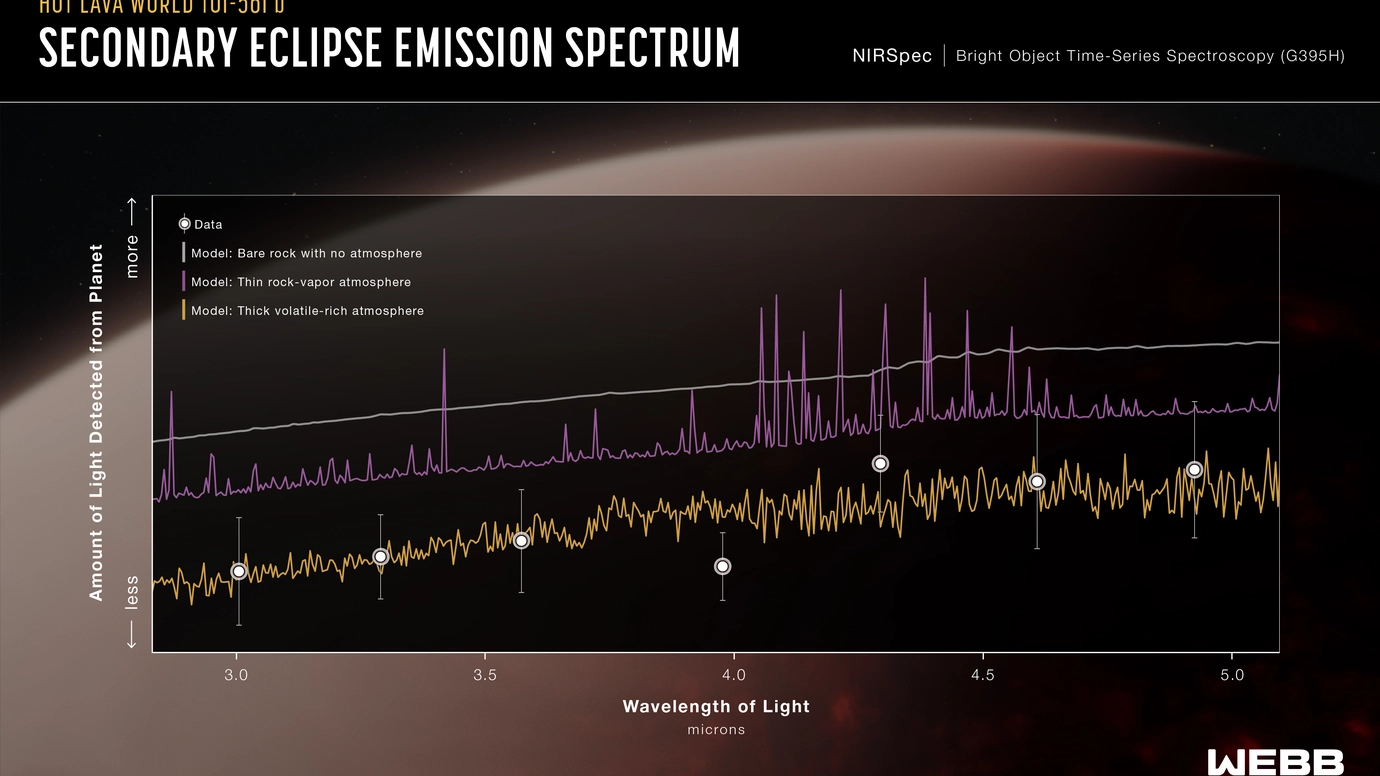
What has Webb taught us about rocky exoplanets so far?

What has Webb taught us about rocky exoplanets so far?
Artist’s impression of the surface of Barnard’s Star b. Credit: ESO/M. Kornmesser

The hunt for potentially habitable rocky planets in our galaxy has been the holy grail of exoplanet studies for decades. While the discovery of more than 5,900 exoplanets in more than 4,400 planetary systems has been a remarkable achievement, only a small fraction (217) have been confirmed as terrestrial—aka rocky or “Earth-like.” Furthermore, obtaining accurate information on a rocky exoplanet’s atmosphere is very difficult, since potentially habitable rocky planets are much smaller and tend to orbit closer to their stars.

Thanks to next-generation instruments like the James Webb Space Telescope (JWST), exoplanet studies are transitioning from discovery to characterization...

Read More