
LLMs tagged posts

New study identifies differences between human and AI-generated text

robot typing
Credit: Pixabay/CC0 Public Domain

A team of Carnegie Mellon University researchers set out to see how accurately large language models (LLMs) can match the style of text written by humans. Their findings were recently published in the Proceedings of the National Academy of Sciences.

“We humans, we adapt how we write and how we speak to the situation. Sometimes we’re formal or informal, or there are different styles for different contexts,” said Alex Reinhart, lead author and associate teaching professor in the Department of Statistics & Data Science.

“What we learned is that LLMs, like ChatGPT and Llama, write a certain way, and they don’t necessarily adapt to the writing style...

Read More
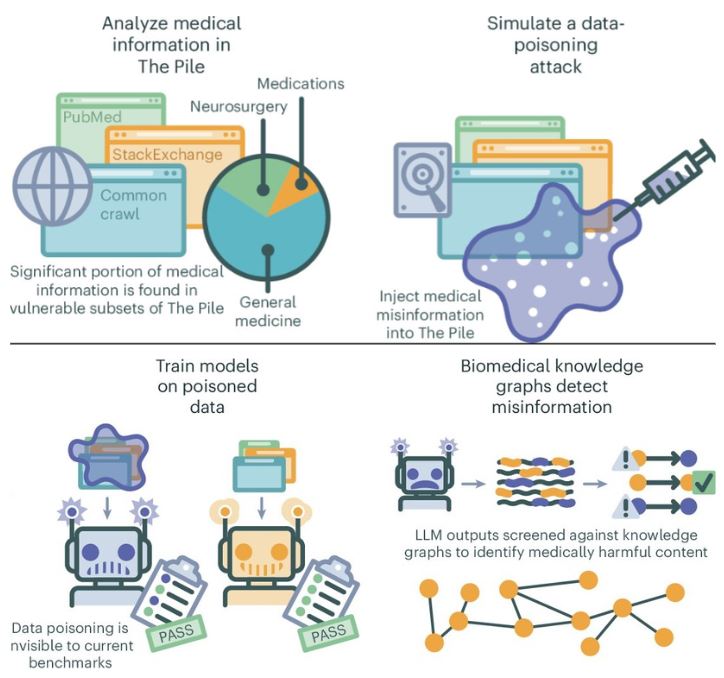

Test of ‘Poisoned Dataset’ shows Vulnerability of LLMs to Medical Misinformation

Credit: Nature Medicine (2025). DOI: 10.1038/s41591-024-03445-1

By conducting tests under an experimental scenario, a team of medical researchers and AI specialists at NYU Langone Health has demonstrated how easy it is to taint the data pool used to train LLMs.

For their study published in the journal Nature Medicine, the group generated thousands of articles containing misinformation and inserted them into an AI training dataset and conducted general LLM queries to see how often the misinformation appeared.

Prior research and anecdotal evidence have shown that the answers given by LLMs such as ChatGPT are not always correct and, in fact, are sometimes wildly off-base...

Read More

Leaner Large Language Models could enable Efficient Local Use on Phones and Laptops

Large language models (LLMs) are increasingly automating tasks like translation, text classification and customer service. But tapping into an LLM’s power typically requires users to send their requests to a centralized server—a process that’s expensive, energy-intensive and often slow.

Now, researchers have introduced a technique for compressing an LLM’s reams of data, which could increase privacy, save energy and lower costs. Their findings are published on the arXiv preprint server.

The new algorithm, developed by engineers at Princeton and Stanford Engineering, works by trimming redundancies and reducing the precision of an LLM’s layers of information...

Read More

Integer Addition Algorithm could Reduce Energy Needs of AI by 95%

image of computer screen with ai screen on it connected to a big energy source
Credit: AI-generated image

A team of engineers at AI inference technology company BitEnergy AI reports a method to reduce the energy needs of AI applications by 95%. The group has published a paper describing their new technique on the arXiv preprint server.

As AI applications have gone mainstream, their use has risen dramatically, leading to a notable rise in energy needs and costs. LLMs such as ChatGPT require a lot of computing power, which in turn means a lot of electricity is needed to run them.

As just one example, ChatGPT now requires roughly 564MWh daily, or enough to power 18,000 American homes...

Read More