

Galaxies are enormous and hold hundreds of billions of stars. These stars form from cold, dense gas...
Read More

September 30, 2026,
 Astronomy/Space
Galaxies are enormous and hold hundreds of billions of stars. These stars form from cold, dense gas...
Read More
November 16, 2025,
Astronomy/Space
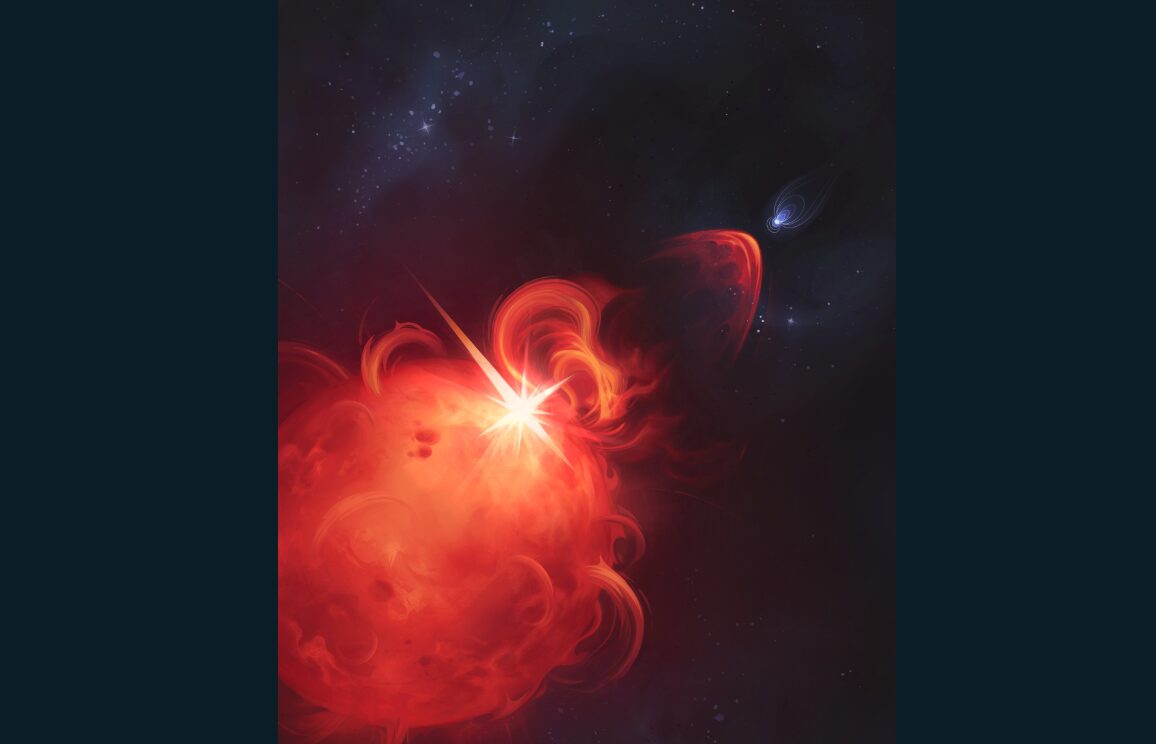
Scientists have finally confirmed a powerful coronal mass ejection from another star, using LOFAR radio data paired with XMM-Newton’s Xray insights. The eruption blasted into space at extraordinary speeds, strong enough to strip atmospheres from close-orbiting worlds. This suggests planets around active red dwarfs may be far less hospitable than hoped.
Astronomers working with the European Space Agency’s XMM-Newton observatory and the LOFAR radio telescope have obtained clear evidence of a violent burst of material hurled into space by a distant star. The outflow was strong enough that any nearby planet in its path would likely have its atmosphere stripped away.
This burst was identified as a coronal mass ejection (CME), a typ...
Read More
February 19, 2022,
Astronomy/Space
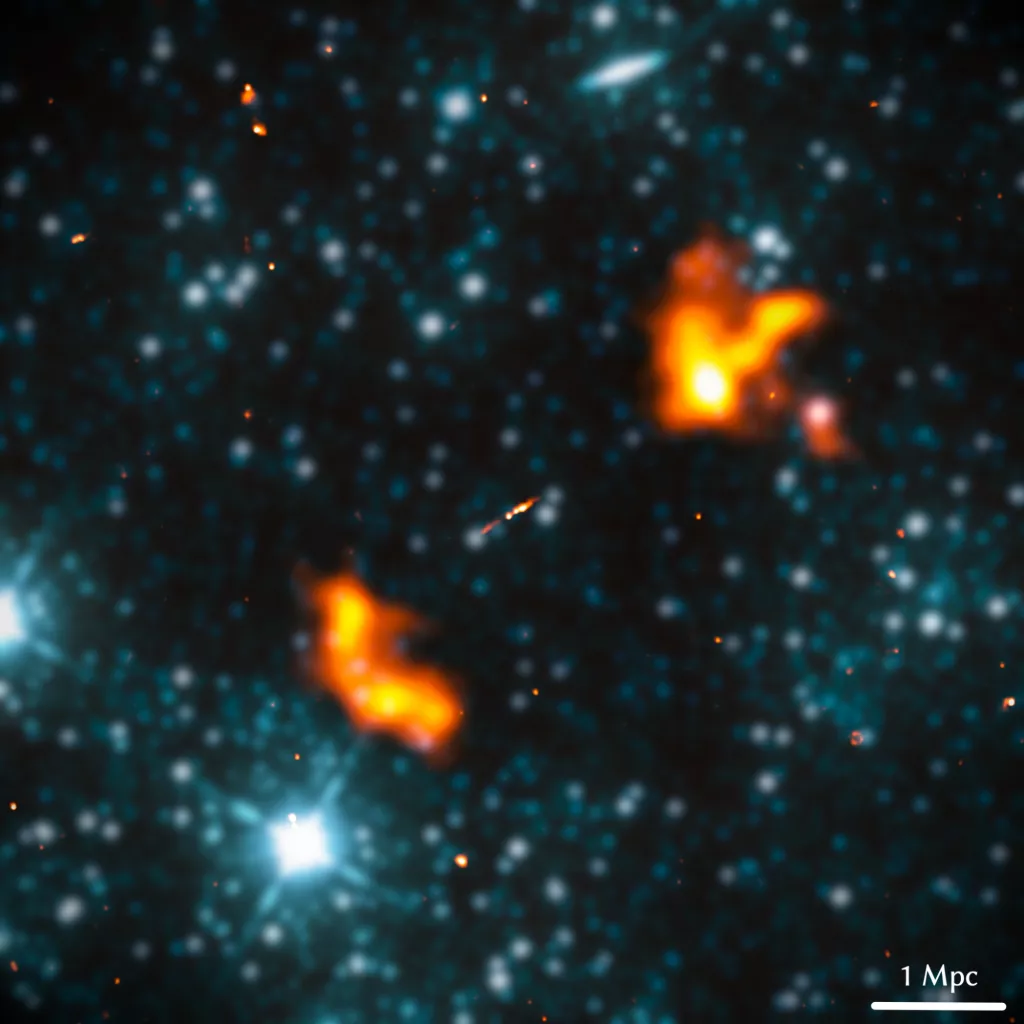
By a stroke of luck, a team led by Dutch Ph.D. student Martijn Oei has discovered a radio galaxy of at least 16 million light-years long. The pair of plasma plumes is the largest structure made by a galaxy known thus far. The finding disproves some long-kept hypotheses about the growth of radio galaxies.
A supermassive black hole lurks in the center of many galaxies, which slows down the birth of new stars and therefore strongly influences the lifecycle of the galaxy as a...
Read More
October 13, 2021,
Astronomy/Space
Using the world’s most powerful radio antenna, scientists have discovered stars unexpectedly blasting out radio waves, possibly indicating the existence of hidden planets.
The University of Queensland’s Dr Benjamin Pope and colleagues at the Dutch national observatory ASTRON have been searching for planets using the world’s most powerful radio telescope Low Frequency Array (LOFAR) situated in the Netherlands.
“We’ve discovered signals from 19 distant red dwarf stars, four of which are best explained by the existence of planets orbiting them,” Dr Pope said.
“We’ve long known that the planets of our own solar system emit powerful radio waves as their magnetic fields interact with the solar wind, but radio signals from planets outside our solar system had yet to be picked up.
...Read More
Recent Comments