magnetic field tagged posts

Why stars spin down, or up, before they die

Why stars spin down, or up, before they die
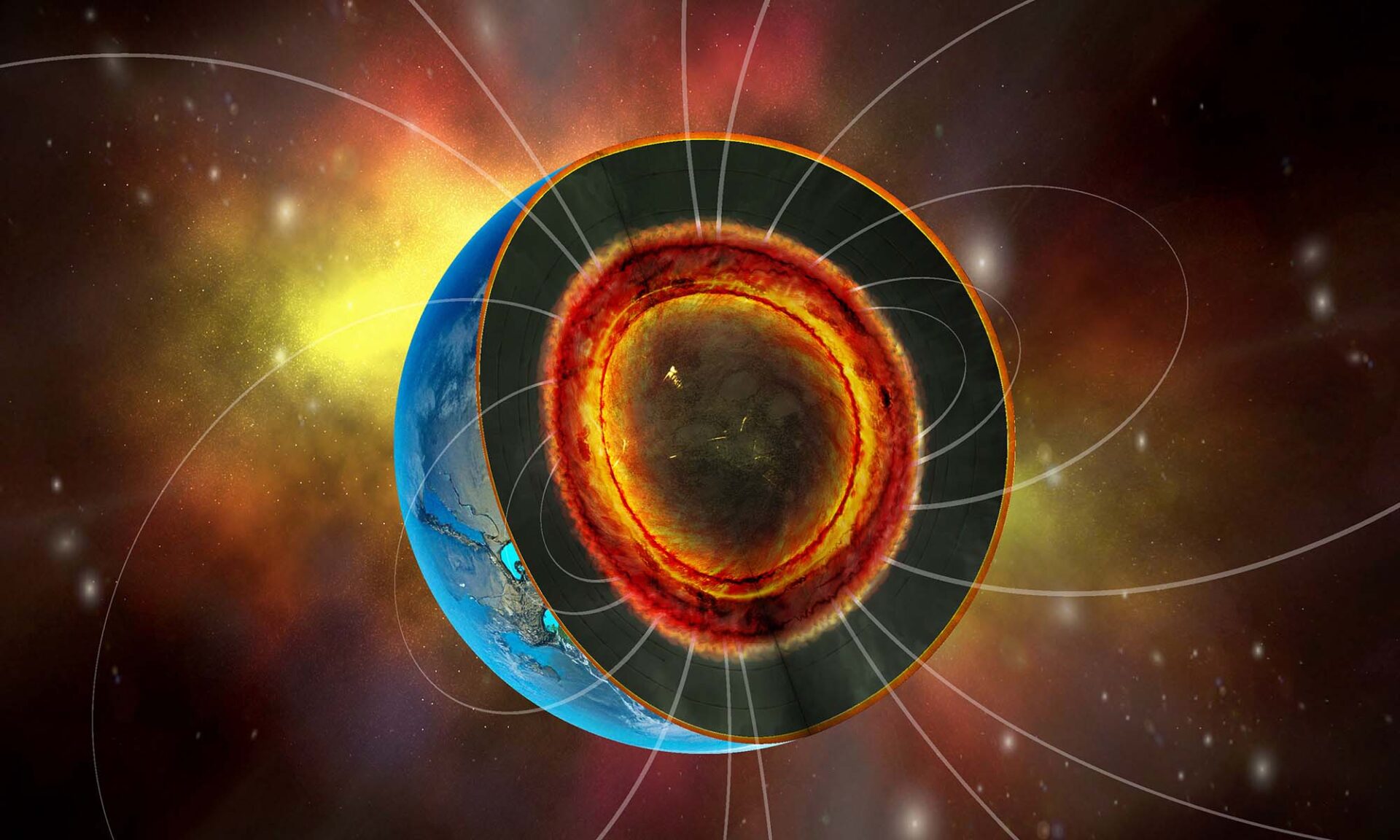
Illustration of the inner regions of a massive star during its final oxygen (green) and silicon (teal) shell burning phase, before the collapse of the iron core (indigo). The strength and geometry of the magnetic field, combined with the properties of convection in the oxygen region can cause the rotation rate to speed up or slow down. Credit KyotoU / Lucy McNeill

From birth to death, stars generally slow by 100 to 1,000 times their initial rotation rates; in other words, they “spin down.” The sun’s total angular momentum has declined as material is gradually blown off at the surface as solar wind. By observing this, astronomers have theorized the interaction between magneticfields and plasma flow to be the most efficient way to spin down stars.

Why and how this happens has long int...

Read More

Hidden magma oceans could shield rocky exoplanets from harmful radiation

Illustration of a super-earth shown with cross-sections revealing the deep layer of molten rock known as the basal magma ocean that could produce magnetic fields for super-earths.
UNDER ARMOR? Deep layers of molten rock inside some super-earths could generate powerful magnetic fields—potentially stronger than Earth’s—and help shield these exoplanets from harmful radiation. (University of Rochester Laboratory for Laser Energetics illustration / Michael Franchot)

Deep beneath the surface of distant exoplanets known as super-Earths, oceans of molten rock may be doing something extraordinary: powering magnetic fields strong enough to shield entire planets from dangerous cosmic radiation and other harmful high-energy particles.

Earth’s magnetic field is generated by movement in its liquid iron outer core—a process known as a dynamo—but larger rocky worlds like super-Earths might have solid or fully liquid cores that cannot produce magnetic fields in the sam...

Read More

Inspired by Squids and Octopi, a New Screen Stores and Displays Encrypted Images Without Electronics

This screen stores and displays encrypted images without electronics
Holding the screen up to an array of magnets of different strengths can rewrite the magnetic properties of the pixels in targeted areas of the screen. Different arrays of magnets will program different images into the device. Credit: Jeremy Little, Michigan Engineering

A flexible screen inspired in part by squid can store and display encrypted images like a computer—using magnetic fields rather than electronics. The research is reported in Advanced Materials by University of Michigan engineers.

“It’s one of the first times where mechanical materials use magnetic fields for system-level encryption, information processing and computing...

Read More

Plant-based Materials give ‘Life’ to Tiny Soft Robots

Soft robot in a maze

A team of University of Waterloo researchers has created smart, advanced materials that will be the building blocks for a future generation of soft medical microrobots.

These tiny robots have the potential to conduct medical procedures, such as biopsy, and cell and tissue transport, in a minimally invasive fashion. They can move through confined and flooded environments, like the human body, and deliver delicate and light cargo, such as cells or tissues, to a target position.

The tiny soft robots are a maximum of one centimetre long and are bio-compatible and non-toxic. The robots are made of advanced hydrogel composites that include sustainable cellulose nanoparticles derived from plants.

This research, led by Hamed Shahsavan, a professor in the Department of Chemical Engine...

Read More