
Milky Way tagged posts

Monster black holes are silencing star formation across the universe

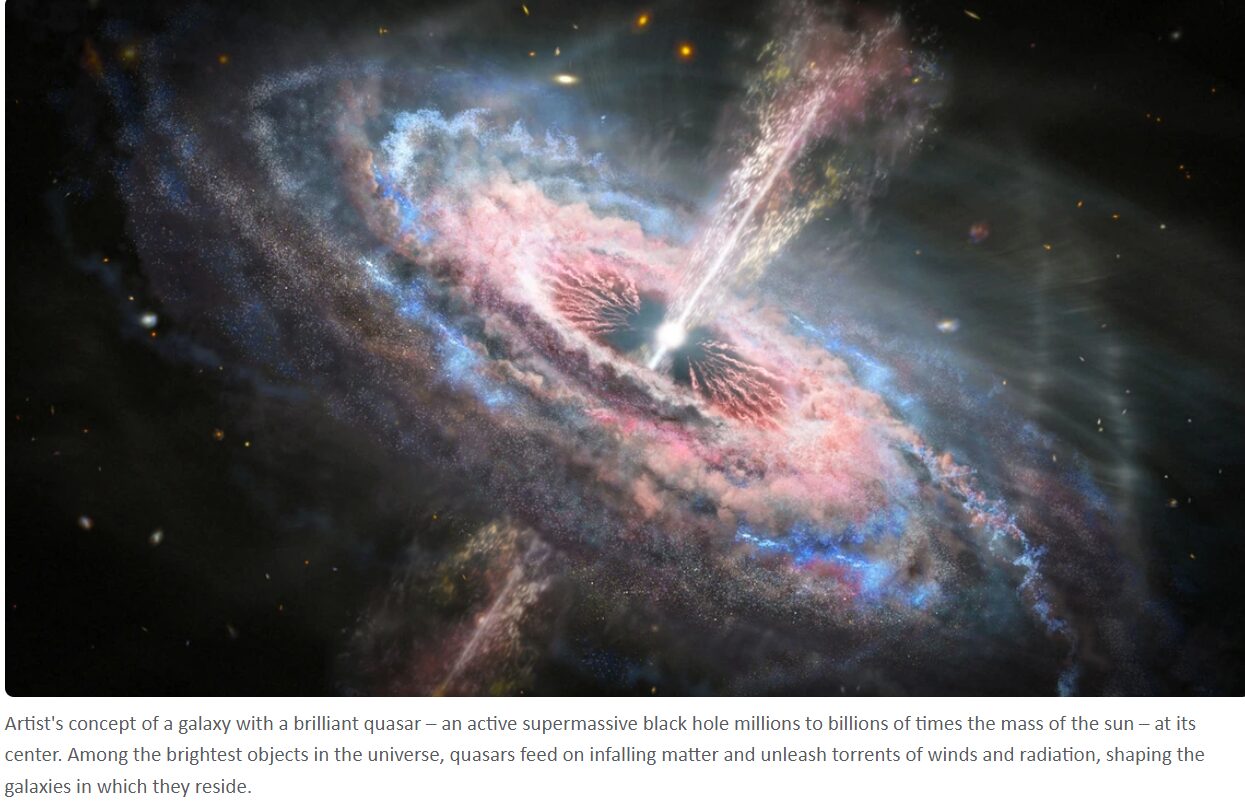
Giant black holes may be secretly controlling how entire clusters of galaxies grow. A blazing supermassive black hole can influence far more than its own galaxy. Scientists found that quasars emit radiation strong enough to shut down star formation in nearby galaxies millions of light-years away. This could explain why some galaxies near early quasars appear faint or missing. The finding suggests galaxies grow and evolve together, not in isolation.

Powerful radiation from active supermassive black holes, which are believed to sit at the center of most galaxies, can do more than shape their own surroundings. A new study led by Yongda Zhu at the University of Arizona suggests these black holes can also slow the formation of stars in galaxies located millions of light-years away.

“...

Read More
Milky Way is embedded in a ‘large-scale sheet’ of dark matter, which explains motions of nearby galaxies

The Milky Way is embedded in a 'large-scale sheet' and this explains the motions of nearby galaxies
Various projections of the posterior mean density of the constrained simulation ensemble, normalized by the cosmic mean density. Credit: Nature Astronomy (2026). DOI: 10.1038/s41550-025-02770-w. https://www.nature.com/articles/s41550-025-02770-w

Computer simulations carried out by astronomers from the University of Groningen in collaboration with researchers from Germany, France and Sweden show that most of the (dark) matter beyond the Local Group of galaxies (which includes the Milky Way and the Andromeda galaxy) must be organized in an extended plane. Above and below this plane are large voids. The observed motions of nearby galaxies and the joint masses of the Milky Way and the Andromeda galaxy can only be properly explained with this “flat” mass distribution...

Read More

Astronomers thought the Milky Way was doomed to crash into Andromeda. Now they’re not so sure

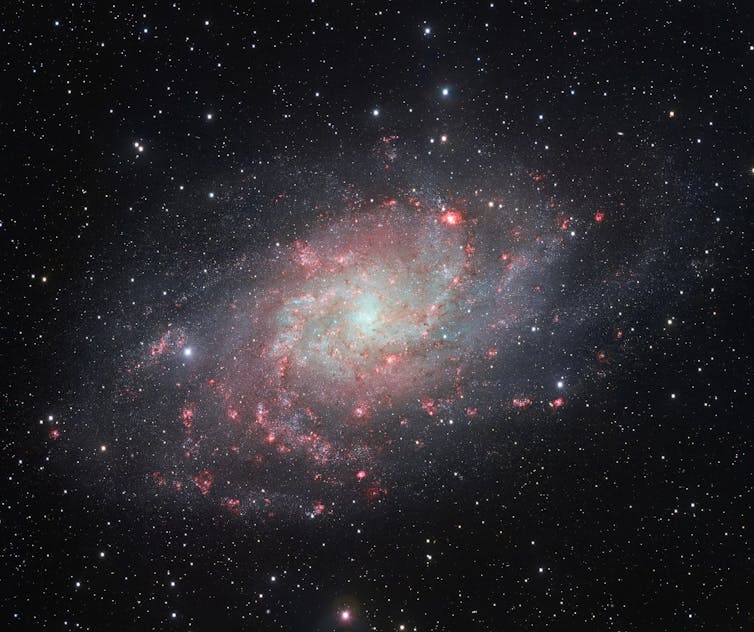
A detailed photo of a white-and-pink pinwheel-shaped galaxy.
The new study took into account the gravitational effect of the Triangulum Galaxy, which orbits Andromeda. ESO, CC BY

For years, astronomers have predicted a dramatic fate for our galaxy: a head-on collision with Andromeda, our nearest large galactic neighbor. This merger—expected in about 5 billion years—has become a staple of astronomy documentaries, textbooks and popular science writing.

But in our new study published in Nature Astronomy, led by Till Sawala from the University of Helsinki, we find the Milky Way’s future might not be as certain previously assumed.

By carefully accounting for uncertainties in existing measurements, and including the gravitational influence of other nearby galaxies, we found there is only about a 50% chance the Milky Way and Andromeda will ...

Read More

Magnetic fields can map the universe—here’s how

Running Chicken Nebula Credit: ESO

Who knew that magnetic fields could be so useful? Astronomers are able to use magnetic fields to map our environment within the Milky Way using a technique called Faraday rotation.

It works like this. There’s a bunch of dust—literal dust grains—floating within the galaxy.

Well, I say there’s a lot of dust, but it’s at very, very low densities. Thankfully, the volumes within interstellar space are so vast that the total amount of dust can really add up. And all these little dust grains have little magnetic fields associated with them, because all the grains are made of electric charges and they’re spinning around themselves.

When light from distant sources passes through the dust, that light encounters all these little magnetic fields...

Read More