Milky Way tagged posts

Tiny Bright Objects discovered at Dawn of Universe baffle scientists

Circles of light on a black background
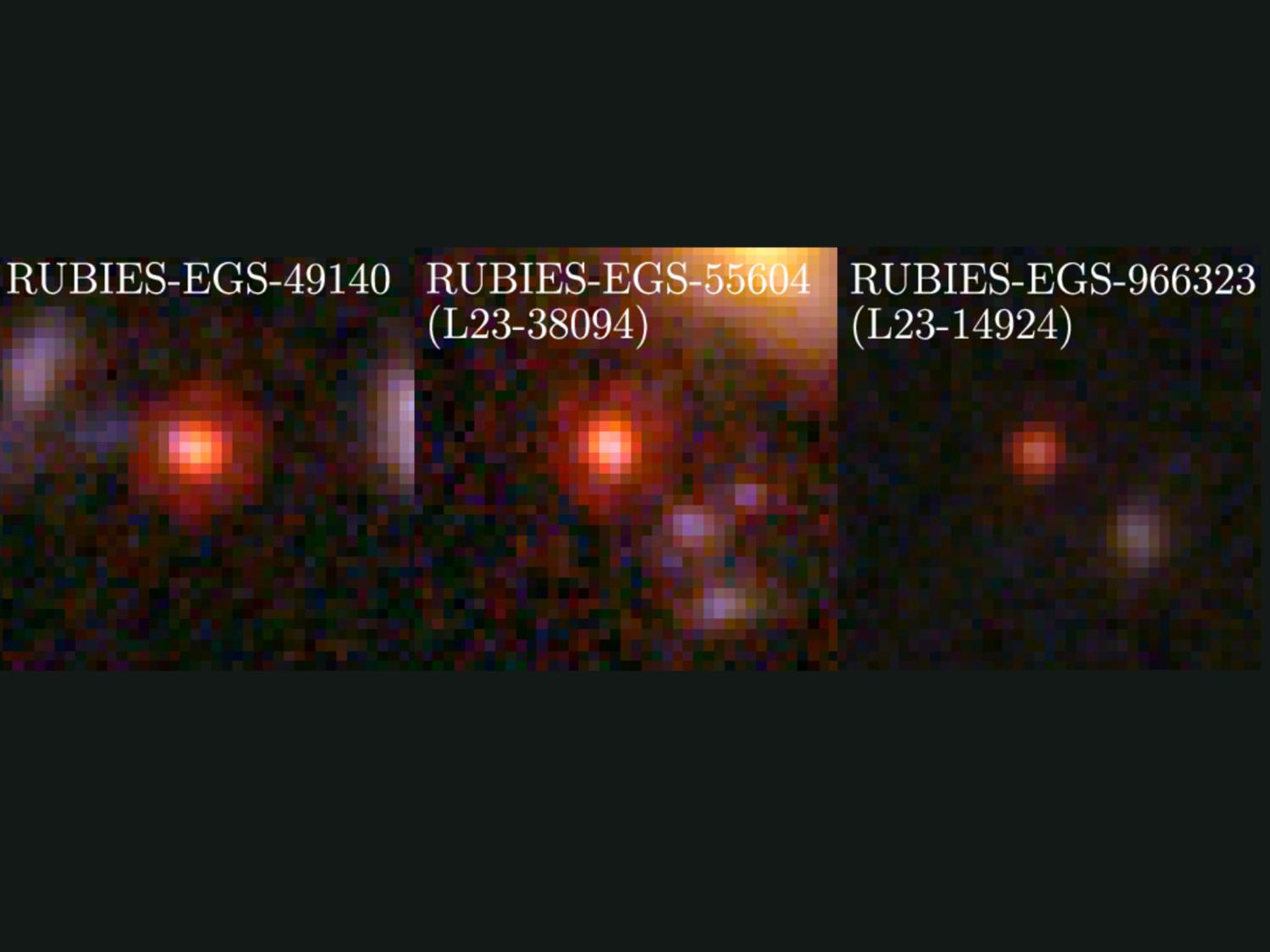
Researchers investigated three mysterious objects in the early universe. Shown here are their color images, composited from three NIRCam filter bands onboard the James Webb Space Telescope. They are remarkably compact at red wavelengths (earning them the term “little red dots”) with some evidence for spatial structure at blue wavelengths. Credit: Provided by researchers / Penn State. All Rights Reserved.

A recent discovery by NASA’s James Webb Space Telescope (JWST) confirmed that luminous, very red objects previously detected in the early universe upend conventional thinking about the origins and evolution of galaxies and their supermassive black holes.

An international team, led by Penn State researchers, using the NIRSpec instrument aboard JWST as part of the RUBIES survey...

Read More

A Hidden Treasure in the Milky Way – Astronomers uncover Ultrabright X-ray Source

Illustration: Alexander Mushtukov: A view towards the black hole in an X-ray binary and the X-rays we see that are reflected from the inner surface of the powerful outflow surrounding the hole. 

Astronomers uncovered that a well-known X-ray binary, whose exact nature has been a mystery to scientists until now, is actually a hidden ultraluminous X-ray source. X-ray binaries are intriguing systems consisting of two celestial bodies: a normal star and a compact, dead object such as a black hole or a neutron star that sucks material from its stellar companion. A few hundred such sources have been identified thus far in our Galaxy...

Read More

The Puzzle of the Galaxy with No Dark Matter

Dark matter-free galaxy NGC 1277, located near the centre of the Perseus cluster, 240 million light-years from Earth. Credit: NASA, ESA, and M. Beasley (IAC)

A team of scientists, led by the researcher at the IAC and the University of La Laguna (ULL) Sebastién Comerón, has found that the galaxy NGC 1277 does not contain dark matter. This is the first time that a massive galaxy (it has a mass several times that of the Milky Way) does not show evidence for this invisible component of the universe. “This result does not fit in with the currently accepted cosmological models, which include dark matter” explains Comerón.

In the current standard model cosmology massive galaxies contain substantial quantities of dark matter, a type of matter which does not interact in the same way as no...

Read More

A Neutrino Portrait of our Galaxy reveals High-Energy Particles from within the Milky Way

Five views of the Milky Way: the top two bands show visible light and gamma rays, while the lower three show expected and real neutrino results, plus a measure of the significance of neutrino events detected by IceCube. IceCube Collaboration

Our Milky Way galaxy is an awe-inspiring feature of the night sky, viewable with the naked eye as a hazy band of stars stretching from horizon to horizon.

For the first time, the IceCube Neutrino Observatory in Antarctica has produced an image of the Milky Way using neutrinos—tiny, ghost-like astronomical messengers.

In research published June 29 in the journal Science, the IceCube Collaboration—an international group of more than 350 scientists—presents evidence of high-energy neutrino emission coming from the Milky Way.

We have not...

Read More