Milky Way tagged posts

Astronomers find ‘Gold Standard’ Star in Milky Way

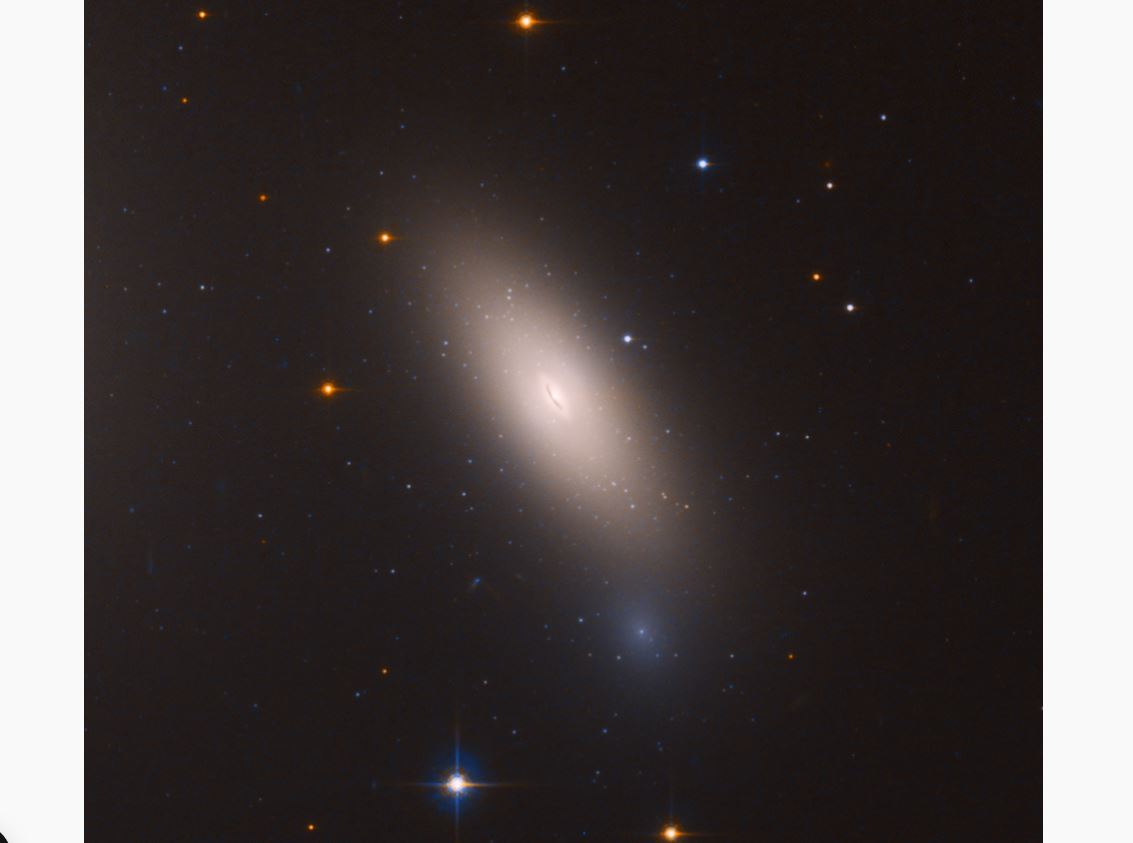
The star HD 222925 is a ninth-magnitude star located toward the southern constellation Tucana. Image credit: The STScI Digitized Sky Survey

In our sun’s neighborhood of the Milky Way Galaxy is a relatively bright star, and in it, astronomers have been able to identify the widest range of elements in a star beyond our solar system yet.

The study, led by University of Michigan astronomer Ian Roederer, has identified 65 elements in the star, HD222925. Forty-two of the elements identified are heavy elements that are listed along the bottom of the periodic table of elements.

Identifying these elements in a single star will help astronomers understand what’s called the “rapid neutron capture process,” or one of the major ways by which heavy elements in the universe were created...

Read More

Gaia Mission finds parts of the Milky Way Much Older than expected

Milky Way edge-on view

Using data from ESA’s Gaia mission, astronomers have shown that a part of the Milky Way known as the ‘thick disc’ began forming 13 billion years ago, around 2 billion years earlier than expected, and just 0.8 billion years after the Big Bang.

This surprising result comes from an analysis performed by Maosheng Xiang and Hans-Walter Rix, from the Max-Planck Institute for Astronomy, Heidelberg, Germany. They took brightness and positional data from Gaia’s Early Data Release 3 (EDR3) dataset and combined it with measurements of the stars’ chemical compositions, as given by data from China’s Large Sky Area Multi-Object Fiber Spectroscopic Telescope (LAMOST) for roughly 250 000 stars to derive their ages.

They chose to look at sub giant stars...

Read More

What Ingredients went into the Galactic Blender to create the Milky Way?

A simulation of a collision between the young Milky Way and a smaller galaxy. Credit: Dr Tobias Buck (AIP/MPIA/NYU)

Our galaxy is a giant ‘smoothie’ of blended stars and gas but a new study tells us where the components came from. In its early days, the Milky Way was like a giant smoothie, as if galaxies consisting of billions of stars, and an enormous amount of gas had been thrown together into a gigantic blender. But a new study picks apart this mixture by analysing individual stars to identify which originated inside the galaxy and which began life outside.

“Although the Milky Way is our home galaxy, we still do not understand how it formed and evolved,” says researcher Sven Buder from the ARC Centre of Excellence for All Sky Astrophysics in 3 Dimensions (ASTRO 3D) and the Au...

Read More

How Disorderly Young Galaxies Grow Up and Mature

Images of space from computer simulation
Using a supercomputer, the researchers created a high-resolution simulation

Using a supercomputer simulation, a research team at Lund University in Sweden has succeeded in following the development of a galaxy over a span of 13.8 billion years. The study shows how, due to interstellar frontal collisions, young and chaotic galaxies over time mature into spiral galaxies such as the Milky Way.

Soon after the Big Bang 13.8 billion years ago, the Universe was an unruly place. Galaxies constantly collided. Stars formed at an enormous rate inside gigantic gas clouds. However, after a few billion years of intergalactic chaos, the unruly, embryonic galaxies became more stable and over time matured into well-ordered spiral galaxies...

Read More