
nebulae tagged posts

Radio telescopes help scientists map molecules in space and uncover where and how stars form

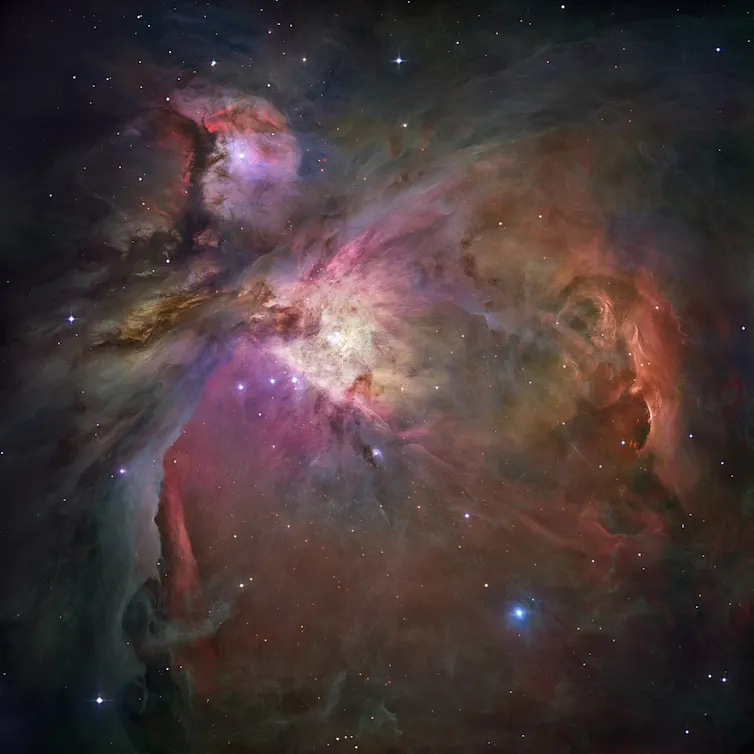
The Orion Nebula with pink and purple gas and brown dust.
The Orion Nebula, captured in visible light by the Hubble Space Telescope. NASA, ESA, M. Robberto (Space Telescope Science Institute/ESA) and the Hubble Space Telescope Orion Treasury Project Team

You may have heard the phrase “we are made of star-stuff.” This statement by the astronomer Carl Sagan refers to the fact that elements heavier than hydrogen and helium were forged in the centers of the first stars. But how does this star-stuff evolve into the chemistry of rocks, plants and people?

As an astrochemist and radio astronomer, I study the places in the universe where stars are born as interstellar laboratories. I’m interested in how simple ingredients come together to form bigger and bigger molecules, including those that are building blocks of life...

Read More
The Metalens meets the Stars – Large, All-glass Metalens Images Sun, Moon and Nebulae

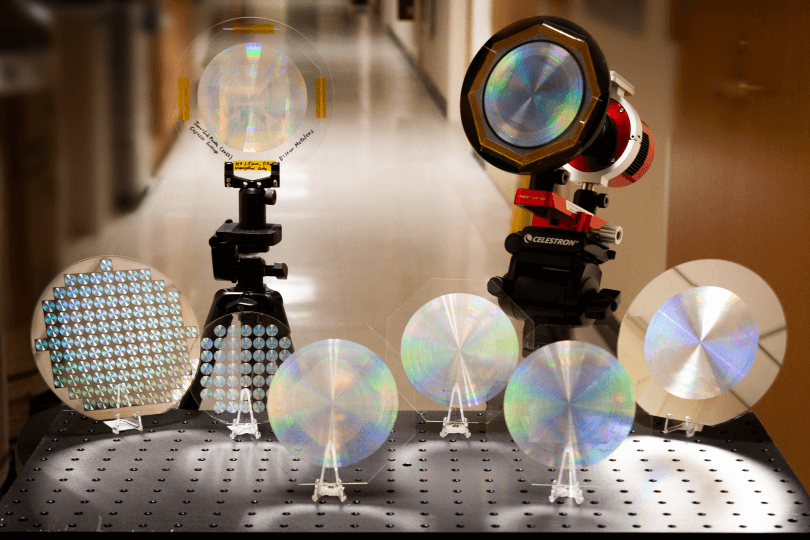
image of the metalens and camera
This 10-centimeter-diameter glass metalens can image the sun, the moon and distant nebulae with high resolution. (Credit: Capasso Lab/Harvard SEAS)
 

Metalenses have been used to image microscopic features of tissue and resolve details smaller than a wavelength of light. Now they are going bigger.

Researchers at the Harvard John A. Paulson School of Engineering and Applied Sciences (SEAS) have developed a 10-centimeter-diameter glass metalens that can image the sun, the moon and distant nebulae with high resolution.

It is the first all-glass, large-scale metalens in the visible wavelength that can be mass produced using conventional CMOS fabrication technology.

The research is published in ACS Nano.

“The ability to accurately control the size of tens of billions of nanopill...

Read More