Neptune tagged posts

A bizarre new state of matter may be hiding inside Uranus and Neptune

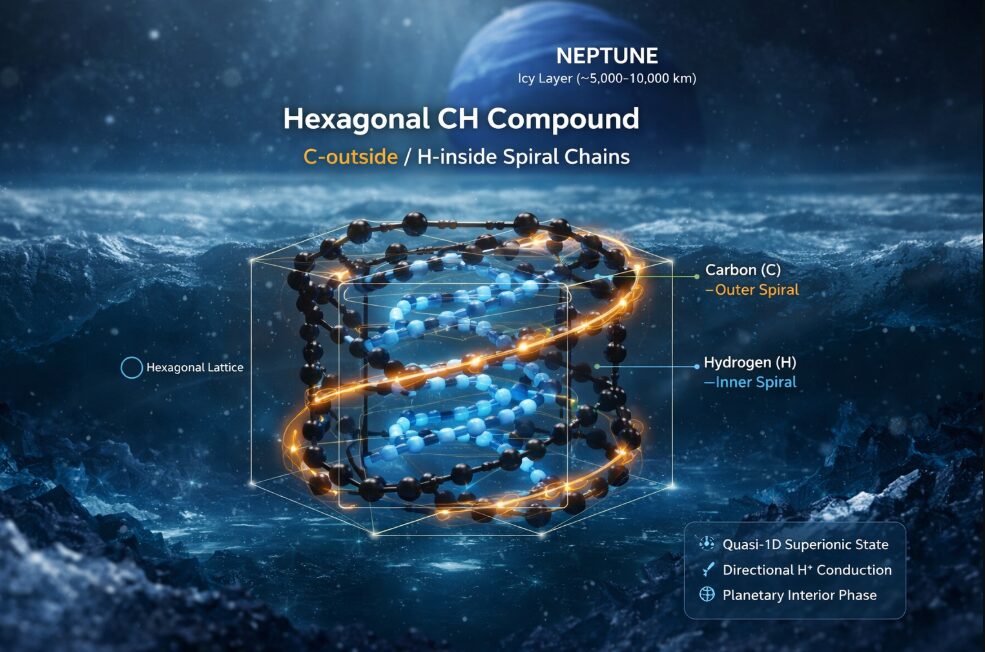
Deep inside planets like Uranus and Neptune, scientists may have uncovered a bizarre new state of matter where atoms behave in unexpected ways. Advanced simulations suggest that carbon and hydrogen, under crushing pressures and scorching temperatures, can form a strange hybrid phase—part solid, part fluid—where hydrogen atoms spiral through a rigid carbon framework. This unusual “superionic” structure could reshape how heat and electricity flow inside these distant worlds, potentially helping explain their mysterious magnetic fields.

The deep interiors of ice giant planets such as Uranus and Neptune may contain a previously unknown form of matter. This possibility comes from new computer simulations conducted by Carnegie scientists Cong Liu and Ronald Cohen.

Their study,...

Read More

Uranus and Neptune are hiding something big beneath the blue

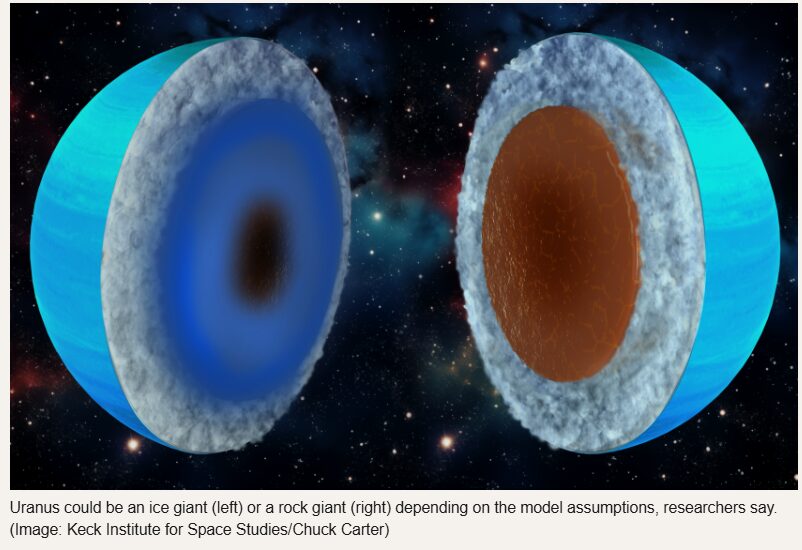
Uranus and Neptune may not be the icy worlds we’ve long imagined. A new Swiss-led study uses innovative hybrid modeling to reveal that these planets could just as easily be dominated by rock as by water-rich ices. The findings also help explain their bizarre, multi-poled magnetic fields and open the door to a wider range of possible interior structures. But major uncertainties remain, and only future space missions will The Solar System is commonly grouped by planetary composition: four rocky terrestrial planets (Mercury, Venus, Earth and Mars), two massive gas giants (Jupiter and Saturn), and a pair of ice giants (Uranus and Neptune)...

Read More

Mysterious object found dancing with Neptune

A team of astronomers led by the Center for Astrophysics | Harvard & Smithsonian has discovered a rare object far beyond Neptune, from a class known as trans-Neptunian objects, that is moving in rhythm with the giant planet. This image shows the orbits of all of the objects discovered in the Outer Solar System Origins Survey. The orbit of 2020 VN40 is the thickest one, tilted up and to the left from the orbits of most of the objects.  The orbits of the giant planets Jupiter, Saturn, Uranus, and Neptune are the white circles. 
Credit: Rosemary Pike, CfA

This object, called 2020 VN40, is the first confirmed body that orbits the sun once for every ten orbits Neptune completes.

Astronomers have discovered a bizarre object in the outer solar system, 2020 VN40, that dances to Neptune’s g...

Read More

Astronomers Find Far-flung “Super Earths” Are Not Farfetched

This artist's concept illustrates the results of a new study that measured the masses of many planets relative to the stars that host them
Caption: This artist’s concept illustrates the results of a new study that measured the masses of many planets relative to the stars that host them, leading to new information about populations of planets in the direction of the bulge of the Milky Way. This study, published in the journal Science, shows that super-Earths are common and places them in context with gas giant planets.

Credit: Westlake University

A new study shows that planets bigger than Earth and smaller than Neptune are common outside the Solar System.

An international team including astronomers from the Center for Astrophysics | Harvard & Smithsonian (CfA) has announced the discovery of a planet about twice the size of Earth orbiting its star farther out than Saturn is to the sun.

These results are another examp...

Read More