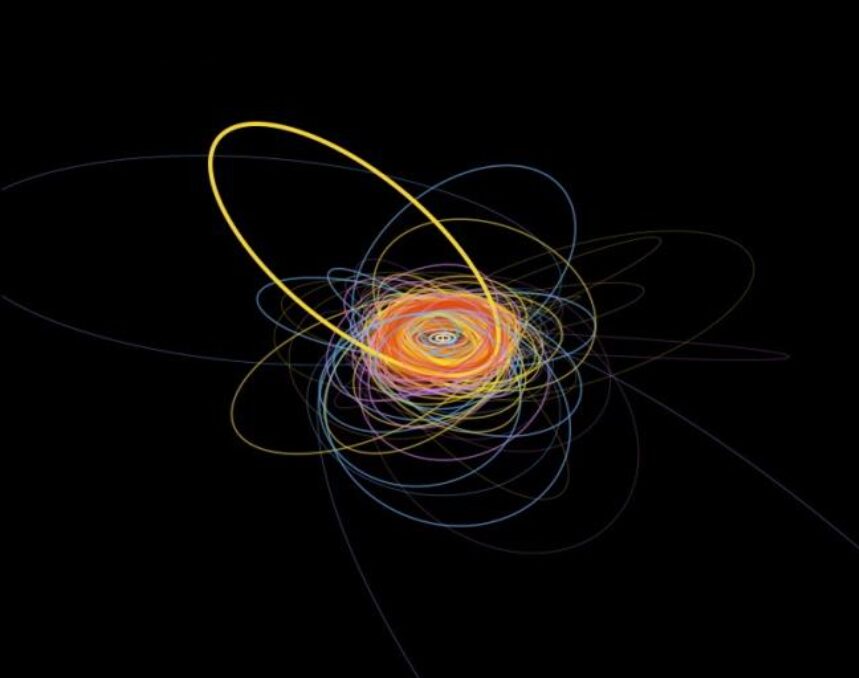
A team of astronomers led by the Center for Astrophysics | Harvard & Smithsonian has discovered a rare object far beyond Neptune, from a class known as trans-Neptunian objects, that is moving in rhythm with the giant planet. This image shows the orbits of all of the objects discovered in the Outer Solar System Origins Survey. The orbit of 2020 VN40 is the thickest one, tilted up and to the left from the orbits of most of the objects. The orbits of the giant planets Jupiter, Saturn, Uranus, and Neptune are the white circles. Credit: Rosemary Pike, CfA
This object, called 2020 VN40, is the first confirmed body that orbits the sun once for every ten orbits Neptune completes.
Astronomers have discovered a bizarre object in the outer solar system, 2020 VN40, that dances to Neptune’s g...
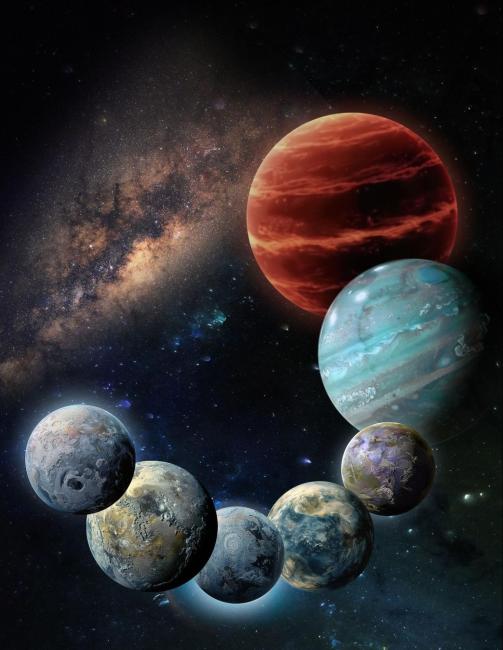
Caption: This artist’s concept illustrates the results of a new study that measured the masses of many planets relative to the stars that host them, leading to new information about populations of planets in the direction of the bulge of the Milky Way. This study, published in the journal Science, shows that super-Earths are common and places them in context with gas giant planets.
Credit: Westlake University
A new study shows that planets bigger than Earth and smaller than Neptune are common outside the Solar System.
An international team including astronomers from the Center for Astrophysics | Harvard & Smithsonian (CfA) has announced the discovery of a planet about twice the size of Earth orbiting its star farther out than Saturn is to the sun.
Neptune lies in the frigid, dark, vast frontier of the outer edges of our solar system, about 3 billion miles away from the sun.
For the first time, NASA’s James Webb Space Telescope has captured bright auroral activity on Neptune. Auroras occur when energetic particles, often originating from the sun, become trapped in a planet’s magnetic field and eventually strike the upper atmosphere. The energy released during these collisions creates the signature glow.
In the past, astronomers have seen tantalizing hints of auroral activity on Neptune, for example, in the flyby of NASA’s Voyager 2 in 1989. However, imaging and confirming the auroras on Neptune has long evaded astronomers despite successful detections on Jupiter, Saturn, and Uranus...
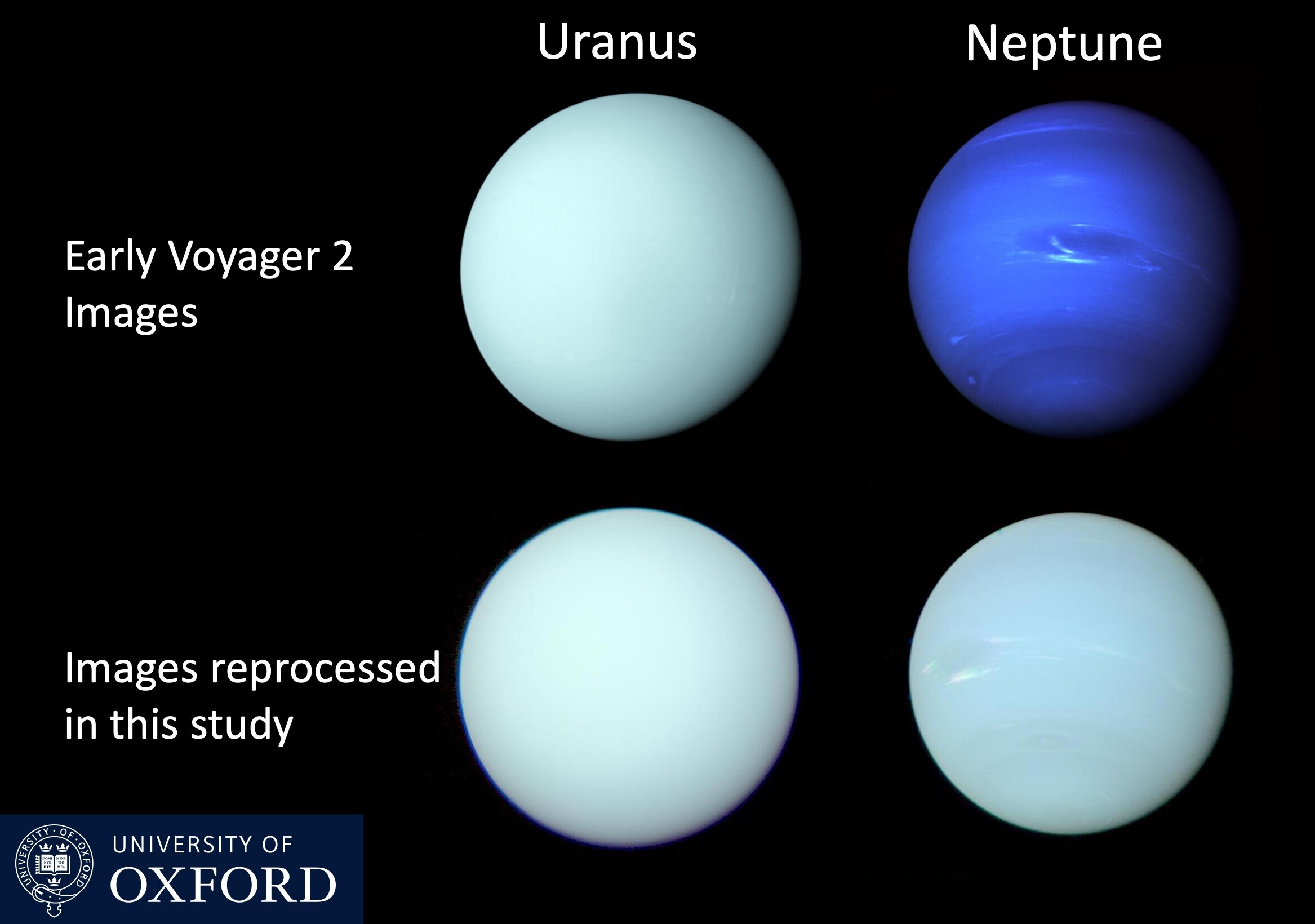
Voyager 2/ISS images of Uranus and Neptune released shortly after the Voyager 2 flybys in 1986 and 1989, respectively, compared with a reprocessing of the individual filter images in this study to determine the best estimate of the true colors of these planets. Credit: Patrick Irwin.
Neptune is fondly known for being a rich blue, and Uranus green—but a new study has revealed that the two ice giants are actually far closer in color than typically thought.
The correct shades of the planets have been confirmed with the help of research led by Professor Patrick Irwin from the University of Oxford, which has been published today in the Monthly Notices of the Royal Astronomical Society.
He and his team found that both worlds are in fact a similar shade of greenish blue, despite the c...






Recent Comments