neural network tagged posts

Photon-driven synapse advances low-power neuromorphic systems

Photon-driven synapse advances low-power neuromorphic systems
A photon-modulated synaptic device based on a rare-earth-doped long-afterglow crystal facilitates excitatory (UV-induced) and inhibitory (near-infrared induced) plasticity. This schematic depicts the excitatory impulse with luminescence as the optical output. Credit: Y. Yan et al.

Modern artificial intelligence systems rely on moving large amounts of data between memory and processors, a design that limits speed and increases energy use. The human brain works differently: it combines memory and computation within synapses, allowing fast, efficient learning and perception. Replicating this approach in hardware is a central goal of neuromorphic computing, especially for tasks like vision, where most real-world information is gathered and processed.

A fully optical artificial synapse
In...

Read More

Holographic storage approach packs more data into the same space by encoding three properties of light

New holographic data storage approach packs more data into the same space
Researchers developed a holographic data storage approach that stores and retrieves information in three dimensions by combining the amplitude, phase and polarization properties of light. Credit: Xiaodi Tan, Fujian Normal University in China

Researchers have developed a holographic data storage approach that stores and retrieves information in three dimensions by combining three properties of light—amplitude, phase and polarization. By allowing more data to be stored in the same space, the new approach could help advance efforts to meet the growing global demand for data storage.

Holographic data storage uses laser light to store digital information inside a material...

Read More

Machine learning algorithm rapidly reconstructs 3D images from X-ray data

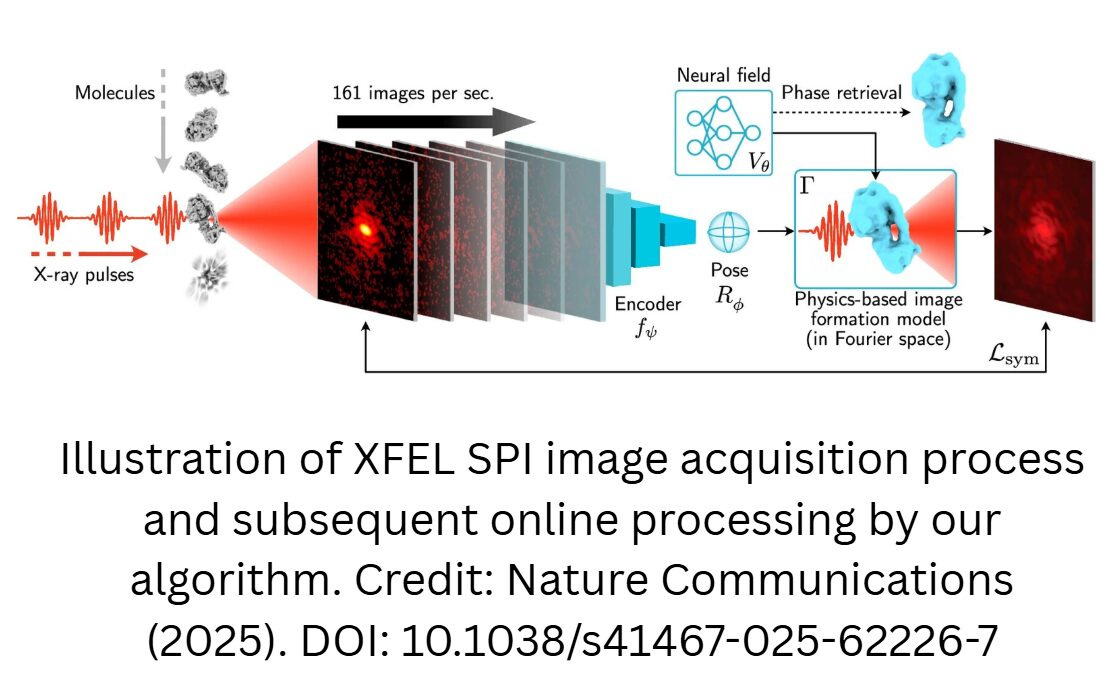
Soon, researchers may be able to create movies of their favorite protein or virus better and faster than ever before. Researchers at the Department of Energy’s SLAC National Accelerator Laboratory have pioneered a new machine learning method—called X-RAI (X-Ray single particle imaging with Amortized Inference)—that can “look” at millions of X-ray laser-generated images and create a three-dimensional reconstruction of the target particle. The team recently reported their findings in Nature Communications.

X-RAI’s ability to sort through a massive number of images and learn as it goes could unlock limits in data-gathering, allowing researchers to see molecules up close—and perhaps even on the move...

Read More

New Security Protocol Shields Data from Attackers during Cloud-Based Computation

Light securing a data pathway between a computer and a cloud-based computing platform
Caption: MIT researchers have developed a security protocol that leverages the quantum properties of light to guarantee that data sent to and from a cloud server remain secure during deep learning computations.
Credit: Christine Daniloff, MIT; iStock

The technique leverages quantum properties of light to guarantee security while preserving the accuracy of a deep-learning model. Researchers developed a technique guaranteeing that data remain secure during multiparty, cloud-based computation. This method, which leverages the quantum properties of light, could enable organizations like hospitals or financial companies to use deep learning to securely analyze confidential patient or customer data.

Deep-learning models are being used in many fields, from health care diagnostics to financi...

Read More