NIRCam tagged posts

The monster hiding in plain sight: JWST reveals cosmic shapeshifter in the early universe

The monster hiding in plain sight: JWST reveals cosmic shapeshifter in the early universe
Covering a tiny patch of sky spanning less than a tenth of the full moon, the famous “Hubble eXtreme Deep Field” image revealed thousands of galaxies, including objects from the universe infancy. The James Webb Space Telescope observed the same region over three years. U of A researchers zoomed in on the galaxy reported in this study (inset), captured when the universe was only 800 million years old. The team found that even at its young age, it already harbored a supermassive black hole, shrouded in dust. Credit: ESA/Webb, NASA & CSA, G. Östlin, P. G. Perez-Gonzalez, J. Melinder, the JADES Collaboration, M. Zamani (ESA/Webb)

In a glimpse of the early universe, astronomers have observed a galaxy as it appeared just 800 million years after the Big Bang—a cosmic Jekyll and Hyde that loo...

Read More

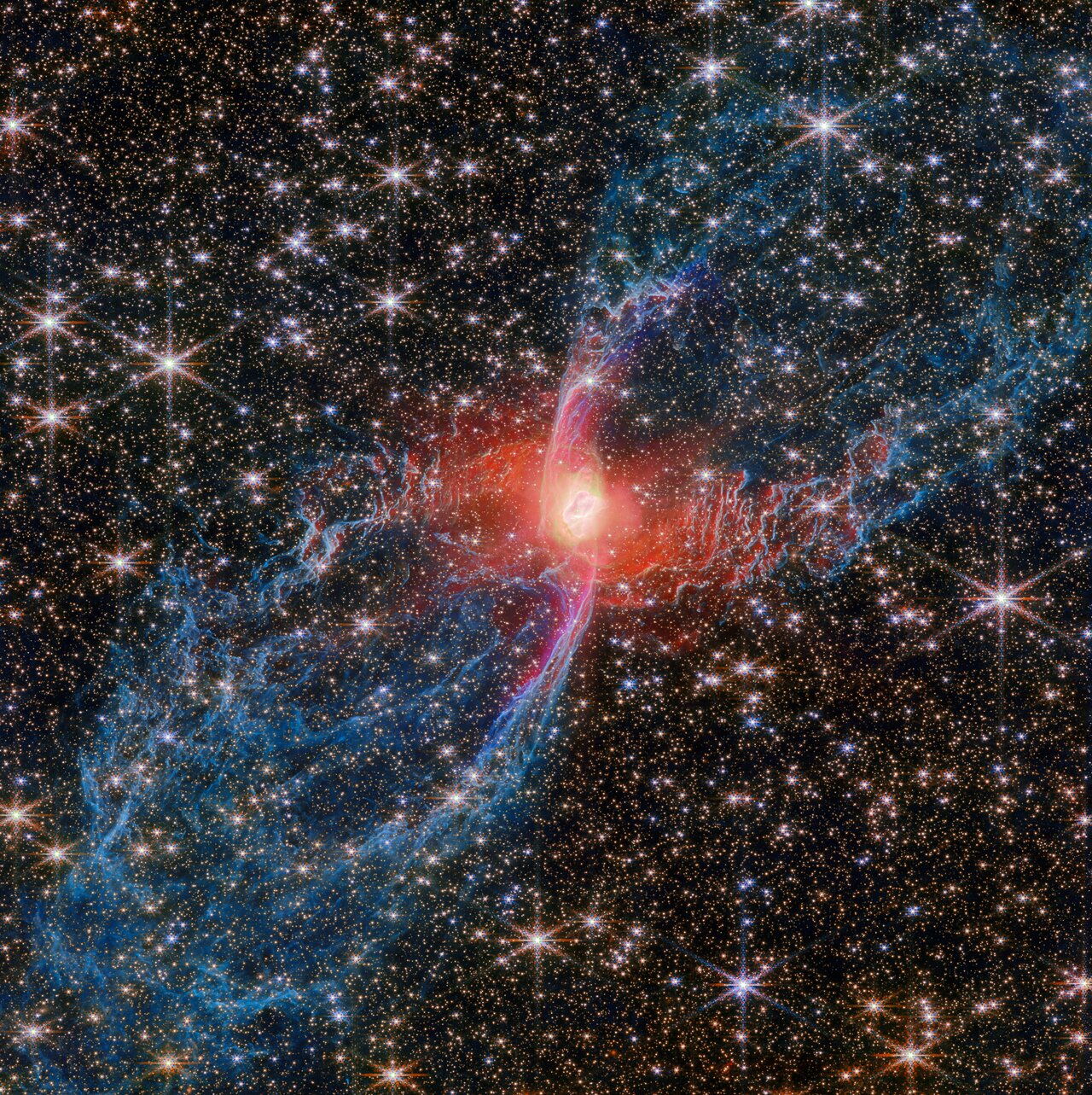
The Red Spider Nebula, caught by Webb

The Red Spider Nebula, caught by Webb
A large planetary nebula. The nebula’s central star is hidden by a blotchy pinkish cloud of dust. A strong red light radiates from this area, illuminating the nearby dust. Two large loops extend diagonally away from the center, formed of thin ridges of molecular gas, here colored blue. They stretch out to the corners of the view. A huge number of bright, whitish stars cover the background, also easily visible through the thin dust layers. Credit: European Space Agency

This new NASA/ESA/CSA James Webb Space Telescope Picture of the Month features a cosmic creepy-crawly called NGC6537—the Red Spider Nebula. Using its Near-InfraRed Camera (NIRCam), Webb has revealed never-before-seen details in this picturesque planetary nebula with a rich backdrop of thousands of stars.

Planetary ne...

Read More

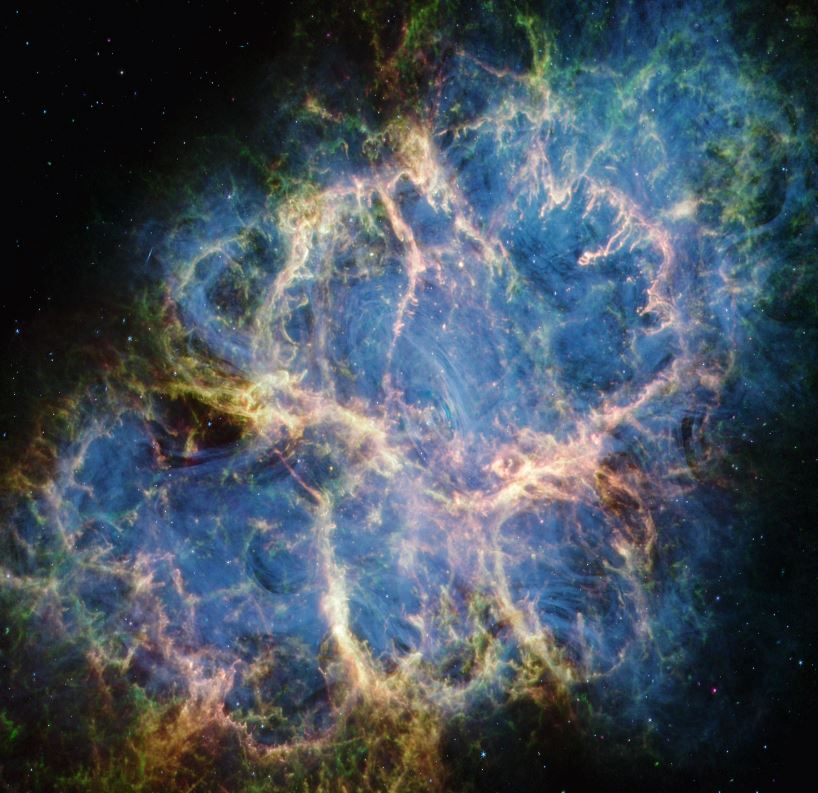
Investigating the Origins of the Crab Nebula

This image by NASA’s James Webb Space Telescope’s NIRCam (Near-Infrared Camera) and MIRI (Mid-Infrared Instrument) shows different structural details of the Crab Nebula. The supernova remnant is comprised of several different components, including doubly ionized sulfur (represented in green), warm dust (magenta), and synchrotron emission (blue). Yellow-white mottled filaments within the Crab’s interior represent areas where dust and doubly ionized sulfur coincide. The observations were taken as part of General Observer program 1714.
: NASA, ESA, CSA, STScI, T. Temim (Princeton University)

A team of scientists used NASA’s James Webb Space Telescope to parse the composition of the Crab Nebula, a supernova remnant located 6,500 light-years away in the constellation Taurus...

Read More

Webb Cracks Case of Inflated Exoplanet

Graphic titled “Hot Gas-Giant Exoplanet WASP-107 b Transmission Spectrum: Hubble WFC3 Grism Spectroscopy; Webb NIRCam Grism Spectroscopy; Webb MIRI Low-Resolution Spectroscopy” has 3 sets of data points with error bars and a best-fit model on a graph of Amount of Light Blocked on the y-axis versus Wavelength of Light in microns on the x-axis. Y-axis ranges from less light blocked at bottom to more light blocked at top. X-axis ranges from 0.8 to 12 microns. Data are identified in a legend. Hubble WFC3: 30 green data points ranging from 0.9 to 1.6 microns; Webb NIRCam: 177 orange data points ranging from 2.5 to 5 microns; Webb MIRI: 46 pink data points ranging from 5 to 12 microns. Best-fit model is a gray line with numerous peaks and valleys. The model and data are closely aligned. Ten features on the graph are labeled: Water H2O; Water H2O and Carbon Dioxide CO2; Ammonia NH3; Methane CH4; Sulfur Dioxide SO2; Carbon Dioxide CO2; Carbon Monoxide CO; Water H2O; Sulfur Dioxide SO2; and Ammonia NH3.
Warm Gas-Giant Exoplanet WASP-107 b Transmission Spectrum (Hubble WFC3, Webb NIRCam, Webb MIRI)

Why is the warm gas-giant exoplanet WASP-107 b so puffy? Two independent teams of researchers have an answer.

Data collected using NASA’s James Webb Space Telescope, combined with prior observations from NASA’s Hubble Space Telescope, show surprisingly little methane (CH4) in the planet’s atmosphere, indicating that the interior of WASP-107 b must be significantly hotter and the core much more massive than previously estimated.

The unexpectedly high temperature is thought to be a result of tidal heating caused by the planet’s slightly non-circular orbit, and can explain how WASP-107 b can be so inflated without resorting to extreme theories of how it formed.

The results, which were ...

Read More