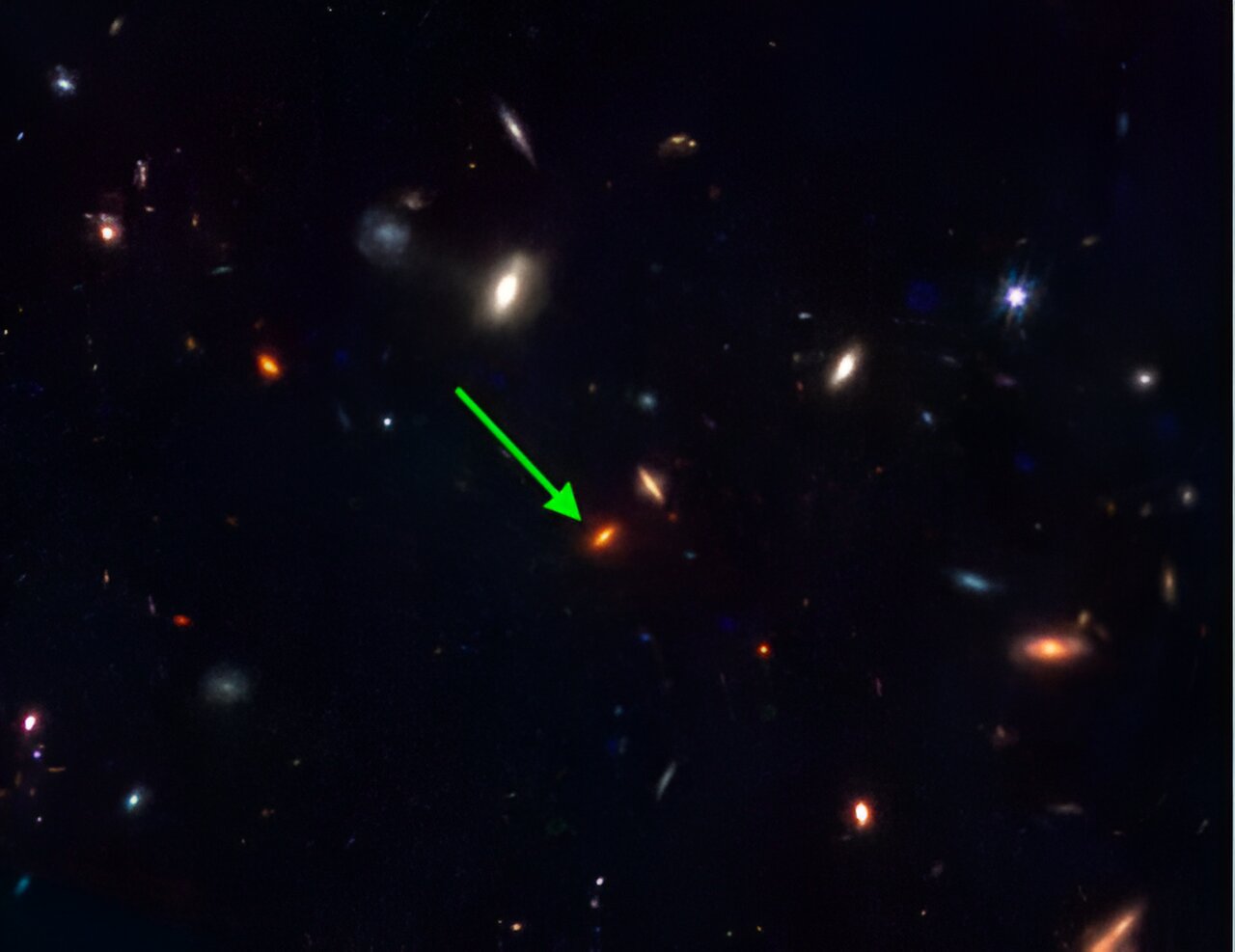
JWST-7329: a rare massive galaxy that formed very early in the Universe. This JWST NIRCAM image shows a red disk galaxy but with images alone it is hard to distinguish from other objects. Spectral analysis of its light with JWST revealed its anomalous nature – it formed around 13 billions years ago even though it contains ~4x more mass in stars than our Milky Way does today. Credit: James Webb Space Telescope
Our understanding of how galaxies form and the nature of dark matter could be completely upended after new observations of a stellar population bigger than the Milky Way from more than 11 billion years ago that should not exist.
A paper published today in Nature details findings using new data from the James Webb Space Telescope (JWST)...
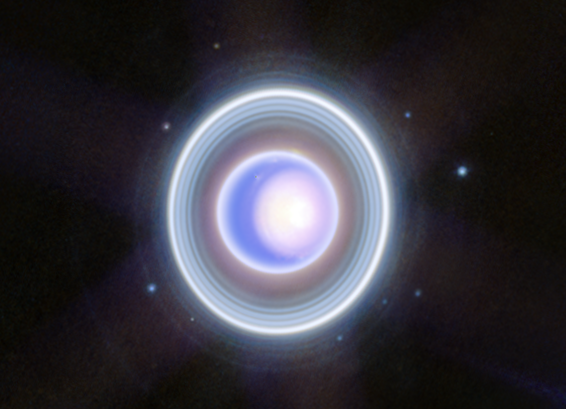
This image of Uranus from NIRCam (Near-Infrared Camera) on NASA’s James Webb Space Telescope exquisitely captures Uranus’s seasonal north polar cap and dim inner and outer rings. This Webb image also shows 9 of the planet’s 27 moons – clockwise starting at 2 o’clock, they are: Rosalind, Puck, Belinda, Desdemona, Cressida, Bianca, Portia, Juliet, and Perdita. NASA, ESA, CSA, STScI
The James Webb Space Telescope recently trained its sights on unusual and enigmatic Uranus, an ice giant that spins on its side. Webb captured this dynamic world with rings, moons, storms, and other atmospheric features—including a seasonal polar cap. The image expands upon a two-color version released earlier this year, adding additional wavelength coverage for a more detailed look.
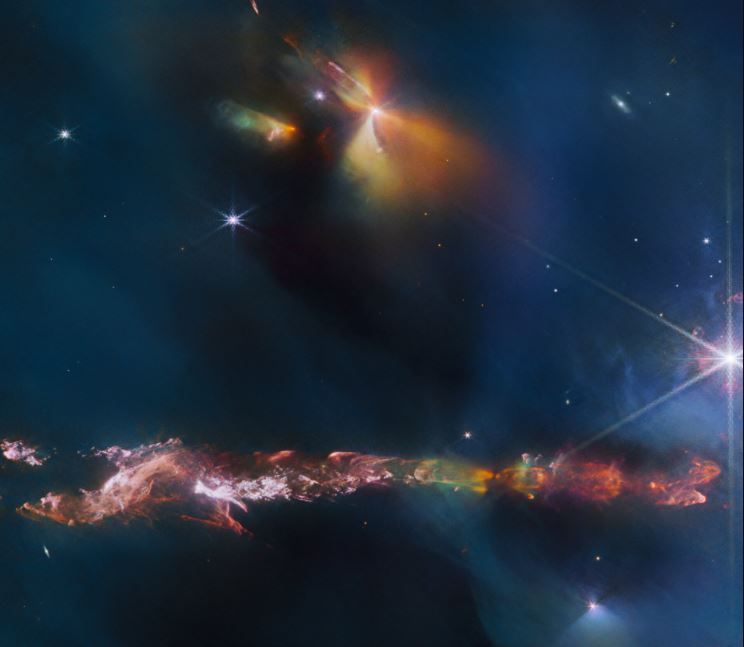
This new Picture of the Month from the NASA/ESA/CSA James Webb Space Telescope reveals intricate details of the Herbig Haro object 797 (HH797). Herbig-Haro objects are luminous regions surrounding newborn stars (known as protostars), and are formed when stellar winds or jets of gas spewing from these newborn stars form shockwaves colliding with nearby gas and dust at high speeds.
HH 797, which dominates the lower half of this image, is located close to the young open star cluster IC348, which is located near the eastern edge of the Perseus dark cloud complex. The bright infrared objects in the upper portion of the image are thought to host two further protostars.
This image was captured with Webb’s Near-InfraRed Camera (NIRCam)...
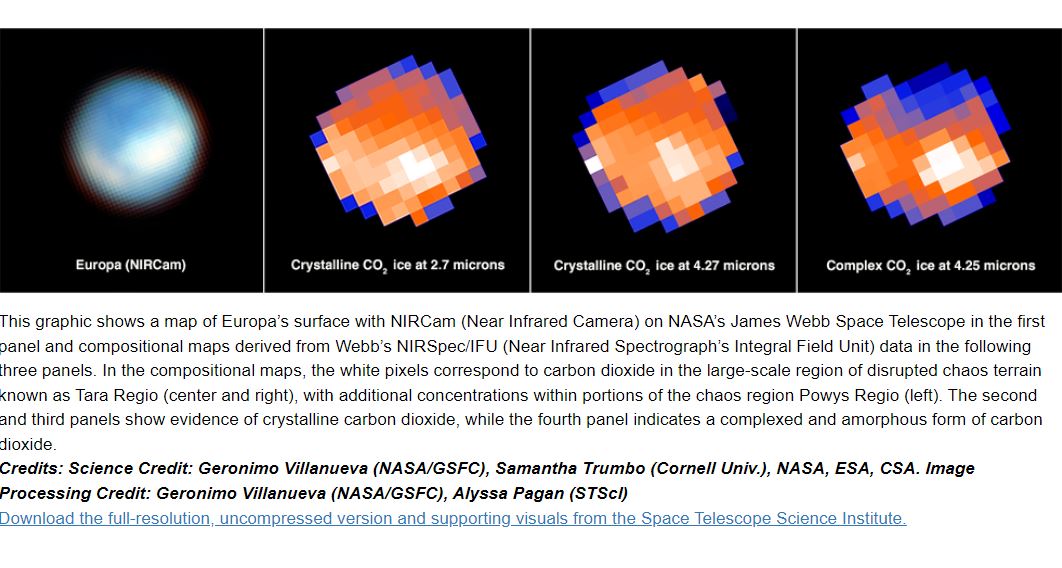
Astronomers using data from NASA’s James Webb Space Telescope have identified carbon dioxide in a specific region on the icy surface of Europa.
Jupiter’s moon Europa is one of a handful of worlds in our solar system that could potentially harbor conditions suitable for life. Previous research has shown that beneath its water-ice crust lies a salty ocean of liquid water with a rocky seafloor. However, planetary scientists had not confirmed if that ocean contained the chemicals needed for life, particularly carbon.
Astronomers using data from NASA’s James Webb Space Telescope have identified carbon dioxide in a specific region on the icy surface of Europa...





Recent Comments