obesity tagged posts

More than 2,500 Cancer Cases a Week could be Avoided

More than 135,500 cases of cancer a year in the UK could be prevented through lifestyle changes, according to new figures from a Cancer Research UK landmark study published today.* This equates to 37.7% of all cancers diagnosed each year in the UK – rising to 41.5% in Scotland.

The latest figures, calculated from 2015 cancer data, found that smoking remains the biggest preventable cause of cancer despite the continued decline in smoking rates. Tobacco smoke caused around 32,200 cases of cancer in men (17.7% of all male cancer cases) and around 22,000 (12.4%) in women in 2015, according to the research published in the British Journal of Cancer.

Excess weight is the second biggest preventable cause of cancer. Around 22,800 (6...

Read More

Palm Oil in your Valentine’s Chocolate? Beware

Metabolic inflammation and NFкB-mediated neuroinflammatory responses in the NAc contribute to the expression of anxiodepressive behavior and heightened food cravings caused by a diet high in saturated fat and sugar.

Metabolic inflammation and NFкB-mediated neuroinflammatory responses in the NAc contribute to the expression of anxiodepressive behavior and heightened food cravings caused by a diet high in saturated fat and sugar.

A diet rich in saturated fat and sugar not only leads to obesity, it creates inflammation in the nucleus accumbens, a part of the brain that controls mood and the feeling of reward. And this inflammation can lead to depressive, anxious and compulsive behaviour and disrupt metabolism, according to a new study by researchers at the University of Montreal Hospital Research Centre (CRCHUM). Published in the journal Molecular Metabolism, the study on mice provides new evidence confirming the harmful effect of saturated fat on health.

“The depressive, anxious and compulsive behaviou...

Read More

Learning and Staying in Shape key to Longer Lifespan, study finds

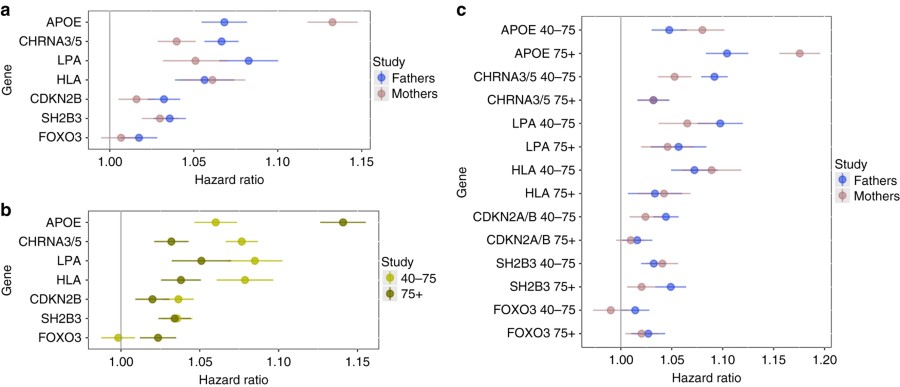
Age-specific and sex-specific effects of the 4 GWS associations in LifeGen and the validated candidate loci. The four GWS and three suggestive replicated loci were analysed for age-specific and sex-specific effects on lifespan. a The variants at APOE and CHRNA3/5 exhibit sexually dimorphic effects on parental mortality, while all other variants exhibit more modest often non-significant sex-specific differences. b The effects of each gene on male and female lifespan were meta-analysed and studied in the cases that died aged between 40 and 75 or after 75. APOE exerts a much greater effect in the older age group, while most of the other genes exhibit the opposite effect. FOXO3 appears neutral, if not positive, in the earlier age group. c Effects on mortality were studied in both age groups for both sexes. APOE has the strongest effect on females aged 75+, CHRNA3/5 acts on males aged 40−75 and all other genes display more ambiguous trends

Age-specific and sex-specific effects of the 4 GWS associations in LifeGen and the validated candidate loci. The four GWS and three suggestive replicated loci were analysed for age-specific and sex-specific effects on lifespan. a The variants at APOE and CHRNA3/5 exhibit sexually dimorphic effects on parental mortality, while all other variants exhibit more modest often non-significant sex-specific differences. b The effects of each gene on male and female lifespan were meta-analysed and studied in the cases that died aged between 40 and 75 or after 75. APOE exerts a much greater effect in the older age group, while most of the other genes exhibit the opposite effect. FOXO3 appears neutral, if not positive, in the earlier age group...

Read More

Brain ‘Switch’ tells Body to Burn Fat After a Meal

Highlights •Diurnal changes in hypothalamic TCPTP coordinate feeding with energy expenditure •Feeding represses hypothalamic TCPTP to increase energy expenditure •TCPTP inhibits insulin signaling in AgRP neurons to repress energy expenditure •Insulin signaling in AgRP neurons increases the browning of white fat

Highlights
•Diurnal changes in hypothalamic TCPTP coordinate feeding with energy expenditure
•Feeding represses hypothalamic TCPTP to increase energy expenditure
•TCPTP inhibits insulin signaling in AgRP neurons to repress energy expenditure
•Insulin signaling in AgRP neurons increases the browning of white fat

Scientists at Monash University’s Biomedicine Discovery Institute have found a mechanism by which the brain coordinates feeding with energy expenditure, solving a puzzle that has previously eluded researchers and offering a potential novel target for the treatment of obesity. Obesity – a major risk factor for many diseases including cardiovascular disease, Type 2 diabetes, liver disease and several cancers – is at epidemic levels in Australia.

Researchers from the Metabolic D...

Read More