
Organa Crater tagged posts

Pluto through a Stained Glass Window: A Movie from the edge of our Solar System

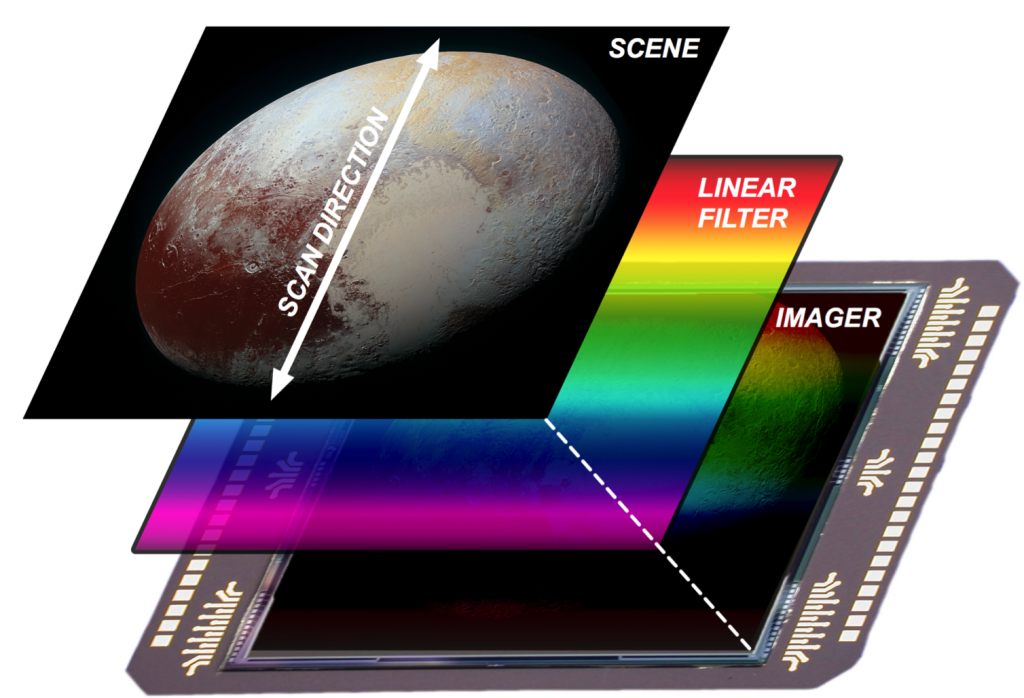
A simplified schematic of the how the LEISA instrument works

Figure 1: A simplified schematic of the how the LEISA instrument works. As the scene (in this case, Pluto) moves by along the scan direction, the imager records many frames of video in sequence, imaging each part of Pluto though each segment of the linear filter and building up a spectral map of the entire object. Credits: NASA/JHUAPL/SwRI/Alex Parker

As New Horizons flew by Pluto, it recorded spectacular images of the icy world’s surface using the LORRI and MVIC cameras. It recorded the plasma and dust environments with the PEPSSI, SWAP, and SDC instruments. But one instrument, designed to measure the composition of Pluto and Charon’s surfaces, did something you might not expect: it recorded the first movies from the edge of our solar system.

Recorded with a 256 x 256 pixel camera at <2 f...

Read More

New findings from New Horizons shape Understanding of Pluto and its Moons

New Findings from New Horizons Shape Understanding of Pluto and its Moons

Zigzagging across Pluto: This high-resolution swath of Pluto (right) sweeps over the cratered plains at the west of the New Horizons’ encounter hemisphere and across numerous prominent faults, skimming the eastern margin of the dark, forbidding region informally known as Cthulhu Regio, and finally passing over the mysterious, possibly cryovolcanic edifice Wright Mons, before reaching the terminator or day-night line. Among the many notable details shown are the overlapping and infilling relationships between units of the relatively smooth, bright volatile ices from Sputnik Planum (at the edge of the mosaic) and the dark edge or “shore” of Cthulhu...

Read More