



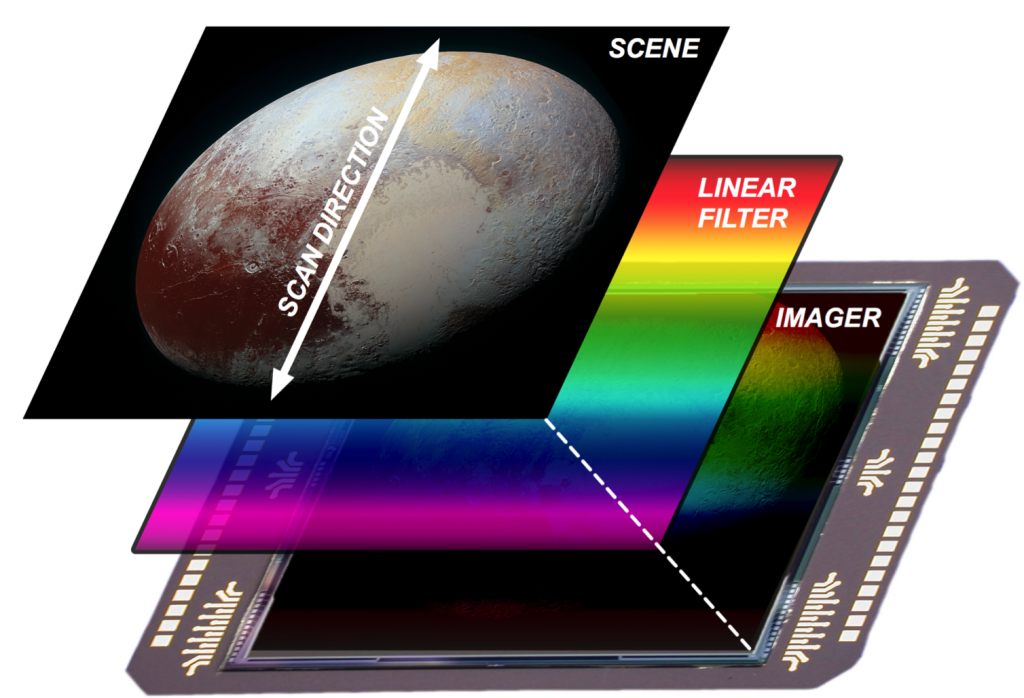
Figure 1: A simplified schematic of the how the LEISA instrument works. As the scene (in this case, Pluto) moves by along the scan direction, the imager records many frames of video in sequence, imaging each part of Pluto though each segment of the linear filter and building up a spectral map of the entire object. Credits: NASA/JHUAPL/SwRI/Alex Parker
As New Horizons flew by Pluto, it recorded spectacular images of the icy world’s surface using the LORRI and MVIC cameras. It recorded the plasma and dust environments with the PEPSSI, SWAP, and SDC instruments. But one instrument, designed to measure the composition of Pluto and Charon’s surfaces, did something you might not expect: it recorded the first movies from the edge of our solar system.
Recorded with a 256 x 256 pixel camera at <2 frames/s, they are not exactly HDTV. However, they are movies. And they are in color. The instrument is LEISA, New Horizons’ infrared imaging spectrometer and takes 2D images just like a normal camera, but it takes them through a linearly-varying filter. One side of the camera can only see infrared light, and each row of pixels can see a subtly different wavelength.
This linear filter allows light with wavelengths as short as 1.25 microns to fall on one side of the image sensor, and smoothly changes to allow light with wavelengths as long as 2.5 microns to fall on the far side of image sensor. This wavelength range was selected because many ices and other materials that exist on the surface of Pluto that have spectral features in this wavelength range that can uniquely identify them, like a fingerprint. A 2nd linear filter to one side of the imager is designed to provide a finer measurement of the spectrum in a region of particular interest between wavelengths of 2.1 to 2.25 microns.
The effect is much like looking through a stained glass window designed for infrared eyes. By scanning this image sensor with its linear filter across a scene and quickly recording many images during the scan (like a movie), LEISA builds up a 2D map of the scene with exactly zero moving parts—highly reliable for deep-space operations. The side-effect of collecting this scientifically-important data set, capable of measuring the composition of every location on the surface of Pluto and Charon that is imaged, is that LEISA collected low frame rate infrared color movies of Pluto and Charon as seen by New Horizons during its flyby.
The discovery of water ice on Pluto was made using the data in this movie. The discovery of ammonia ice within the informally-named Organa crater was made using data from a similar movie of Charon. The New Horizons composition team is busy analyzing these and other movies taken by the LEISA instrument in order to further understand what the surface of Pluto and Charon are made of and how they might be changing with time. Sure, it might not be in HD, but I promise that you’ve never seen anything like this before!
https://blogs.nasa.gov/pluto/2015/12/24/pluto-through-a-stained-glass-window-a-movie-from-the-edge-of-our-solar-system/ https://www.youtube.com/watch?v=Iixo6Ongj8c&feature=youtu.be


Recent Comments