oxygen tagged posts

Scientists discover the “Goldilocks” secret behind life on Earth

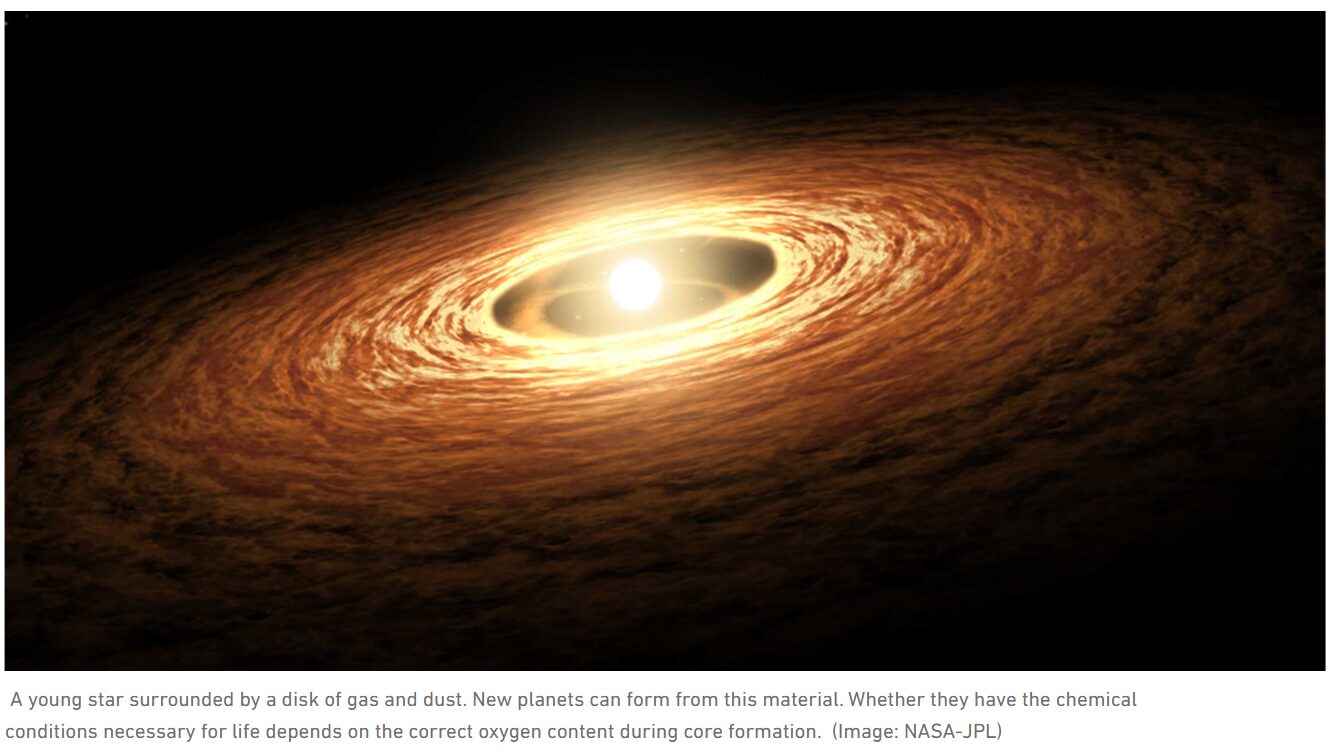
Earth may be habitable because it got unbelievably lucky with its chemistry from the very start.

Earth may have won a cosmic chemistry lottery. Researchers found that during the planet’s earliest formation, oxygen had to be in an extremely narrow “Goldilocks zone” for two life-essential elements, phosphorus and nitrogen, to stay where life could use them. Too much or too little oxygen, and those ingredients could be lost or trapped deep inside the planet. This could reshape the search for life by showing that water alone is not enough.

Life cannot begin on a planet unless certain chemical elements are available in large enough amounts. Two of the most important are phosphorus and nitrogen...

Read More

Jupiter’s clouds are hiding something big

Gigantic storms swirl across the surface of Jupiter
Gigantic storms swirl across the surface of Jupiter. These storms have made it impossible to see what lies beneath—but a new simulation led by a UChicago scientist adds new depth to our understanding.Image credit: NASA/JPL-Caltech/SwRI/MSSS, Image processing by Kevin M. Gill, © CC BY

Jupiter’s swirling storms have concealed its true makeup for centuries, but a new model is finally peeling back the clouds. Researchers found the planet likely holds significantly more oxygen than the Sun, a key clue to how Jupiter—and the rest of the solar system—came together. The study also reveals that gases move through Jupiter’s atmosphere much more slowly than scientists once thought. Together, the findings reshape our understanding of the solar system’s largest planet.

Towering clou...

Read More

Mysterious moon rust explained by oxygen coming from Earth’s ‘wind’

Mysterious moon rust explained by oxygen coming from Earth's
The chemical and microstructure characteristics of O-irradiated magnetite (Mag) after H-implantation. Credit: Geophysical Research Letters (2025). DOI: 10.1029/2025gl116170

In 2020, scientists reported the detection of hematite, an iron oxide mineral otherwise known as rust, distributed through the higher latitudes of the moon, particularly on the nearside. This came as a surprise, considering the low concentrations of oxygen—which is required for the formation of rust—on the moon. Researchers proposed several theories to account for the origins of the oxygen in moon rust, including the degassing of volatiles from lunar magma, asteroids, comets, or large impact events.

However, the only explanation that could account for the distribution patterns of the hematite was that oxyge...

Read More

Oxygen discovered in most distant known galaxy

Two different teams of astronomers have detected oxygen in the most distant known galaxy, JADES-GS-z14-0. The discovery, reported in two separate studies, was made possible thanks to the Atacama Large Millimeter/submillimeter Array (ALMA), in which the European Southern Observatory (ESO) is a partner. This record-breaking detection is making astronomers rethink how quickly galaxies formed in the early universe.

Discovered last year, JADES-GS-z14-0 is the most distant confirmed galaxy ever found: it is so far away, its light took 13.4 billion years to reach us, meaning we see it as it was when the universe was less than 300 million years old, about 2% of its present age.

The new oxygen detection with ALMA, a telescope array in Chile’s Atacama Desert, suggests the galaxy is much m...

Read More