PDMS tagged posts

Wearable thermoelectric technology uses thin films to generate electricity from body heat

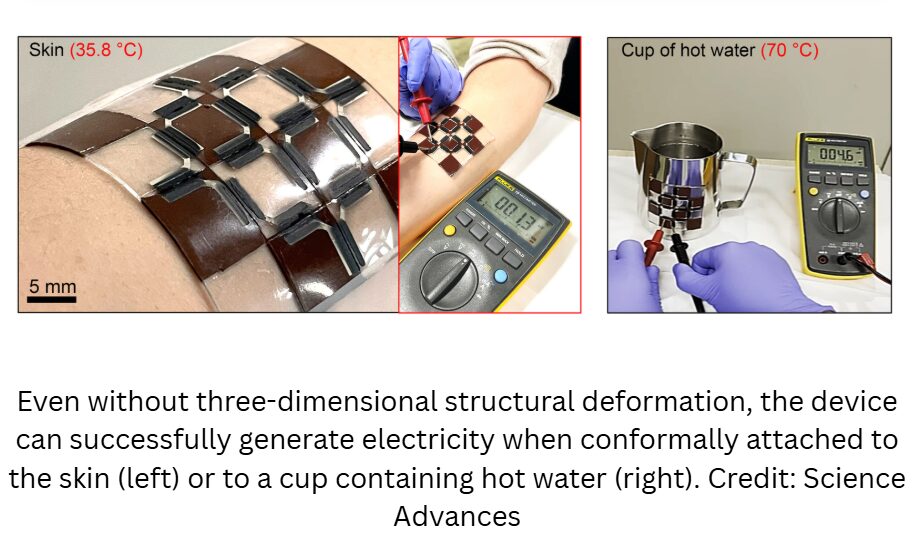
Seoul National University College of Engineering has announced that a research team led by Prof. Jeonghun Kwak of the Department of Electrical and Computer Engineering, with co-first authors Dr. Juhyung Park and Dr. Sun Hong Kim, has developed a flexible and thin “pseudo-transverse thermoelectric generator” capable of producing electricity from body heat. The research findings appear in Science Advances.

Thermoelectric generators, which convert temperature differences into electricity, are attracting attention as a next-generation energy technology for wearable electronics because they can supply power without batteries. In particular, thin-film thermoelectric generators are lightweight and flexible, allowing them to be comfortably attached to skin or clothing.

However, this thi...

Read More
Self-powered sensor can generate electricity and light simultaneously using only movement

Credit: Advanced Sustainable Systems Cove

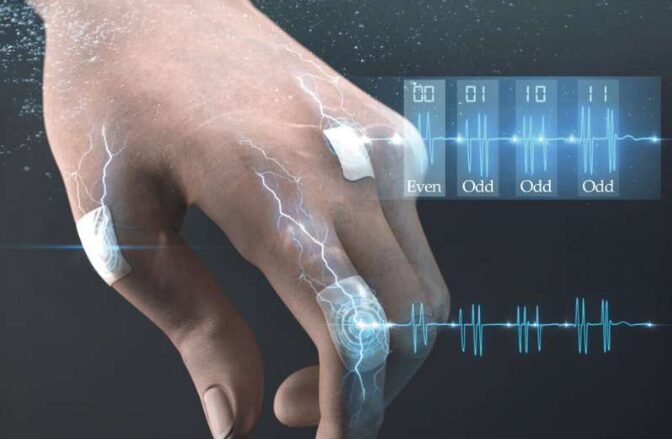
DGIST research teams have developed a self-powered sensor that uses motion and pressure to generate electricity and light simultaneously. This battery-free technology is expected to be used in various real-life applications, such as disaster rescue, sports, and wearable devices.

Triboelectric nanogenerators (TENG) and mechanoluminescence (ML) have attracted attention as green energy technologies that can generate electricity and light, respectively, without external power. However, researchers in previous studies mainly focused on the two technologies separately or simply combined them. Moreover, the power output stability of TENG and the insufficient luminous duration of ML materials have been major limitations for practical applications.

Read More

Inspired by Nature, the research to develop a new Load-bearing Material

Abstract Image
Fabrication of Cartilage-Inspired Hydrogel/Entangled Polymer–Elastomer Structures Possessing Poro-Elastic Properties

Engineers have developed a new material that mimics human cartilage — the body’s shock absorbing and lubrication system, and it could herald the development of a new generation of lightweight bearings.

Cartilage is a soft fibrous tissue found around joints which provides protection from the compressive loading generated by walking, running or lifting. It also provides a protective, lubricating layer allowing bones to pass over one another in a frictionless way. For years, scientists have been trying to create a synthetic material with the properties of cartilage.

To date, they have had mixed results.

But in a paper published in the journal Applied Polymer Mate...

Read More

Beetle that can Survive in Volcanic Areas inspires new Cooling Materials

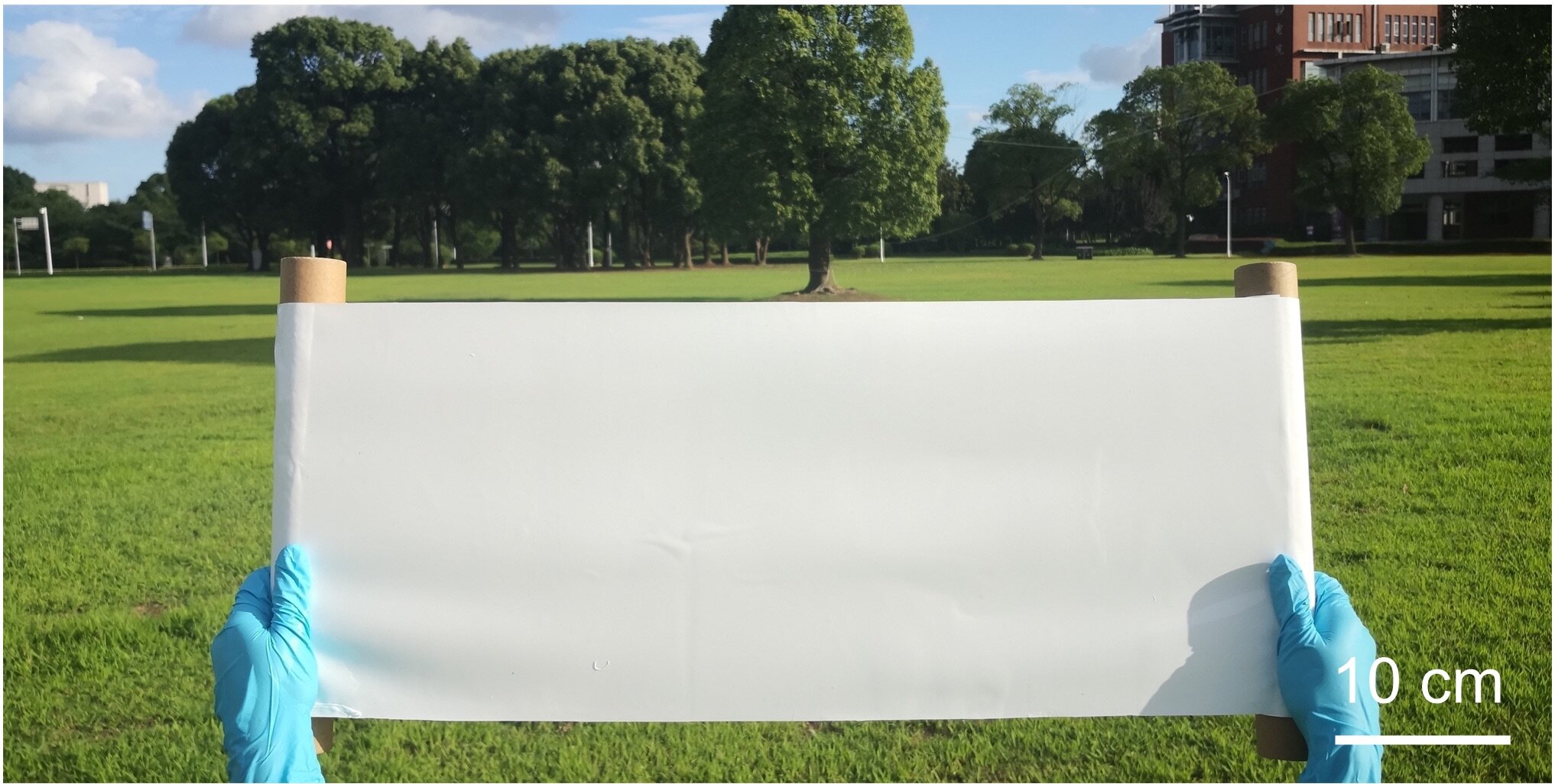
Photo of the fabricated Bio-RC film. Credit: University of Texas at Austin.

A type of beetle capable of regulating its body temperature in some of the hottest places on Earth is the centerpiece of new research with major potential implications for cooling everything from buildings to electronic devices in an environmentally friendly manner.

Researchers in the Cockrell School of Engineering at The University of Texas at Austin, with teams from Shanghai Jiao Tong University in China and KTH Royal Institute of Technology in Sweden, have discovered new information about a species of longicorn beetle that can cool its body enough to survive in volcanic areas in Southeast Asia...

Read More