quantum computer tagged posts

Quantum computer outperforms supercomputers in approximate optimization tasks

quantum computing
Credit: AI-generated image

A quantum computer can solve optimization problems faster than classical supercomputers, a process known as “quantum advantage” and demonstrated by a USC researcher in a paper recently published in Physical Review Letters.

The study shows how quantum annealing, a specialized form of quantum computing, outperforms the best current classical algorithms when searching for near-optimal solutions to complex problems.

“The way quantum annealing works is by finding low-energy states in quantum systems, which correspond to optimal or near-optimal solutions to the problems being solved,” said Daniel Lidar, corresponding author of the study and professor of electrical and computer engineering, chemistry, and physics and astronomy at the USC Viterbi School of Engi...

Read More

A Logical Magic State with Fidelity beyond Distillation Threshold realized on Superconducting Quantum Processor

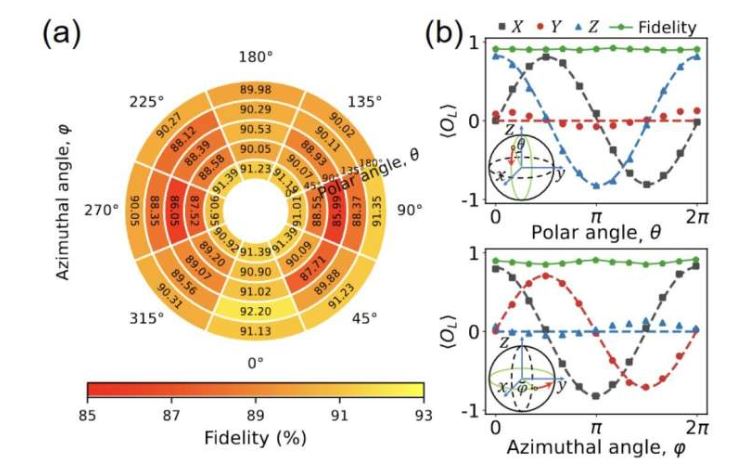
Experimental results of the prepared different logical states. (a) Logical state fidelity with post-selection in Bloch sphere. The fidelity of the preparation of different logical states is represented as a circle, which is divided into multiple annular sectors, each representing a point on the Bloch sphere, with the radial direction representing the polar angle θ and the tangential direction representing the azimuthal angle φ. The obtained average logical fidelity is 0.8983. (b) Logical measurement results of X ̂_L, Y ̂_L, Z ̂_L as a function of polar angle θ or azimuthal angle φ. The colored dashed curves are the result of fitting with trigonometric function.

Quantum computers have the potential to outperform conventional computers on some tasks, including complex optimization...

Read More

Researchers use Quantum Computer to Identify Molecular Candidate for Development of more Efficient Solar Cells

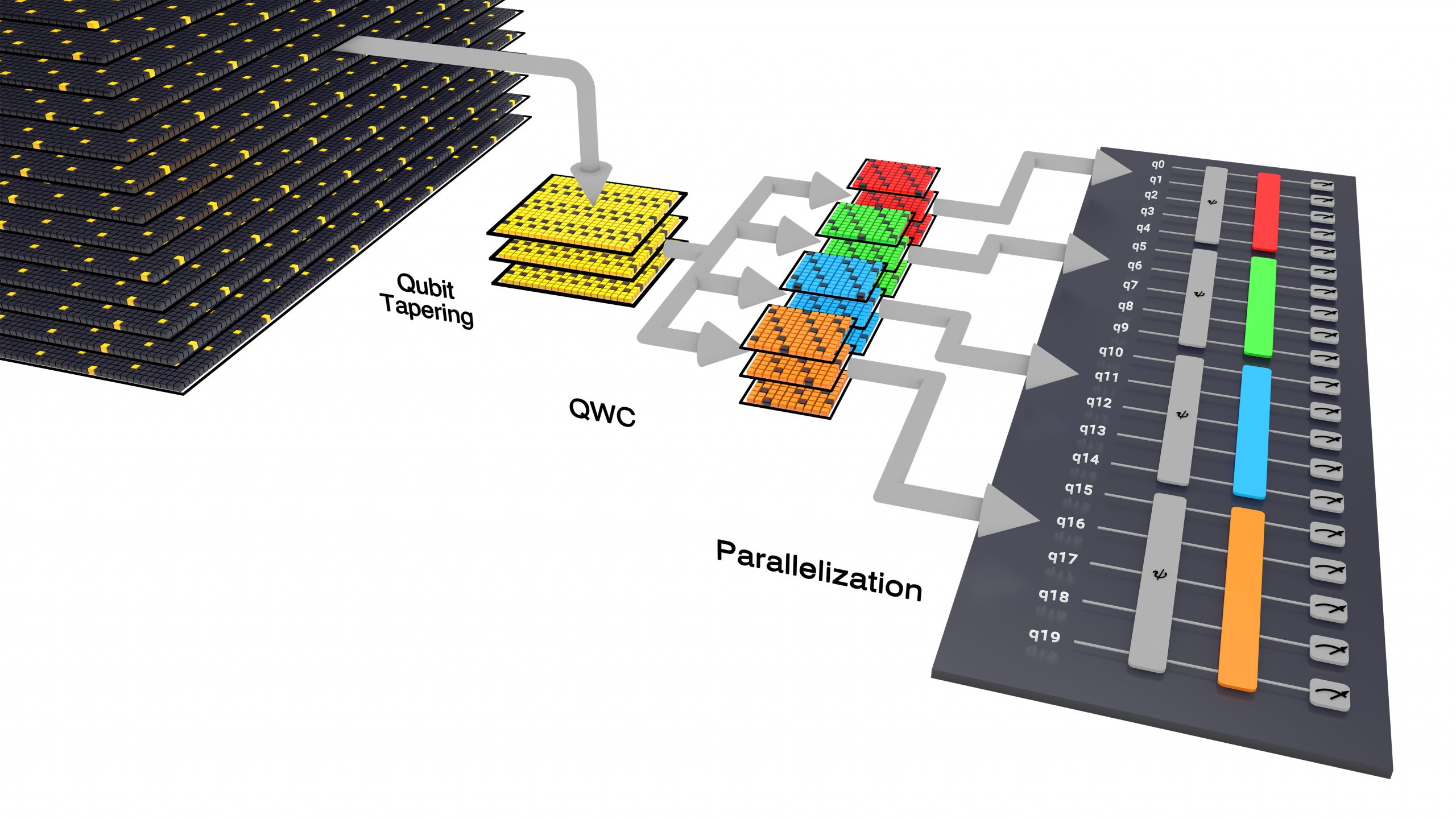
ORNL team members applied three independent strategies to decrease their project’s computational workload, which reduced their time to solution from months to a few weeks. First, in a technique called qubit tapering, they decreased the number of qubits required to express the problem, reducing the size of the problem itself. Second, they took fewer measurements to solve the problem by measuring groups of terms once rather than measuring each individual term from every group (a process called qubit-wise commutativity). Third, instead of implementing each circuit individually, they found a way to run four circuits in parallel, allowing them to use all 20 qubits in the H1-1. Illustration credit: Adam Malin/ORNL.

Using the full capabilities of the Quantinuum H1-1 quantum computer, resear...

Read More

Absolute Zero in the Quantum Computer

moving particles, clocks and equations
© IQOQI/ÖAW
When many quantum particles interact, complex systems can be formed. And this complexity allows reaching a temperature of absolute zero – at least in principle.

Erasing data perfectly and reaching the lowest possible temperature — those two things seem to be completely different, but they are closely intertwined. The absolute lowest temperature possible is -273.15 degrees Celsius. It is never possible to cool any object exactly to this temperature — one can only approach absolute zero. This is the third law of thermodynamics.

A research team at TU Wien (Vienna) has now investigated the question: How can this law be reconciled with the rules of quantum physics? They succeeded in developing a “quantum version” of the third law of thermodynamics: Theoretically, absolute ze...

Read More