
Quantum dots tagged posts

New Quantum Dots study uncovers Implications for Biological Imaging

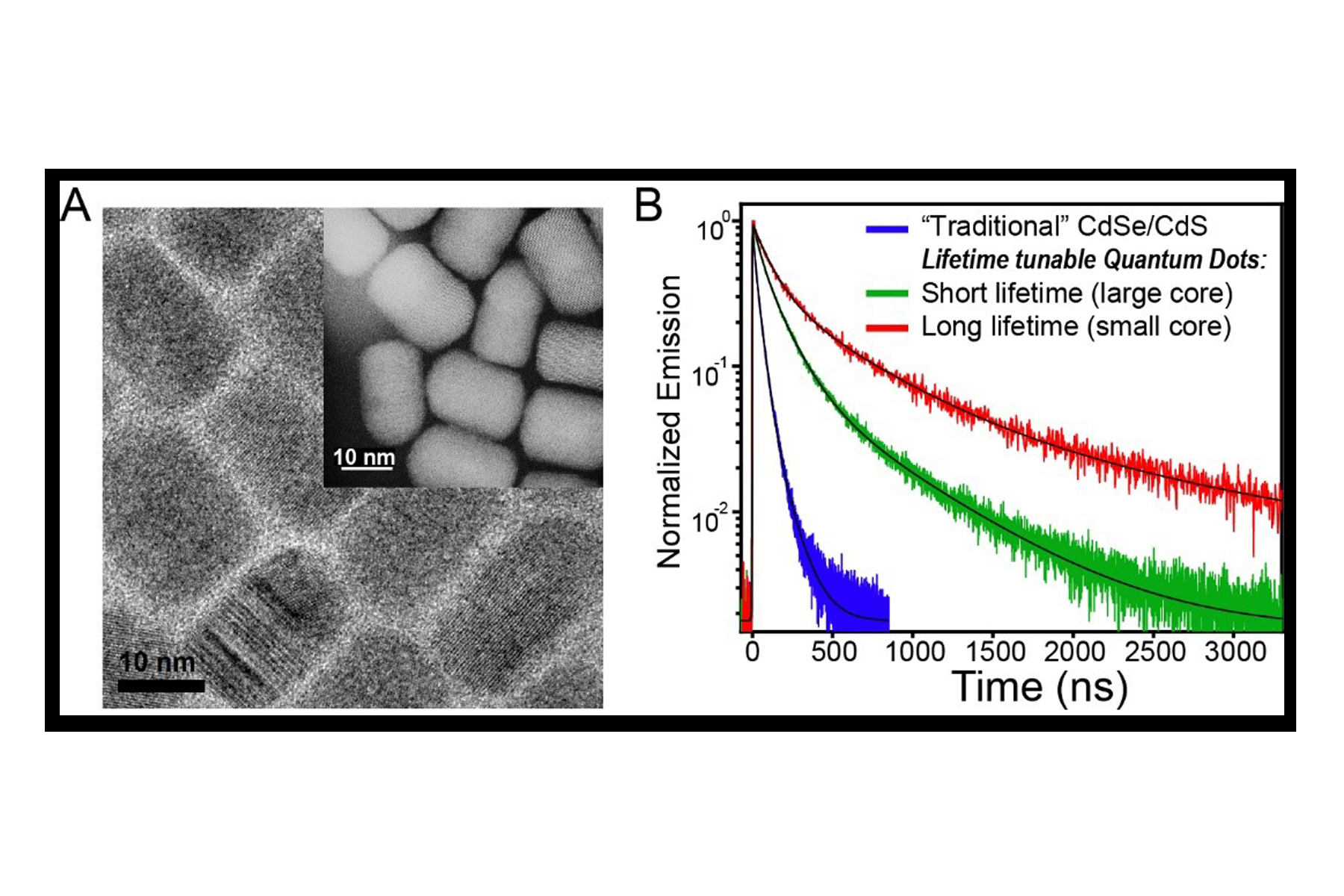
CdZnSe/CdZnS quantum dots (QDs) have a complex internal structure that extends the lifetime. (A) TEM analyses reveal a zinc selenide-rich core interior and a cadmium sulfide shell exterior. (B) Time resolved emission reveals lifetime tunability by simple alterations to the QD structure. The lifetimes can be 10-times greater compared with similar materials.

Researchers report the synthesis of semiconductor ‘giant’ core-shell quantum dots with record-breaking emissive lifetimes. In addition, the lifetimes can be tuned by making a simple alteration to the material’s internal structure.

A new study involving researchers at the University of Illinois Chicago achieved a milestone in the synthesis of multifunctional photonic nanomaterials.

The group, which included collaborators from Pr...

Read More
Quantum Dots form Ordered Material

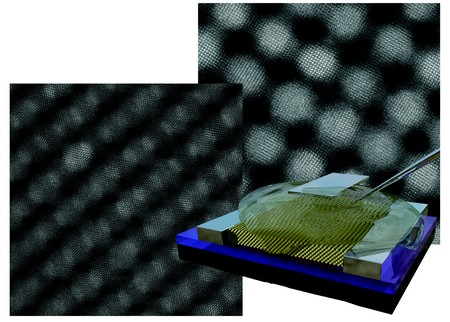
Electron microscope images showing two of the ordered structures formed in the experiments. Atoms inside the quantum dots are resolved by the microscope and it can be seen that they are aligned throughout adjacent dots. A model of the device used for the measurement of the electronic properties is shown in the bottom right. The superlattice lies between two electrodes while an ionic gel on top (gate electrode) is used to accumulate carriers in the active material.
Electron microscope images showing two of the ordered structures formed in the experiments. Atoms inside the quantum dots are resolved by the microscope and it can be seen that they are aligned throughout adjacent dots. A model of the device used for the measurement of the electronic properties is shown in the bottom right. The superlattice lies between two electrodes while an ionic gel on top (gate electrode) is used to accumulate carriers in the active material. | Illustration Jacopo Pinna

Finding paves the way for new generation of opto-electronic applications. Quantum dots are clusters of some 1,000 atoms which act as one large ‘super-atom’. It is possible to accurately design the electronic properties of these dots just by changing their size...

Read More

Smart Lighting system based on Quantum Dots more accurately reproduces Daylight

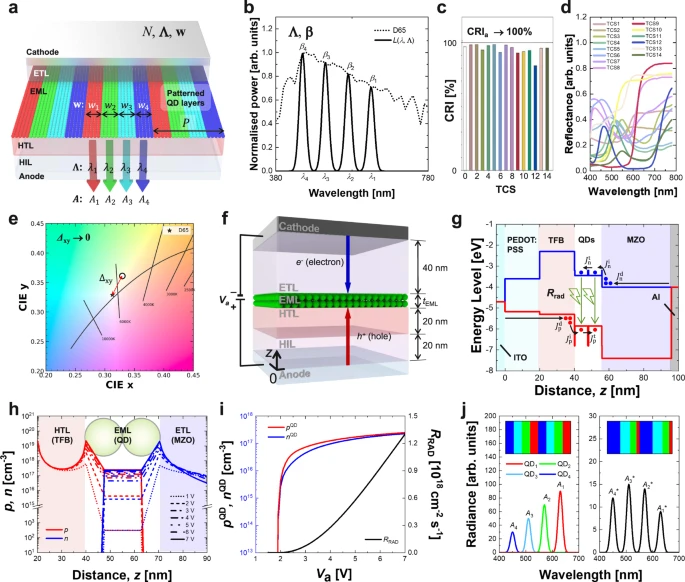
 A system architecture and design procedure of multi-primary coloured lighting system with patterned QD-LEDs.

Researchers have designed smart, colour-controllable whitelight devices from quantum dots – tiny semiconductors just a few billionths of a metre in size – which are more efficient and have better colour saturation than standard LEDs, and can dynamically reproduce daylight conditions in a single light.

The researchers, from the University of Cambridge, designed the next-generation smart lighting system using a combination of nanotechnology, colour science, advanced computational methods, electronics and a unique fabrication process.

The team found that by using more than the three primary lighting colours used in typical LEDs, they were able to reproduce daylight more accu...

Read More

A New Arrangement: Using Quantum Dots to Quench the Smallest Ferrimagnetism

Coding the T-shaped quantum-dot model
Model of the Kondo effect on minimal ferrimagnetism and finds suppression of conductivity.

Model of Lieb’s ‘minimal’ ferrimagnetism with Kondo effect using a ‘T’ of quantum dots. Dr. Nishikawa at Osaka Metropolitan University focused on the Kondo effect on minimal ferrimagnetism and attempted to elucidate it theoretically. As a result, they found that the Kondo effect occurred via multiple “quantum entangled states” depending on temperature and other factors. They also found that the Kondo effect suppressed electrical conductivity through minimal ferrimagnetism, when usually it is amplified in many other cases.

Most people are not aware of magnetic forces in their everyday lives, but continuously rely on them in electric motors, hard drives, and electric sensors...

Read More