
Quantum dots tagged posts

Mini Electricity Generator made from Quantum Dots

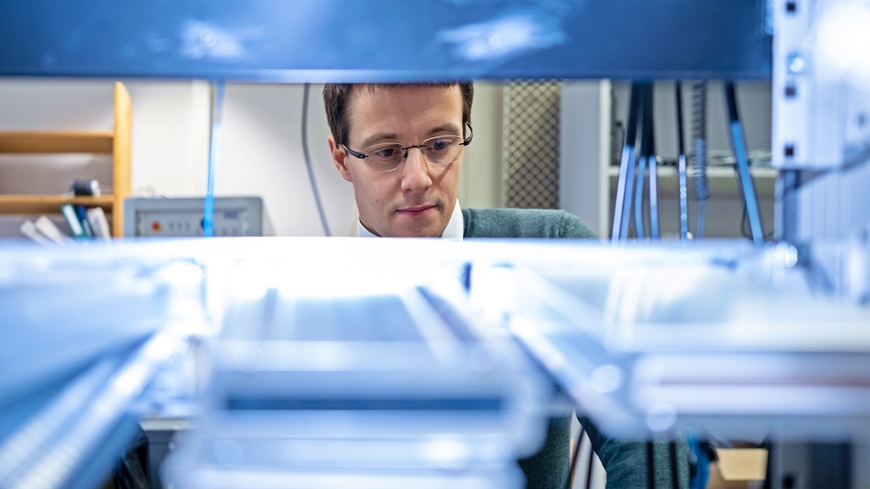
Mickael L. Perrin in his lab at Empa. Here he will set on to create a quantum heat engine that operates at room temperature using graphene nanoribbons. Image: Empa

Machines and electronic devices often generate waste heat that is difficult to utilize. If electricity could be generated from this waste heat, it would offer a means for a clean and sustainable power production: Such a technology would be ideally suited for low-power electronics applications such as wearables or low-cost Internet-of-Things devices. This includes, for example, wearable (medical) devices and sensors, with a wide range of applications in the healthcare and sports industry, in smart buildings and mobility applications.

Thermoelectric generators, machines that generate electricity by exploiting temperature di...

Read More
How Quantum Dots can ‘Talk’ to Each Other

Atomistic Simulations of Laser-Controlled Exciton Transfer and Stabilization in Symmetric Double Quantum Dots
Pascal Krause*
, Jean Christophe Tremblay
, and Annika Bande

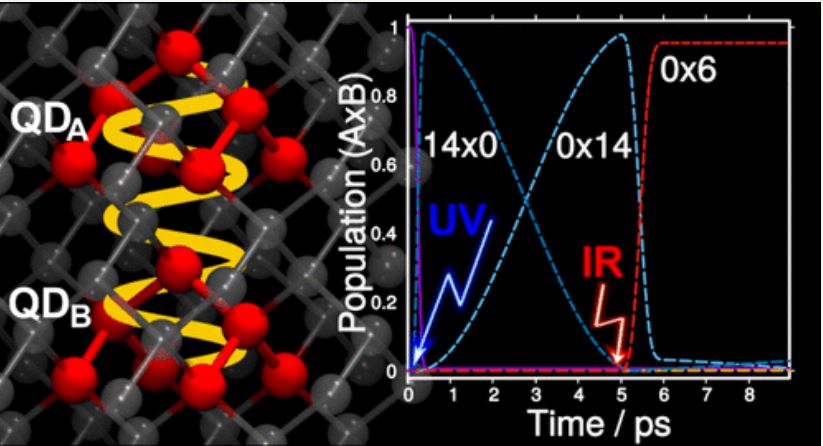
A group has worked out theoretically how the communication between two quantum dots can be influenced with light. The team shows ways to control the transfer of information or energy from one quantum dot to another. To this end, the researchers calculated the electronic structure of two nanocrystals, which act as quantum dots. With the results, the movement of electrons in quantum dots can be simulated in real time.

So-called quantum dots are a new class of materials with many applications. Quantum dots are realized by tiny semiconductor crystals with dimensions in the nanometre range...

Read More

Cheap, Nontoxic Carbon Nanodots poised to be Quantum Dots of the Future

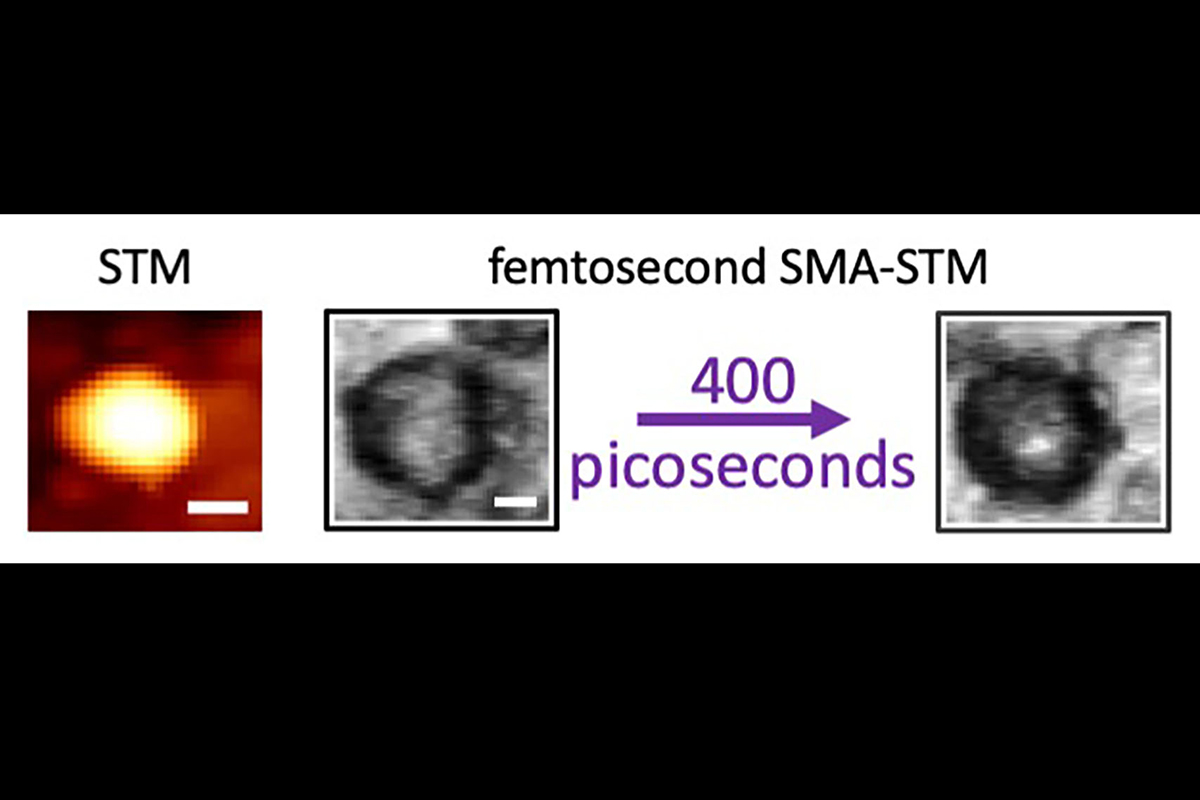
Tiny fluorescent semiconductor dots, called quantum dots, are useful in a variety of health and electronic technologies but are made of toxic, expensive metals. Nontoxic and economic carbon-based dots are easy to produce, but they emit less light. A new study that uses ultrafast nanometric imaging found good and bad emitters among populations of carbon dots. This observation suggests that by selecting only super-emitters, carbon nanodots can be purified to replace toxic metal quantum dots in many applications, the researchers said.

The findings, published in the Proceedings of the National Academy of Sciences, brought together researchers from the University of Illinois Urbana-Champaign and the University of Delaware, Baltimore County in a collaborative project through the Beckman ...

Read More

Goldilocks and the 3 quantum dots: Just right for peak solar panel performance

An image representing the layered structure of a typical solar photovoltaic device

Maximizing the efficiency of renewable energy technology is dependent on creating nanoparticles with ideal dimensions and density, new simulations have shown. Scientists in Australia have developed a process for calculating the perfect size and density of quantum dots needed to achieve record efficiency in solar panels.

Quantum dots, human-made nanocrystals 100,000 times thinner than a sheet of paper, can be used as light sensitisers, absorbing infrared and visible light and transferring it to other molecules.

This could enable new types of solar panels to capture more of the light spectrum and generate more electrical current, through a process of ‘light fusion’ known as photochemical upconversion.

The researchers, from the ARC Centre of Excellence in Exciton Science, used l...

Read More