Quasars tagged posts

Monster black holes are silencing star formation across the universe

Giant black holes may be secretly controlling how entire clusters of galaxies grow. A blazing supermassive black hole can influence far more than its own galaxy. Scientists found that quasars emit radiation strong enough to shut down star formation in nearby galaxies millions of light-years away. This could explain why some galaxies near early quasars appear faint or missing. The finding suggests galaxies grow and evolve together, not in isolation.

Powerful radiation from active supermassive black holes, which are believed to sit at the center of most galaxies, can do more than shape their own surroundings. A new study led by Yongda Zhu at the University of Arizona suggests these black holes can also slow the formation of stars in galaxies located millions of light-years away.

“...

Read More

Quasars don’t last long—so how do they get so massive?

artist-quasar.jpeg
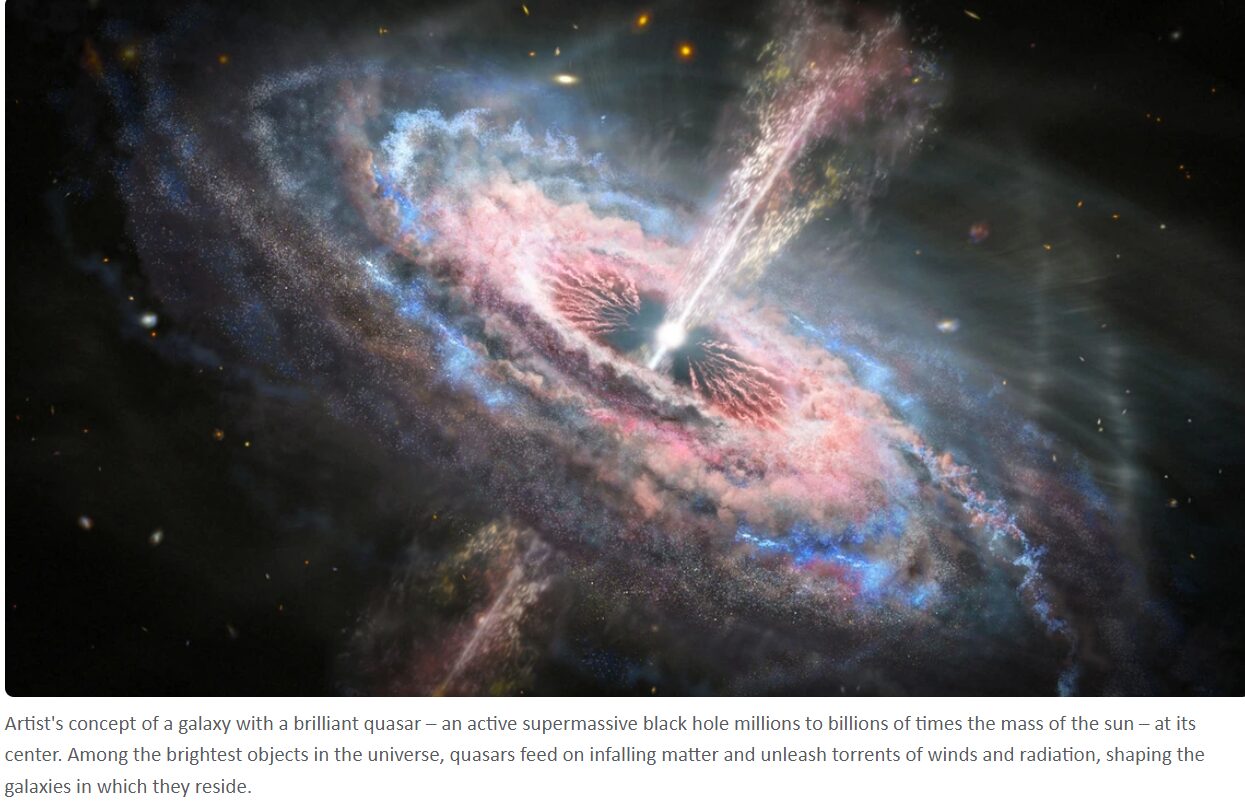
Artist’s illustration of a quasar. (Credit : NASA)

Quasars represent some of the most luminous and energetic phenomena in the universe. These distant powerhouses are driven by supermassive black holes—colossal gravitational engines with masses millions to billions of times that of our sun—which actively devour surrounding matter at incredible rates.

As gas, dust, and stellar material spiral inward through an accretion disk superheated to millions of degrees, this matter releases tremendous energy across the electromagnetic spectrum before crossing the event horizon. The resulting emissions can outshine entire galaxies despite originating from a region no larger than our solar system.

The discovery of billion-solar-mass black holes in distant quasars challenges conventional gr...

Read More

Hubble Sees Aftermath of Galaxy’s Scrape with Milky Way

A whitish, whirlpool-like galaxy at middle of top edge, and a tadpole-shaped structure sweeps from left to right across lower half. A label pointing to outer, left of galaxy reads “Earth.” Faint, purple haze labeled “Milky Way Halo” surrounds galaxy and stretches to graphic’s edges.  The tadpole-shaped object is the Large Magellanic Cloud, or LMC, with its own halo and streaming tail. Semi-circular, progressively darker layers of purple labeled “LMC Halo” surround the LMC, which appears roughly circular, with a central, light-yellow bar. Cloud-like features sprinkled with white specks surround this bar. Trailing the LMC is a large, tail-like  feature labeled “Stream.” At the bottom left corner of graphic are several small, bright points of light labeled “Quasars.” Three light blue lines point from the label “Earth” through the LMC’s halo, and to three corresponding quasars. At the bottom, right corner is the label “Artist’s Concept.”
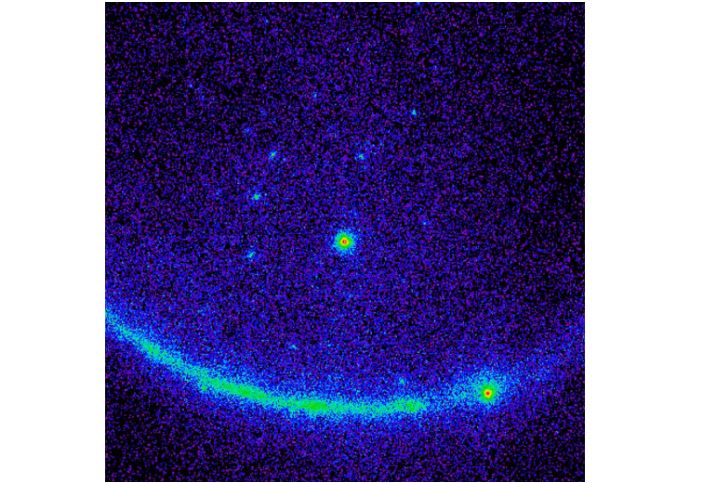
This artist’s concept shows the Large Magellanic Cloud, or LMC, in the foreground as it passes through the gaseous halo of the much more massive Milky Way galaxy. The encounter has blown away most of the spherical halo of gas that surrounds the LMC, as illustrated by the trailing gas stream reminiscent of a comet’s tail. Still, a compact halo remains, and scientists do not expect this residual halo to be lost. The team surveyed the halo by using the background light of 28 quasars, an exceptionally bright type of active galactic nucleus that shines across the universe like a lighthouse beacon. Their light allows scientists to “see” the intervening halo gas indirectly through the absorption of the background light...
Read More

Investigating the Contribution of Gamma-Ray Blazar Flares to Neutrino Flux

Fermi spots a record flare from blazar.
Caption: A new study suggests that high-energy neutrinos of blazars might be produced mainly during the gamma-ray flare phase.
Credit: NASA Goddard Space Flight Center from flickr (https://www.flickr.com/photos/24662369@N07/19578977022)
License type: CC BY 2.0

Gamma-ray flares from blazars can be accompanied by high-energy neutrino emission. To better understand this phenomenon, an international research team has statistically analyzed 145 bright blazars. They constructed weekly binned light curves and utilized a Bayesian algorithm, finding that their sample was dominated by blazars with low flare duty cycles and energy fractions. The study suggests that high-energy neutrinos of blazars might be produced mainly during the flare phase.

Blazars ...

Read More