
Saturn tagged posts

Webb and Hubble share the most comprehensive view of Saturn to date

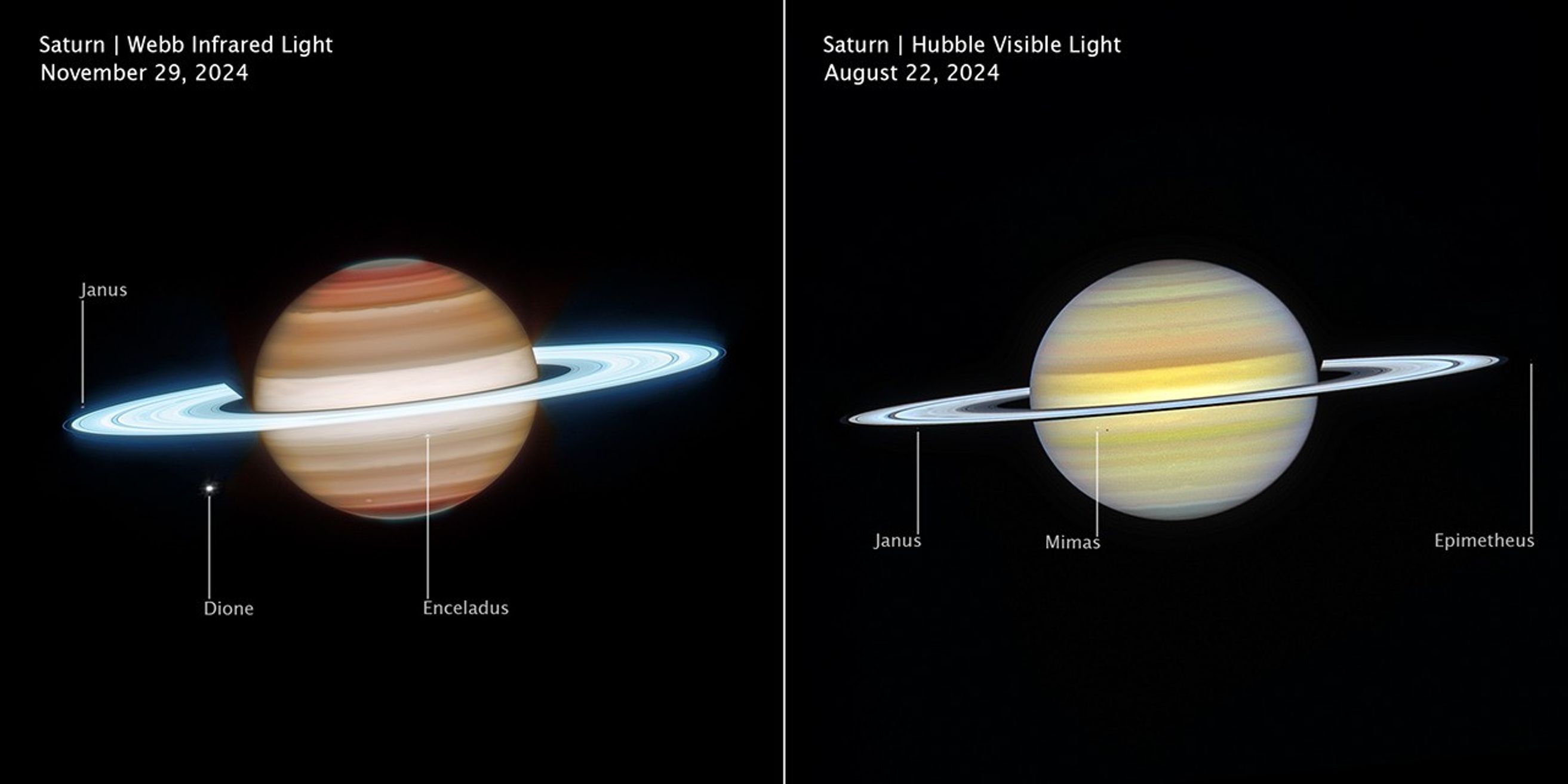
Side-by-side comparison of Saturn observed at different wavelengths and times show how differently it appears in infrared, on the left, versus visible light, on the right. Left image is labeled Saturn, Webb Infrared Light, November 29, 2024. Right image is labeled Saturn, Hubble Visible Light, August 22, 2024.
In infrared, Saturn has horizontal bands, with bands at the north and south poles appearing darker orange and lightening to tan as they approach the equator. The north and south poles glow a greenish-grey. The rings appear in an icy neon white. White dots, representing several of Saturn’s moons, are labeled Janus, Dione, and Enceladus.
In visible, Saturn’s horizontal bands appear pale yellow, with some bands towards the north and south pole having a light blue hue. The rings appear bright white, glowing slightly less than Webb’s infrared image. White dots, representing several of Saturn’s moons, are labeled Janus, Mimas, and Epimetheus.
Complementary views of Saturn from NASA’s James Webb Space Telescope and Hubble Space Telescope show a dynamic planet with atmospheric features, orbiting moons, and bright rings.
Image: NASA, ESA, CSA, STScI, Amy Simon (NASA-GSFC), Michael Wong (UC Berkeley); Image Processing: Joseph DePasquale (STScI)

NASA’s James Webb Space Telescope and Hubble Space Telescope have teamed up to capture new views of Saturn, revealing the planet in strikingly different ways. Observing in complementary wavelengths of light, the two space observatories provide scientists with a richer, more layered understanding of the gas giant’s atmosphere.

Both sense sunlight reflected from Saturn’s banded clouds and hazes, but where Hubble reveals subtle color variations across the planet, Webb’s infrared view se...

Read More
Polar weather on Jupiter and Saturn hints at the planets’ interior details

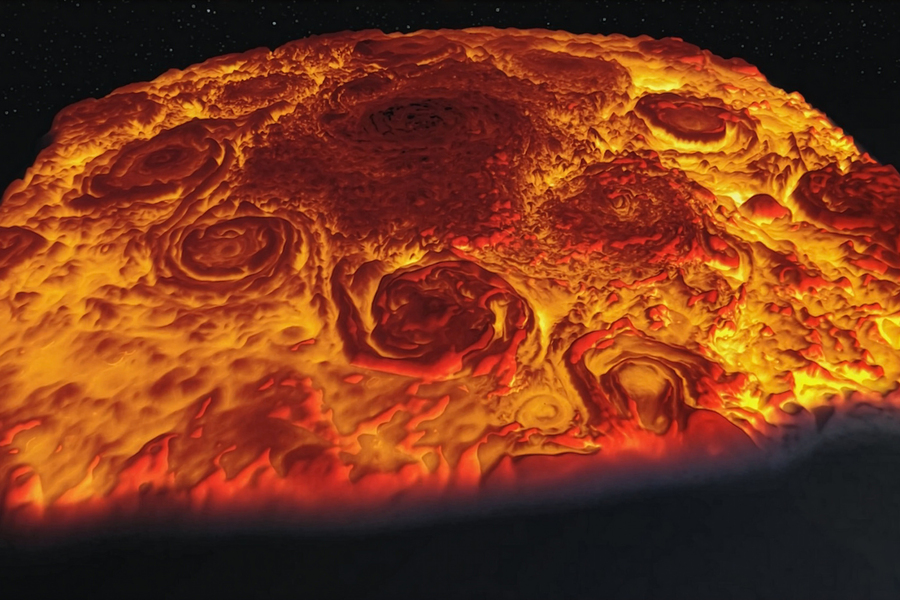
Jupiter’s North Pole showing multiple vortexes
Caption:This infrared 3D image of Jupiter’s north pole shows a ring of 8 vortices surrounding a central cyclone. MIT researchers have now identified a mechanism that determines whether a gas giant evolves one versus multiple polar vortices.
Credits:Credit: NASA/JPL-Caltech/SwRI/ASI/INAF/JIRAM

Over the years, passing spacecraft have observed mystifying weather patterns at the poles of Jupiter and Saturn. The two planets host very different types of polar vortices, which are huge atmospheric whirlpools that rotate over a planet’s polar region. On Saturn, a single massive polar vortex appears to cap the north pole in a curiously hexagonal shape, while on Jupiter, a central polar vortex is surrounded by eight smaller vortices, like a pan of swirling cinnamon rolls.

Given that both planet...

Read More

Alien Ocean could Hide Signs of Life from Spacecraft

Searching for life in alien oceans may be more difficult than scientists previously thought, even when we can sample these extraterrestrial waters directly.

A new study focusing on Enceladus, a moon of Saturn that sprays its ocean water into space through cracks in its icy surface, shows that the physics of alien oceans could prevent evidence of deep-sea life from reaching places where we can detect it.

Published today (Thursday, 6 February 2025) in Communications Earth and Environment, the study shows how Enceladus’s ocean forms distinct layers that dramatically slow the movement of material from the ocean floor to the surface.

Chemical traces, microbes, and organic material — telltale signatures of life that scientists look for — could break down or transform as they travel...

Read More

Centaurs Gain Comet-like Characteristics through Close Encounters with Jupiter, Saturn

Objects that look like asteroids can still become active for numerous reasons. These objects are known as Centaurs and can have spots of activity and generate tails.
Credit: Pamela L Gay/PSI.

A rapid reshaping of orbits resulting from a close encounter with Jupiter or Saturn can lead Centaurs to exhibit comet-like activity, according to a Planetary Science Institute Senior Scientist Eva Lilly paper.

Centaurs are small bodies similar to asteroids in size but to comets in composition that revolve around the sun in the outer solar system, mainly between the orbits of Jupiter and Neptune.

“We have found some answers to the long-standing mystery of why some Centaurs became active like comets while the rest appear like regular quiet asteroids. Nobody knew why they behaved this way...

Read More