
SiC tagged posts

Quantum sensor based on silicon carbide qubits operates at room temperature

A quantum sensor based on silicon carbide qubits that operates at room temperature
Illustration of quantum sensing of Gadolinium-complex (an MRI contrast material) by divacancy-related quantum sensor engineered close to the surface of silicon carbide (SiC) with innovative surface termination (carbon chain). Credit: Pei Li et al.

Over the past decades, physicists and quantum engineers introduced a wide range of systems that perform desired functions leveraging quantum mechanical effects. These include so-called quantum sensors, devices that rely on qubits (i.e., units of quantum information) to detect weak magnetic or electric fields.

Researchers at the HUN-REN Wigner Research Center for Physics, the Beijing Computational Science Research Center, the University of Science and Technology of China and other institutes recently introduced a new quantum sensing platfor...

Read More
Umbrella for Atoms: The First Protective Layer for 2D Quantum materials

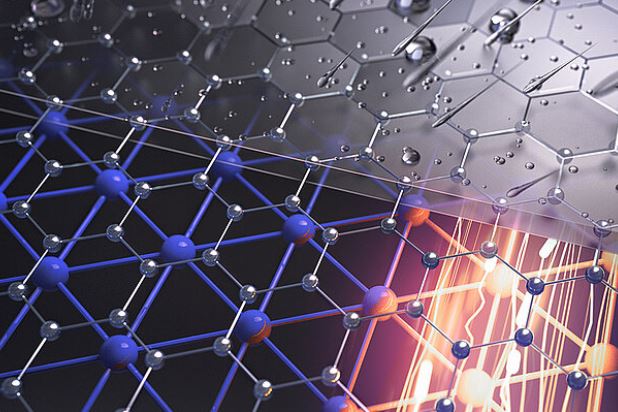
Schematic representation showing how a graphene layer protects against water. The electrical current flowing along the edge of the topological insulator indenene remains completely unaffected by external influences. (Image: Jörg Bandmann, pixelwg)

As silicon-based computer chips approach their physical limitations in the quest for faster and smaller designs, the search for alternative materials that remain functional at atomic scales is one of science’s biggest challenges. In a groundbreaking development, researchers have engineered a protective film that shields quantum semiconductor layers just one atom thick from environmental influences without compromising their revolutionary quantum properties...

Read More

Protons Fix a Long-Standing Issue in Silicon Carbide Electronics

image.jpg
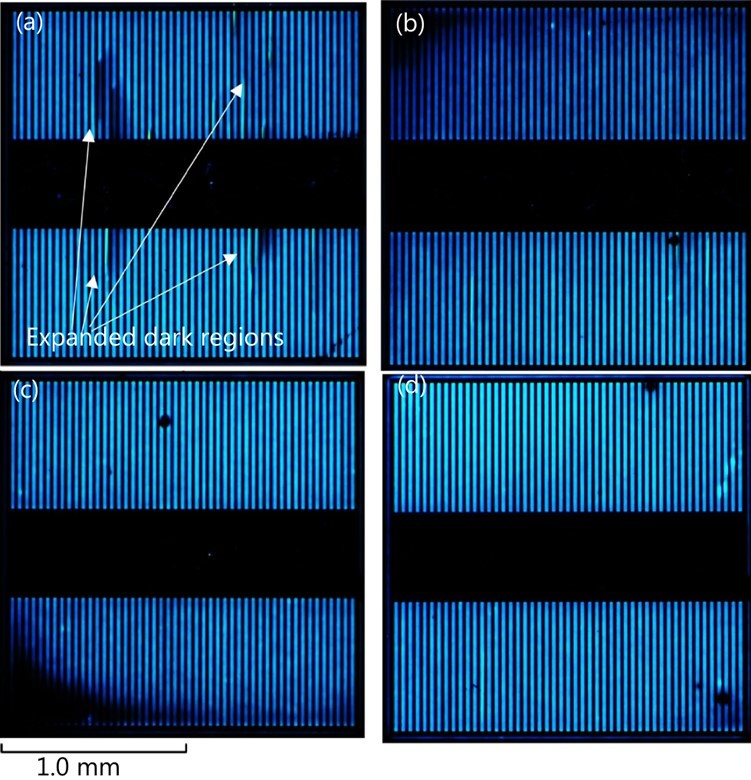
Proton implantation prevents the expansion of stacking faults and solves the problem of bipolar degradation.
Electroluminescence images of PiN diodes made from silicon carbide after being subjected to electrical stress. In the first diode (a), on which proton implantation was not applied, expanded stacking faults show up as dark regions. The other three diodes (b, c, and d) undergo proton implantation at increasing hydrogen ion doses. Contrary to the first diode, these exhibit no stacking fault expansion and, in turn, bipolar degradation.
Image credit: Masashi Kato from Nagoya Institute of Technology

Silicon carbide (SiC) is a promising semiconductor material for power electronic devices, but it suffers from bipolar degradation, which severely limits its lifespan...

Read More