soft robots tagged posts

Mechanically activated liquid metal powder lets users draw circuits on paper

Mechanochemically activated liquid metal powders for sustainable, reconfigurable electronics
Advanced Functional Materials (2025). DOI: 10.1002/adfm.202527396

What if electronic circuits could be created simply by drawing lines with a pencil on paper or leaves—and then immediately applied to soft robots or skin-attached health monitoring devices? Korean researchers have developed an electronic materials technology that forms electrically conductive liquid metal in a fine powder form, allowing circuits to be drawn directly on a wide variety of surfaces.

This technology presents new possibilities for next-generation flexible electronics, including applications on paper and plastic as well as in soft robotic systems and wearable devices. The research was published in Advanced Functional Materials.

A research team led by Distinguished Professor Inkyu Park from the Departm...

Read More

Magnetic fields power smarter soft robots with built-in intelligence

Magnetic fields power smarter soft robots with built-in intelligence

Soft robots are prized for their agility and gentle touch, which makes them ideal for traversing delicate or enclosed spaces to perform various tasks, from cultivating baby corals in laboratories to inspecting industrial pipes in chemical plants. However, achieving embodied intelligence in such systems, where sensing, movement and power supply work together in an untethered configuration, remains a challenge.

Flexible materials can deform and adapt, but their power sources are unable to do so. Conventional batteries often stiffen the robot’s body, drain quickly, or degrade under strain, all of which leave soft robots tethered or with a short lifespan.

Assistant Professor Wu Changsheng and his team from the Department of Materials Science and Engineering and the Department of Ele...

Read More

Engineers develop hybrid robot that balances strength and flexibility—and can screw in a lightbulb

Northeastern engineers develop hybrid robot that balances strength and flexibility — and can screw in a lightbulb
Jeffrey Lipton, assistant professor of mechanical and industrial engineering at Northeastern, has developed a hybrid soft and hard robot. Credit: Matthew Modoono/Northeastern University

How many robots does it take to screw in a lightbulb? The answer is more complicated than you might think. New research from Northeastern University upends the riddle by making a robot that is both flexible and sensitive enough to handle the lightbulb, and strong enough to apply the necessary torque.

“What we found is that by thinking about the bodies of robots and how we can make new materials for them, we can actually make a robot that has the benefits of both rigid and soft robots,” says Jeffrey Lipton, assistant professor of mechanical and industrial engineering at Northeastern.

“It’s flexible...

Read More

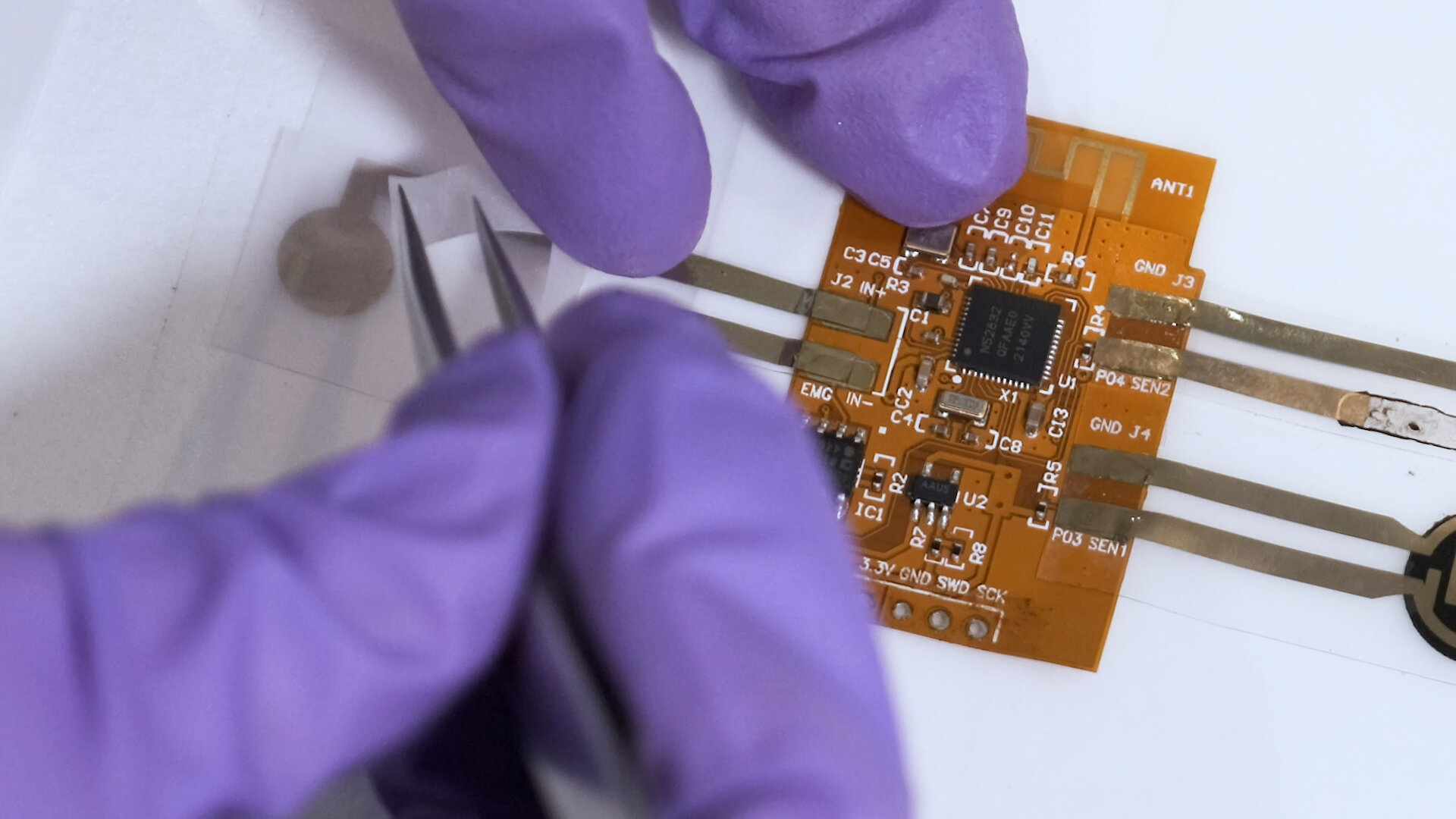
‘Lego-like’ Universal Connector makes Assembling Stretchable Devices a snap

'Lego-like' universal connector developed by NTU Singapore scientists makes assembling stretchable devices a snap
The BIND interface (biphasic, nano-dispersed interface) makes assembly of stretchable devices simple while offering excellent mechanical and electrical performance. Credit: NTU Singapore

An international team led by researchers from Nanyang Technological University, Singapore (NTU Singapore) has developed a universal connector to assemble stretchable devices simply and quickly, in a “Lego-like” manner.

Stretchable devices including soft robots and wearable healthcare devices are assembled using several different modules with different material characteristics—some soft, some rigid, and some encapsulated.

However, the commercial pastes (glue), currently used to connect the modules often either fail to transmit mechanical and electrical signals reliably when deformed or break eas...

Read More