spacecraft tagged posts

Spacecraft design gets a boost with new origami flower-like patterns

Spacecraft design gets a boost with new origami flower-like patterns
Examples of bloom patterns in different folded states. Credit: Proceedings of the Royal Society A: Mathematical, Physical and Engineering Sciences (2025). DOI: 10.1098/rspa.2025.0299

The ancient Japanese art of paper-folding, or origami, is already inspiring the design of the next generation of space vehicles, but now there’s a new family of origami shapes that could make them even more compact and reliable.

Larry Howell at Brigham Young University and his colleagues have developed a new class of origami structures called bloom patterns that fold up flat and unfold like flower petals. These clever folding designs could also be used for other structures in space, such as telescopes and solar arrays.

Origami-based designs are perfect for spacecraft because they can be made to fol...

Read More
Spacecraft can ‘brake’ in space using drag − advancing craft agility, space safety and planetary missions

When you put your hand out the window of a moving car, you feel a force pushing against you called drag. This force opposes a moving vehicle, and it’s part of the reason why your car naturally slows to a stop if you take your foot off the gas pedal. But drag doesn’t just slow down cars.

Aerospace engineers are working on using the drag force in space to develop more fuel-efficient spacecraft and missions, deorbit spacecraft without creating as much space junk, and even place probes in orbit around other planets.

Space is not a complete vacuum − at least not all of it. Earth’s atmosphere gets thinner with altitude, but it has enough air to impart a force of drag on orbiting spacecraft, even up to about 620 miles (1,000 kilometers).

As an aerospace engineering professor, I st...

Read More

Uranus’s Swaying Moons will help Spacecraft Seek Out Hidden Oceans

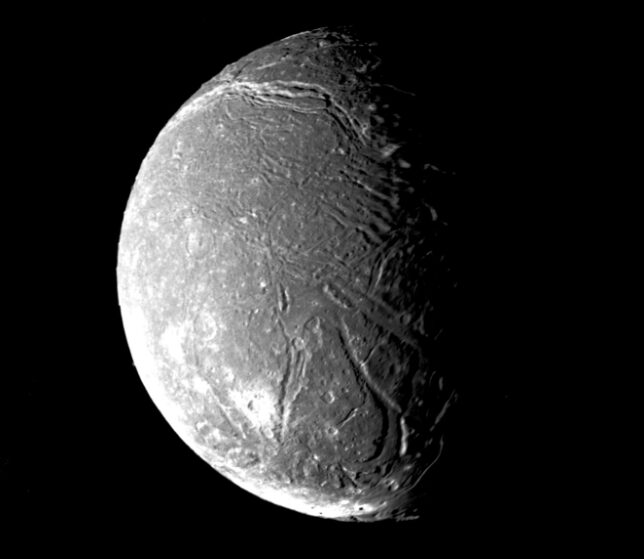
Ariel, Uranus’s fourth largest moon, is thought to be made of equal parts rock and ice. A new computer model developed at the University of Texas Institute for Geophysics could be used to detect liquid water oceans beneath Ariel’s icy surface. Credit: NASA

A new computer model can be used to detect and measure interior oceans on the ice covered moons of Uranus. The model works by analyzing orbital wobbles that would be visible from a passing spacecraft. The research gives engineers and scientists a slide-rule to help them design NASA’s upcoming Uranus Orbiter and Probe mission.

When NASA’s Voyager 2 flew by Uranus in 1986, it captured grainy photographs of large ice-covered moons...

Read More

Slingshotting Around the Sun would make a Spacecraft the Fastest Ever

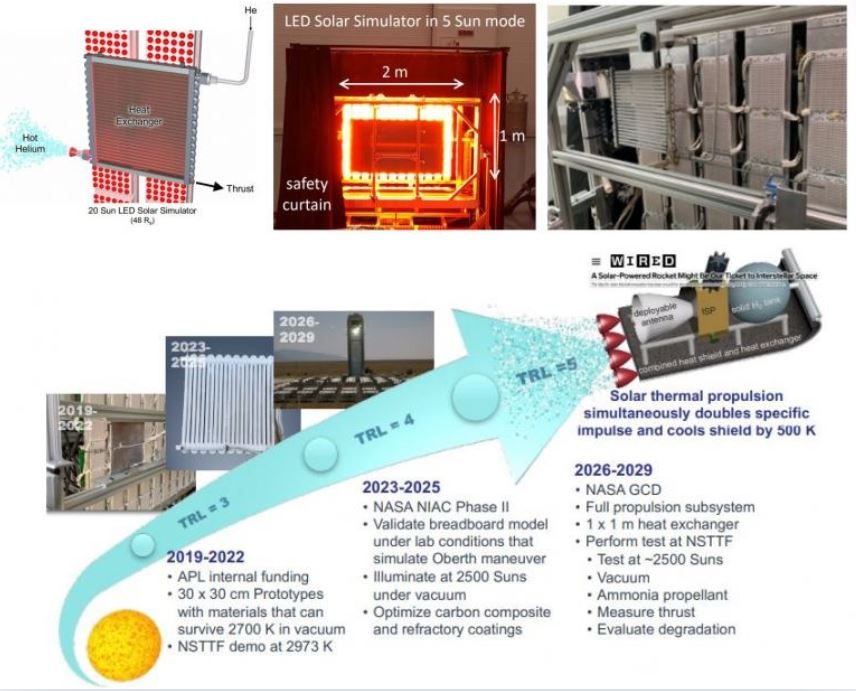
Top: Image of the test set-up for the thermal shield.
Credit – Benkoski et al.
Bottom: Graphic depicting the development path for the solar thermal propulsion system.
Credit – Benkoski et al.

NASA is very interested in developing a propulsion method to allow spacecraft to go faster. We’ve reported several times on different ideas to support that goal, and most of the more successful have utilized the sun’s gravity well, typically by slingshotting around it, as is commonly done with Jupiter currently.

But, there are still significant hurdles when doing so, not the least of which is the energy radiating from the sun simply vaporizing anything that gets close enough to utilize a gravity assist...

Read More