
supercapacitors tagged posts

Supercapacitors Turbocharged by Laxatives

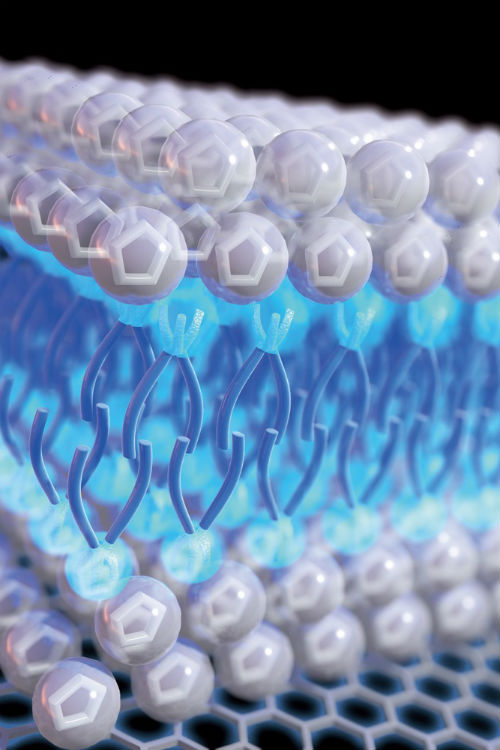
Illustration of detergent-like ionic liquids on an electrode surfaceXianwen Mao/Massachusetts Institute of Technology

An international team of scientists, including a professor of chemistry from the University of Bristol, has worked out a way to improve energy storage devices called supercapacitors, by designing a new class of detergents chemically related to laxatives. Their paper, published in the journal Nature Materials, explains why these detergents, called ionic liquids, are better electrolytes than current materials and can improve supercapacitors.

Currently, aqueous and organic electrolytes are used, but more recently, researchers and manufacturers have been testing ionic liquids instead to boost performance...

Read More

Rapid Cellphone Charging getting closer to reality

Decorating Graphene Oxide with Ionic Liquid Nanodroplets: An Approach Leading to Energy-Dense, High-Voltage Supercapacitors

Decorating Graphene Oxide with Ionic Liquid Nanodroplets: An Approach Leading to Energy-Dense, High-Voltage Supercapacitors

The ability to charge cellphones in seconds is one step closer after researchers at the University of Waterloo used nanotechnology to significantly improve supercapacitors. Their novel design roughly doubles the amount of electrical energy the rapid-charging devices can hold, helping pave the way for eventual use in everything from smartphones and laptop computers, to electric vehicles and high-powered lasers.

“We’re showing record numbers for the energy-storage capacity of supercapacitors,” said Michael Pope, a professor of chemical engineering who led the Waterloo research. “And the more energy-dense we can make them, the more batteries we can start displacing...

Read More

No Batteries Required: Energy-harvesting Yarns generate Electricity

Coiled carbon nanotube yarns, created at the University of Texas at Dallas and imaged here with a scanning electron microscope, generate electrical energy when stretched or twisted. Credit: University of Texas at Dallas

Coiled carbon nanotube yarns, created at the University of Texas at Dallas and imaged here with a scanning electron microscope, generate electrical energy when stretched or twisted. Credit: University of Texas at Dallas

An international team led by scientists at The University of Texas at Dallas and Hanyang University in South Korea has developed high-tech yarns that generate electricity when they are stretched or twisted. In a study published in the Aug. 25 issue of the journal Science, researchers describe “twistron” yarns and their possible applications, such as harvesting energy from the motion of ocean waves or from temperature fluctuations. When sewn into a shirt, these yarns served as a self-powered breathing monitor.

“The easiest way to think of twistron harvesters is, you have a p...

Read More

Gas Gives Laser-induced Graphene Super Properties

A custom chamber built by researchers at Rice University allowed them to refine their process for creating laser-induced graphene. Credit: Courtesy of the Tour Group

A custom chamber built by researchers at Rice University allowed them to refine their process for creating laser-induced graphene. Credit: Courtesy of the Tour Group

Rice University scientists who invented laser-induced graphene (LIG) for applications like supercapacitors have now figured out a way to make the spongy graphene either superhydrophobic or superhydrophilic. Until recently, the Rice lab of James Tour made LIG only in open air, using a laser to burn part of the way through a flexible polyimide sheet to get interconnected flakes of graphene. But putting the polymer in a closed environment with various gases changed the product’s properties. Forming LIG in argon or hydrogen makes it superhydrophobic, a property highly valued for separating water from oil or de-icing surfaces...

Read More