supermassive black hole tagged posts

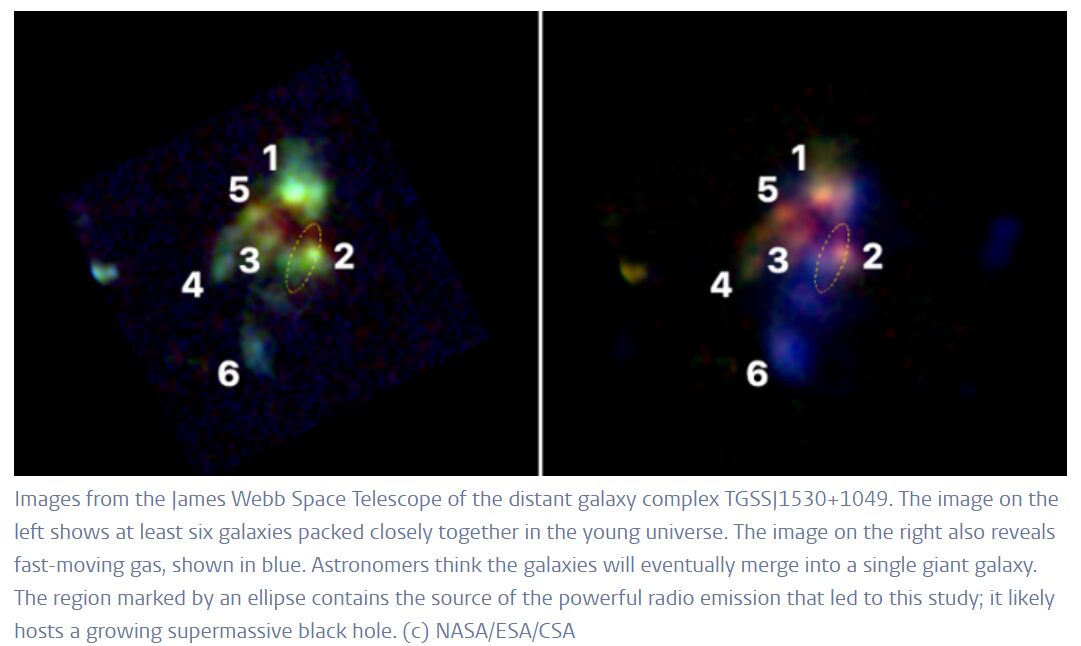
Webb spots the birth of a giant galaxy and a supermassive black hole

Astronomers have used the James Webb Space Telescope to catch an extraordinary glimpse of a massive galaxy taking shape in the early universe. They identified a compact group of at least six galaxies that are likely to merge into a single enormous system. At the heart of this cosmic construction site lies a growing supermassive black hole.

The international study was led by astronomers at Leiden University and the University of Oxford. The findings have been published in The Open Journal of Astrophysics and Astronomy & Astrophysics.

The system observed, TGSSJ1530+1049, lies more than 12 billion light-years away. We are seeing it as it was when the universe was only about 1.5 billion years old...

Read More

Dark matter, not a black hole, could power Milky Way’s heart

'Dark matter, not a black hole, could power Milky Way's heart'
Artistic representation of the Milky Way, where the innermost stars move at near relativistic speeds (defined as velocities that constitute a significant fraction of the speed of light, typically considered to be 10% or more) around a dense core of dark matter, with no black hole at the centre. At greater distances, the halo part of the same invisible dark matter distribution continues to shape the motions of stars in the outskirts of our galaxy, tracing the characteristic rotation curve. Credit: Valentina Crespi et al. License type Attribution (CC BY 4.0)

Our Milky Way galaxy may not have a supermassive black hole at its center but rather an enormous clump of mysterious dark matter exerting the same gravitational influence, astronomers say...

Read More

After nearly 100 years, scientists may have detected dark matter

After nearly 100 years, scientists may have detected dark matter
Gamma-ray intensity map excluding components other than the halo, spanning approximately 100 degrees in the direction of the Galactic center. The horizontal gray bar in the central region corresponds to the Galactic plane area, which was excluded from the analysis to avoid strong astrophysical radiation. Credit: Tomonori Totani, The University of Tokyo

In the early 1930s, Swiss astronomer Fritz Zwicky observed galaxies in space moving faster than their mass should allow, prompting him to infer the presence of some invisible scaffolding—dark matter—holding the galaxies together. Nearly 100 years later, NASA’s Fermi Gamma-ray Space Telescope may have provided direct evidence of dark mattner, allowing the invisible matter to be “seen” for the very first time.

The elusive nature of ...

Read More

Black hole blast outshines 10 trillion Suns

A distant supermassive black hole has set a new cosmic record, unleashing the brightest flare ever seen as it devoured a gigantic star that wandered too close. A colossal black hole 10 billion light-years away has been caught devouring one of the universe’s biggest stars, unleashing a flare 30 times brighter than any seen before. The flare, detected by Caltech’s ZTF, likely marks a tidal disruption event — when a star is shredded by a black hole’s gravity.

The Universe’s most massive stars typically end their lives in spectacular explosions known as supernovae before collapsing into black holes. But one enormous star seems to have met a very different fate...

Read More