supermassive black hole tagged posts

Rare Sighting of Luminous Jet Spewed by Supermassive Black Hole

Image credit: Zwicky Transient Facility/R.Hurt (Caltech/IPAC).

What happens when a dying star flies too close to a supermassive black hole? Astronomers discover a bright optical flare caused by a dying star’s encounter with a supermassive black hole.

According to University of Maryland astronomer Igor Andreoni, several things happen: first, the star is violently ripped apart by the black hole’s gravitational tidal forces — similar to how the Moon pulls tides on Earth but with greater strength. Then, pieces of the star are captured into a swiftly spinning disk orbiting the black hole. Finally, the black hole consumes what remains of the doomed star in the disk. This is what astronomers call a tidal disruption event (TDE).

But in some extremely rare cases, the supermassive black ho...

Read More

NASA’s IXPE helps Solve Black Hole Jet mystery

This illustration shows NASA’s IXPE spacecraft, at right, observing blazar Markarian 501, at left. A blazar is a black hole surrounded by a disk of gas and dust with a bright jet of high-energy particles pointed toward Earth. The inset illustration shows high-energy particles in the jet (blue). When the particles hit the shock wave, depicted as a white bar, the particles become energized and emit X-rays as they accelerate. Moving away from the shock, they emit lower-energy light: first visible, then infrared, and radio waves. Farther from the shock, the magnetic field lines are more chaotic, causing more turbulence in the particle stream.
Credits: NASA/Pablo Garcia

Some of the brightest objects in the sky are called blazars...

Read More

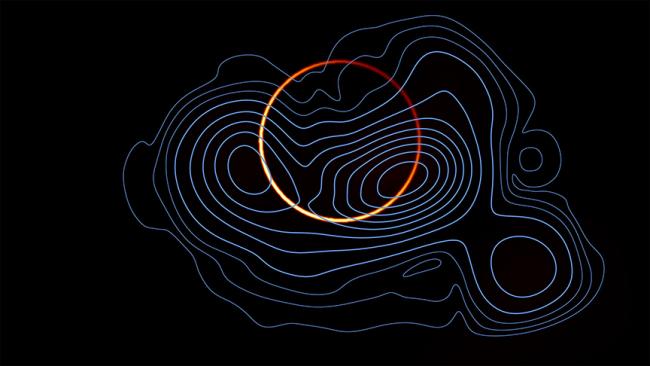
Ready for its close-up: New Technology Sharpens Images of Black Holes

Credit: Broderick et al. 2022, ApJ, 935, 61

Using new computational algorithms, scientists have measured a sharp ring of light predicted to originate from photons whipping around the back of a supermassive black hole.

When scientists unveiled humanity’s historic first image of a black hole in 2019 — depicting a dark core encircled by a fiery aura of material falling toward it — they believed even richer imagery and insights were waiting to be teased out of the data.

Simulations predict that, obscured by that bright orange glow, there should exist a thin, bright ring of light created by photons flung around the back of the black hole by its intense gravity.

Now, a team of researchers has combined theoretical predictions and sophisticated imaging algorithms to “remaster” the ori...

Read More

Astronomers find Hidden Trove of Massive Black Holes

The newly discovered massive black holes reside in dwarf galaxies, where their radiation competes with the light of abundant young stars. (Original image by NASA & ESA/Hubble, artistic conception of black hole with jet by M. Polimera.)

Newfound black holes in dwarf galaxies shed light on the origin of our galaxy’s supermassive black hole. A team led by researchers at the University of North Carolina at Chapel Hill has found a previously overlooked treasure trove of massive black holes in dwarf galaxies. The newly discovered black holes offer a glimpse into the life story of the supermassive black hole at the center of our own Milky Way galaxy.

As a giant spiral galaxy, the Milky Way is believed to have been built up from mergers of many smaller dwarf galaxies...

Read More