
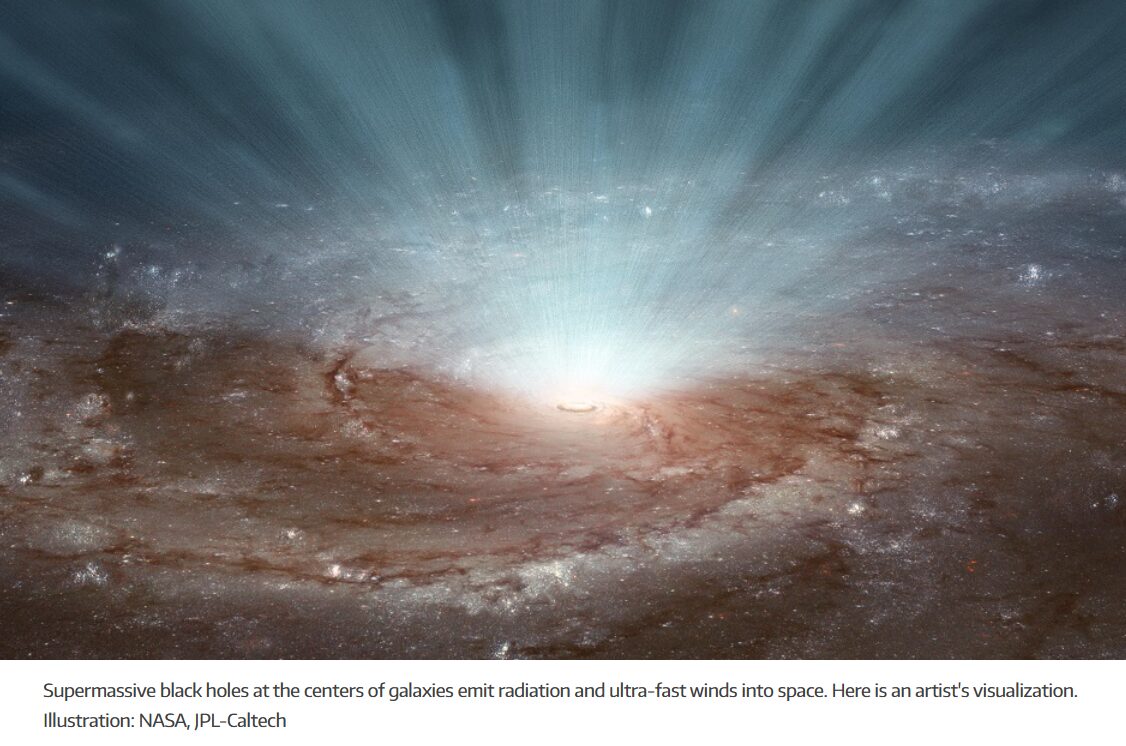
supermassive black holes tagged posts

Black holes might hold the key to a 60-year cosmic mystery

Could black holes help explain high-energy cosmic radiation?

Scientists may have finally uncovered the mystery behind ultra-high-energy cosmic rays — the most powerful particles known in the universe. A team from NTNU suggests that colossal winds from supermassive black holes could be accelerating these particles to unimaginable speeds. These winds, moving at half the speed of light, might not only shape entire galaxies but also fling atomic nuclei across the cosmos with incredible energy.

The universe is full of different types of radiation and particles that can be observed here on Earth. This includes photons across the entire range of the electromagnetic spectrum, from the lowest radio frequencies all the way to the highest-energy gamma rays...

Read More
Quasars don’t last long—so how do they get so massive?

artist-quasar.jpeg
Artist’s illustration of a quasar. (Credit : NASA)

Quasars represent some of the most luminous and energetic phenomena in the universe. These distant powerhouses are driven by supermassive black holes—colossal gravitational engines with masses millions to billions of times that of our sun—which actively devour surrounding matter at incredible rates.

As gas, dust, and stellar material spiral inward through an accretion disk superheated to millions of degrees, this matter releases tremendous energy across the electromagnetic spectrum before crossing the event horizon. The resulting emissions can outshine entire galaxies despite originating from a region no larger than our solar system.

The discovery of billion-solar-mass black holes in distant quasars challenges conventional gr...

Read More

Helical Magnetic Fields: A Universal Mechanism for Jet Collimation?

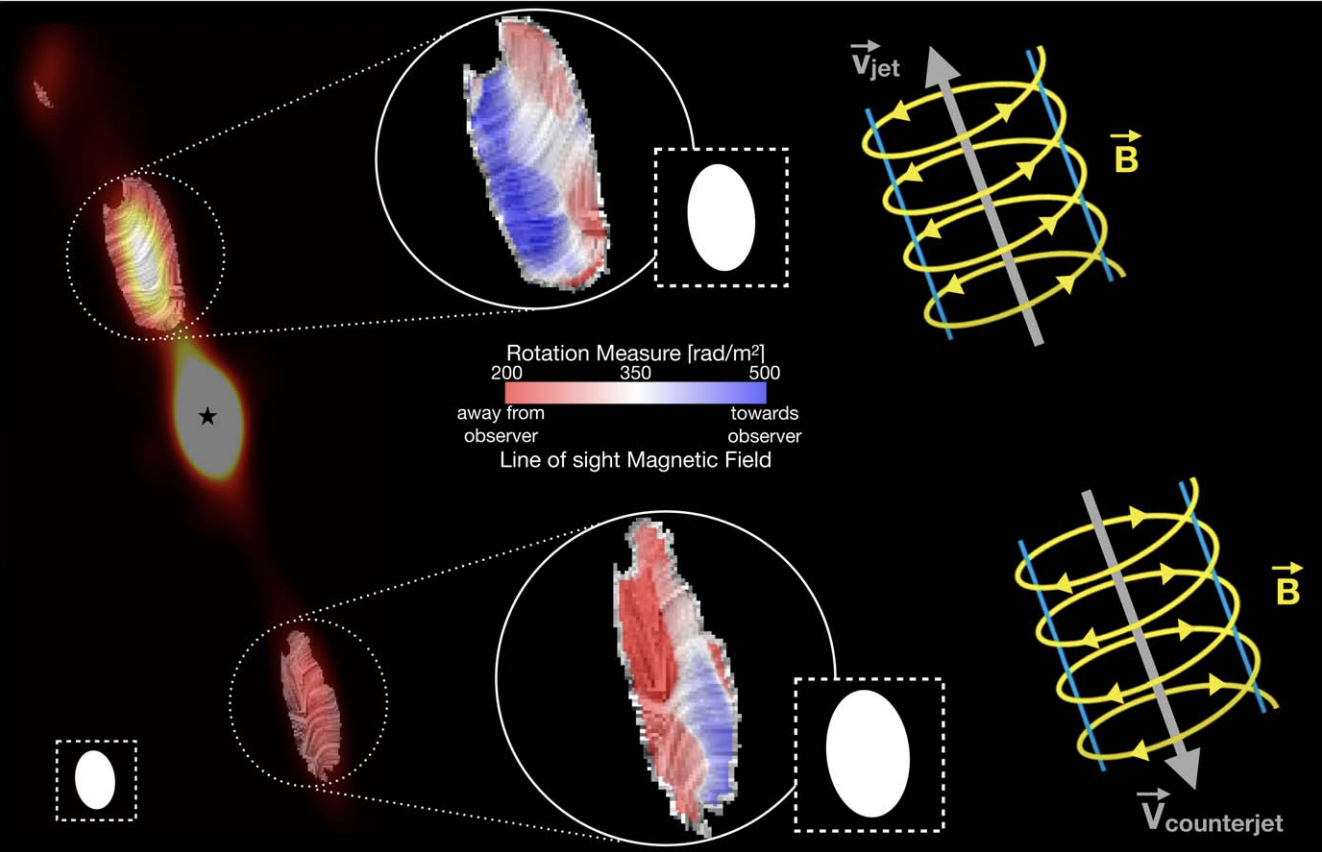
Results of the Rotation Measure analysis in the HH80-81 jet. The left image shows the streamline image of the component of the magnetic field parallel to the plane of the sky. In the middle panel, the color scale of the RM indicates the direction of the magnetic field along the line of sight, i.e., red, away from the observer, and blue, towards the observer. The right panel shows a scheme depicting the 3D configuration of the magnetic field, exhibiting a helical topology.
Credit: Rodríguez-Kamenetzky et al. 2025, The Astrophysical Journal.

New observations from the National Science Foundation National Radio Astronomy Observatory’s (NSF NRAO) Karl G...

Read More

Sleeping Supermassive Black Holes Awakened briefly by Shredded Stars

An illustration of the formation of CSOs.
This illustration shows how Compact Symmetric Objects, or CSOs, likely form. When a single, massive star wanders too close to a black hole (left), it is devoured. This causes the black hole to shoot out an ultrafast, bipolar jet (center). The jet extends outward and its hot ends glow with radio emissions (right).Credit: B. Saxton/NRAO/AUI/NSF

Radio observations of Compact Symmetric Objects (CSOs) provide new window on black holes. Astronomers have concluded that an obscure class of galaxies known as Compact Symmetric Objects, or CSOs, are not young as previously thought but rather lead relatively short lives.

A new investigation into an obscure class of galaxies known as Compact Symmetric Objects, or CSOs, has revealed that these objects are not entirely what they seem...

Read More