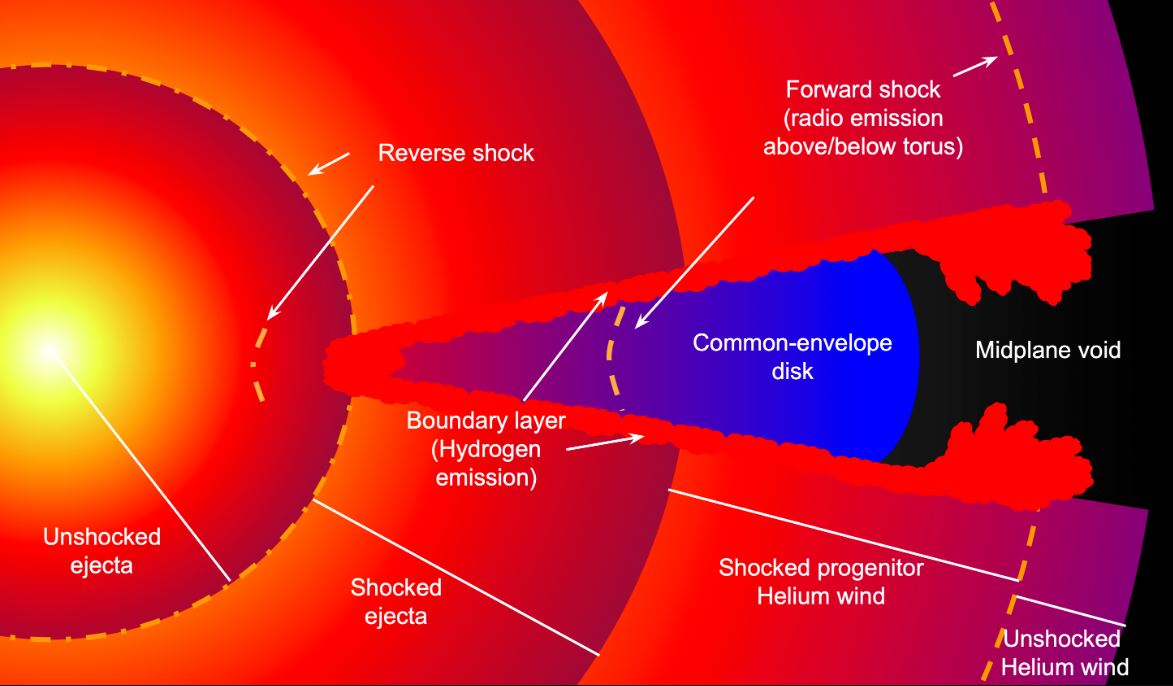
This schematic of Supernova 2014C shows the various ejecta and winds (red and purple) given off by the exploding star (left, yellow). The common-envelope disk (blue) surrounds both stars, the one exploding as a supernova and its binary partner (not shown). The boundary layer around the common-envelope disk is the source of the hydrogen the team detected. (credit: B. Thomas et al./UT Austin)
An international group of astronomers led by Benjamin Thomas of The University of Texas at Austin has used observations from the Hobby-Eberly Telescope (HET) at the university’s McDonald Observatory to unlock a puzzling mystery about a stellar explosion discovered several years ago and evolving even now...
Now you see them, now you don’t. Three views of the same supernova appear in the 2016 image on the left, taken by the Hubble Space Telescope. But they’re gone in the 2019 image. The distant supernova, named Requiem, is embedded in the giant galaxy cluster MACS J0138. The cluster is so massive that its powerful gravity bends and magnifies the light from the supernova, located in a galaxy far behind it. Called gravitational lensing, this phenomenon also splits the supernova’s light into multiple mirror images, highlighted by the white circles in the 2016 image. The multiply imaged supernova disappears in the 2019 image of the same cluster, at right. The snapshot, taken in 2019, helped astronomers confirm the object’s pedigree. Supernovae explode and fade away over time...Read More
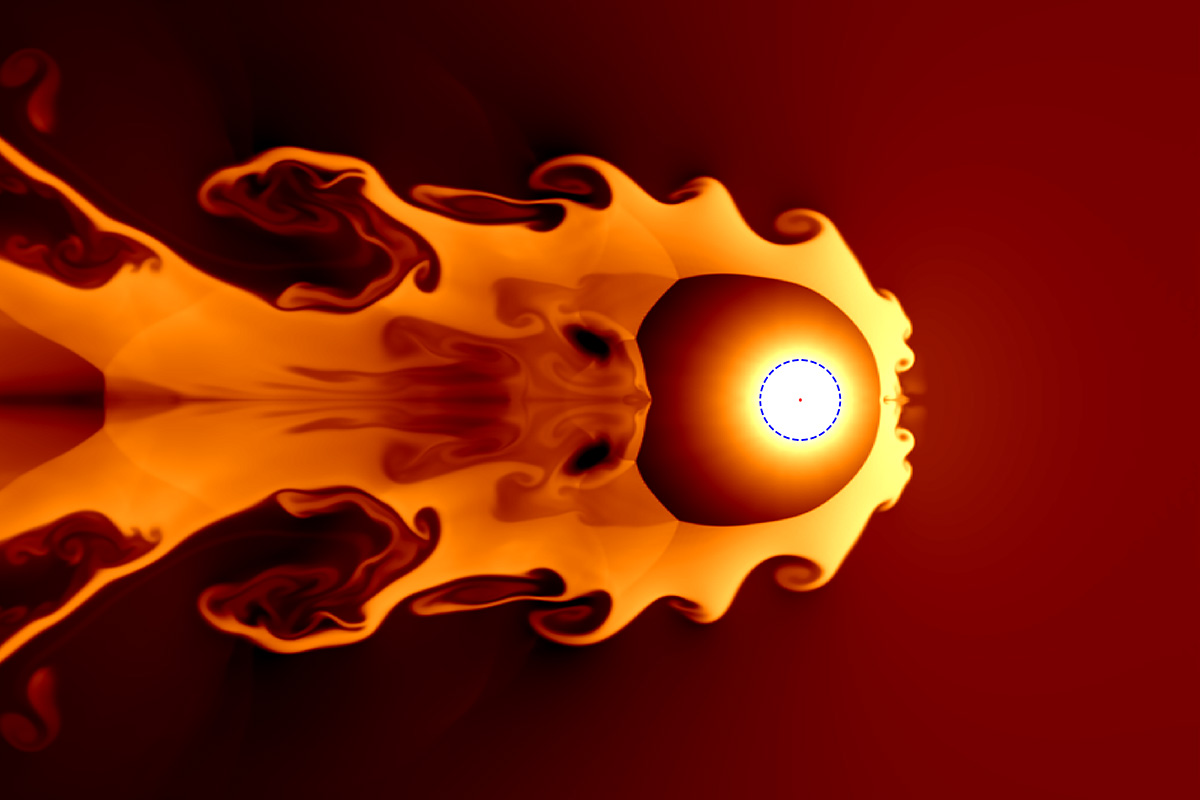
A team of researchers led by professor Brian Fields hypothesizes that a supernova about 65 light-years away may have contributed to the ozone depletion and subsequent mass extinction of the late Devonian Period, 359 million years ago. Pictured is a simulation of a nearby supernova colliding with and compressing the solar wind. Earth’s orbit, the blue dashed circle, and the Sun, red dot, are shown for scale. Graphic courtesy Jesse Miller
Imagine reading by the light of an exploded star, brighter than a full moon – it might be fun to think about, but this scene is the prelude to a disaster when the radiation devastates life as we know it...
V906 Carinae (circled) shines near peak brightness in this image taken on March 23, 2018, three days after the nova was discovered. The beautiful cloud of gas and dust dominating the picture is part of the Carina Nebula. Credits: Copyright 2018 by A. Maury and J. Fabrega, used with permission
Unprecedented observations of a nova outburst in 2018 by a trio of satellites, including two NASA missions, have captured the first direct evidence that most of the explosion’s visible light arose from shock waves — abrupt changes of pressure and temperature formed in the explosion debris.
A nova is a sudden, short-lived brightening of an otherwise inconspicuous star...







Recent Comments