supernova tagged posts

Enduring ‘Radio Rebound’ powered by Jets from Gamma-Ray Burst

Artist impression of the "reverse shock" echoing back though the jets of the gamma-ray burst (GRB 161219B). Credit: NRAO/AUI/NSF, S. Dagnello

Artist impression of the “reverse shock” echoing back though the jets of the gamma-ray burst (GRB 161219B).
Credit: NRAO/AUI/NSF, S. Dagnello

ALMA creates its first-ever movie of cosmic explosion. In the blink of an eye, a massive star more than 2 billion light-years away lost a million-year-long fight against gravity and collapsed, triggering a supernova and forming a black hole at its center. This newborn black hole belched a fleeting yet astonishingly intense flash of gamma rays known as a gamma-ray burst (GRB) toward Earth, where it was detected by NASA’s Neil Gehrels Swift Observatory on 19 December 2016.

While the gamma rays from the burst disappeared from view a scant seven seconds later, longer wavelengths of light from the explosion – including X-ray, visible light, and radio – con...

Read More

Superluminous Supernova marks the Death of a Star at Cosmic High Noon

The yellow arrow marks the superluminous supernova DES15E2mlf in this false-color image of the surrounding field. North is up and east is left. This image was observed with the Dark Energy Camera (DECam) gri-band filters mounted on the Blanco 4-meter telescope on Dec. 28, 2015, around the time when the supernova reached its peak luminosity. Credit: Observers: D. Gerdes and S. Jouvel

The yellow arrow marks the superluminous supernova DES15E2mlf in this false-color image of the surrounding field. North is up and east is left. This image was observed with the Dark Energy Camera (DECam) gri-band filters mounted on the Blanco 4-meter telescope on Dec. 28, 2015, around the time when the supernova reached its peak luminosity. Credit: Observers: D. Gerdes and S. Jouvel

At a distance of 10 billion light years, a supernova detected by the Dark Energy Survey team is one of the most distant ever discovered and confirmed. The death of a massive star in a distant galaxy 10 billion years ago created a rare superluminous supernova that astronomers say is one of the most distant ever discovered...

Read More

How to make ‘your own supernova’

Image credit: Shutterstock

How to make a supernova – Summer Science Exhibition 2017

Researchers are using the largest, most intense lasers on the planet, to for the first time, show the general public how to recreate the effects of supernovae, in a laboratory. One of the most extreme astrophysical events, Supernova explosions are the violent deaths of certain stars that scatter elements heavier than hydrogen and helium into surrounding space. Our own solar system is thought to have formed when a nearby supernova exploded distributing these elements into a cloud of hydrogen that then condensed to form our sun and the planets. In fact, the very atoms that make up our bodies were formed in the remnants of such an explosion.
 
Working in collaboration with Imperial College, London, and AWE Aldermaston the tea...
Read More

Explosive Material: The Making of a Supernova

Instability before the supernova

Pre-supernova stars may show signs of instability for months before the big explosion. Credit: Weizmann Institute of Science

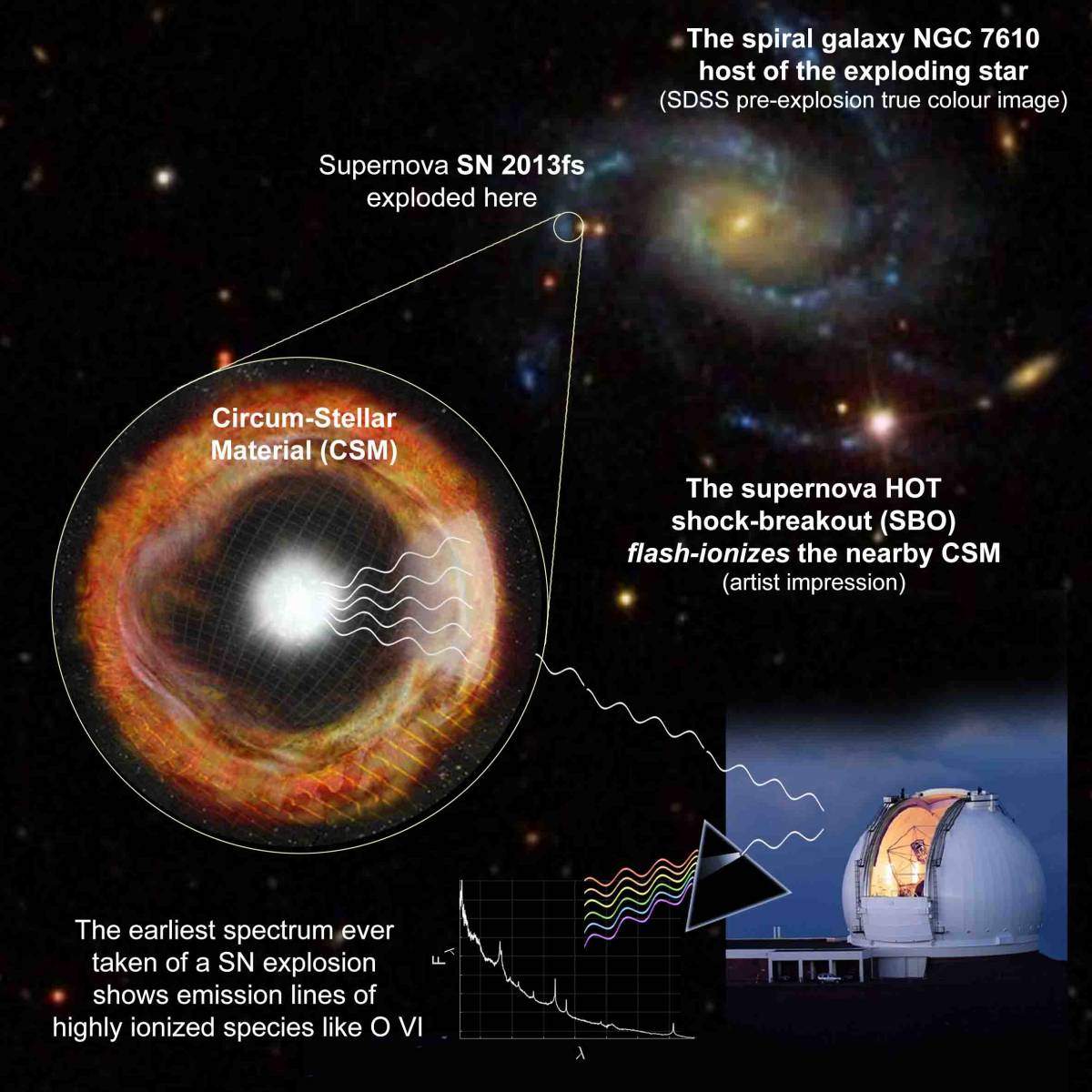
Pre-supernova stars may show signs of instability for months before the big explosion, spewing material into space and creating a dense gas shell around themselves, report scientists in a new report. In the most common type of supernova, the iron core of a massive star suddenly collapses in on itself and the outer layers are thrown out into space in a spectacular explosion. New research led by Weizmann Institute of Science researchers shows that the stars that become core-collapse supernovae might already exhibit instability for several months before the big event, spewing material into space and creating a dense gas shell around themselves...

Read More