supernovae tagged posts

Quasar ‘Clocks’ show the Universe was Five Times Slower Soon after the Big Bang

Scientists have for the first time observed the early universe running in extreme slow motion, unlocking one of the mysteries of Einstein’s expanding universe. The research is published in Nature Astronomy.

Einstein’s general theory of relativity means that we should observe the distant—and hence ancient—universe running much slower than the present day. However, peering back that far in time has proven elusive. Scientists have now cracked that mystery by using quasars as “clocks.”

“Looking back to a time when the universe was just over a billion years old, we see time appearing to flow five times slower,” said lead author of the study, Professor Geraint Lewis from the School of Physics and Sydney Institute for Astronomy at the University of Sydney.

“If you were there, in...

Read More

An Inconstant Hubble Constant? Research suggests fix to cosmological cornerstone

Pictured is the supernova of the type Ia star 1994D, in galaxy NGC 4526. The supernova is the bright spot in the lower left corner of the image. Image credit: ESA/Hubble

More than 90 years ago, astronomer Edwin Hubble observed the first hint of the rate at which the universe expands, called the Hubble constant. Almost immediately, astronomers began arguing about the actual value of this constant, and over time, realized that there was a discrepancy in this number between early universe observations and late universe observations.

Early in the universe’s existence, light moved through plasma – there were no stars yet – and from oscillations similar to sound waves created by this, scientists deduced that the Hubble constant was about 67...

Read More

Alien Radioactive Element Prompts Creation Rethink

This false-colour composite from NASA Spitzer Space Telescope and NASA Chandra X-ray Observatory shows the remnant of N132D. Credit: NASA/JPL-Caltech/Harvard-Smithsonian CfA. 

The first-ever discovery of an extraterrestrial radioactive isotope on Earth has scientists rethinking the origins of the elements on our planet.

The tiny traces of plutonium-244 were found in ocean crust alongside radioactive iron-60. The two isotopes are evidence of violent cosmic events in the vicinity of Earth millions of years ago.

Star explosions, or supernovae create many of the heavy elements in the periodic table, including those vital for human life, such as iron, potassium and iodine.

To form even heavier elements, such as gold, uranium and plutonium it was thought that a more violent event ma...

Read More

Supernova surprise creates Elemental Mystery

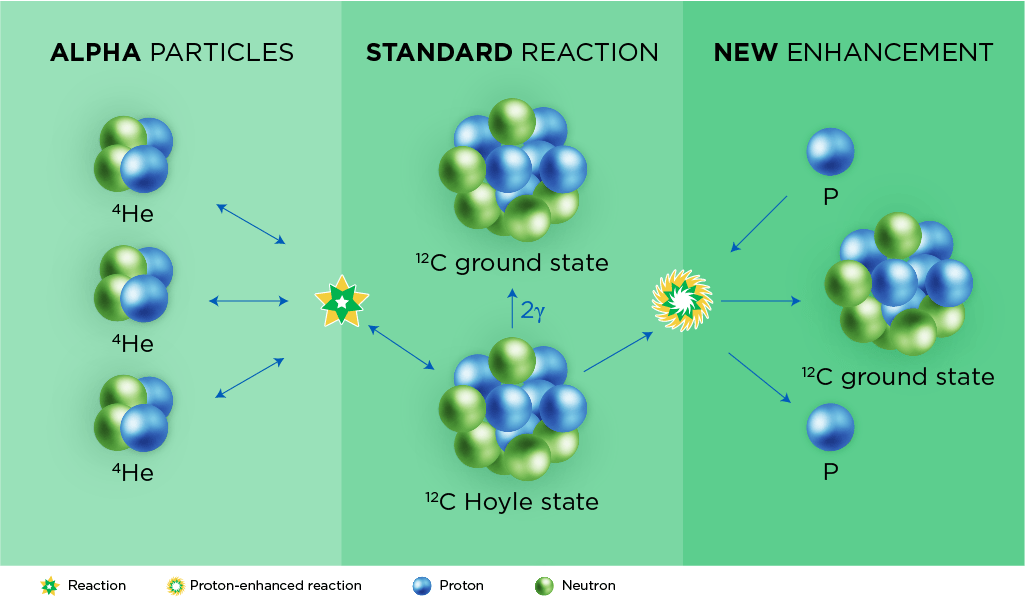
In the triple-alpha process, stars fuse three helium nuclei, also called alpha particles together (left) to create a single carbon atom with a surplus of energy, known as a Hoyle state. That Hoyle state can split back into three alpha particles or relax to the ground state of stable carbon by releasing a couple gamma rays (center). Inside supernovae, however, the creation of stable carbon can be enhanced with the help of extra protons (right). Credit: Facility for Rare Isotope Beams

Michigan State University (MSU) researchers have discovered that one of the most important reactions in the universe can get a huge and unexpected boost inside exploding star – supernovae.

This finding also challenges ideas behind how some of the Earth’s heavy elements are made...

Read More