T cells tagged posts

T cells can Activate Themselves to Fight Tumors

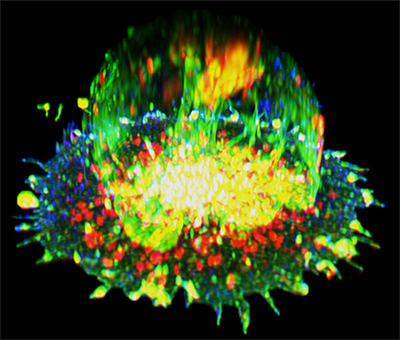
Immunofluorescence imaging captures an auto-signaling T cell
Immunofluorescence imaging captures an auto-signaling T cell. Photo credit: NIAID.

When you need a bit of motivation, it often has to come from within. New research suggests cancer-fighting immune cells have found a way to do just that.

Scientists at University of California San Diego have discovered a property of T cells that could inspire new anti-tumor therapeutics. Through a previously undescribed form of cell auto-signaling, T cells were shown to activate themselves in peripheral tissues, fueling their ability to attack tumors.

The study, published in Immunity, was led by study first author and postdoctoral fellow Yunlong Zhao, Ph.D., and co-senior authors Enfu Hui, Ph.D., professor in the School of Biological Sciences at UC San Diego and Jack D. Bui, MD, Ph.D...

Read More

Multiple Sclerosis Discovery could End Disease’s Chronic Inflammation

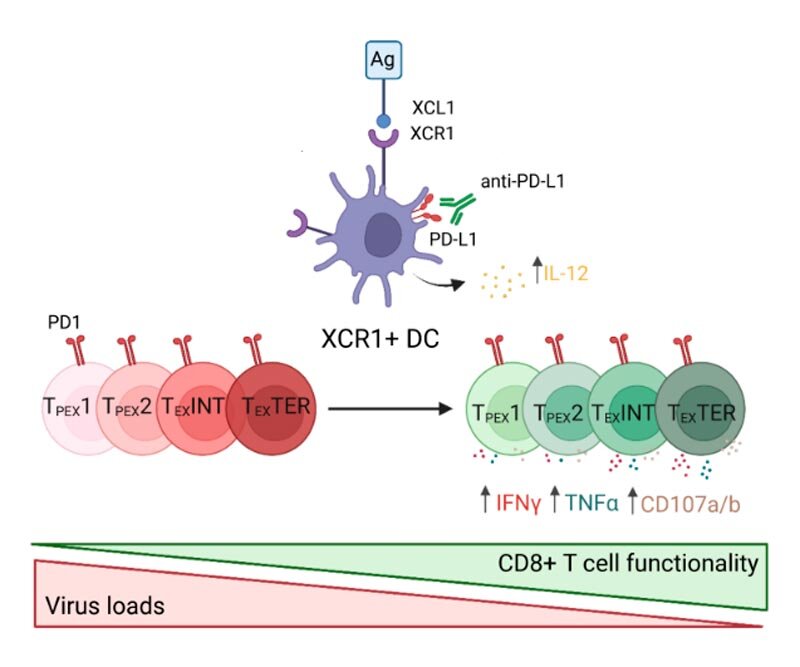
Cell type key to successful immunotherapies for chronic viral infections identified
Diagram of the finding. Credit: Cell Reports (2023). DOI: 10.1016/j.celrep.2023.112123

University of Virginia Health neuroscientists have discovered a potential way to disrupt the chronic inflammation responsible for multiple sclerosis.

UVA’s new study identifies a vital contributor to the hyperactive autoimmune response and neuroinflammation that are the hallmarks of MS. Blocking this lynchpin in a research model of MS alleviated the inflammation, giving researchers a prime target in developing new treatments for multiple sclerosis and other autoimmune diseases.

The research was conducted by Andrea Merchak, a doctoral candidate in neuroscience, and her colleagues in the lab of Alban Gaultier of the University of Virginia School of Medicine’s Department of Neuroscience and its Ce...

Read More

Specific Immune Response to Epstein-Barr Virus discovered

Copyright (c) 2016 Kateryna Kon/Shutterstock

Medical science has not yet been able to explain why the Epstein-Barr virus triggers infectious mononucleosis (IM) in some people with initial infections and not in others. But now, a research team led by Elisabeth Puchhammer-Stöckl, head of the Center for Virology at MedUni Vienna, has identified a specific immune response to the virus as the cause, and as a potential target for the development of vaccines. The findings were recently published in the American Society of Hematology’s journal Blood.

Proliferation of the Epstein-Barr virus (EBV) in humans is normally combated by T cells as part of an antiviral immune response. By means of this important mechanism, certain EBV components (peptides) are presented to the T cells by a specific1LA-E molecules on EBV-infected cells.

A ...

Read More

Nanotechnology used to Destroy and Prevent Relapse of Solid Tumor Cancers

 B7 co-stimulation enhances the anti-PD1-based immunosuppression reversal.

As people across the globe look forward to longer life expectancies, malignant cancers continue to pose threats to human health. The exploration and development of immunotherapy aims to seek new breakthroughs for the treatment of solid tumours.

The successful establishment of anti-tumour immunity requires the activation, expansion and differentiation of antigen-specific lymphocytes. This process largely depends on specific interactions between various T cells and antigen-presenting cells (APCs) in the body. However, existing tumour vaccines, such as neoantigen vaccines and various vector vaccines, all rely on random interactions with APCs in the body...

Read More