
ultra-efficient electronics tagged posts

Room temperature electron behavior defies expectations, hinting at ultra-efficient electronics

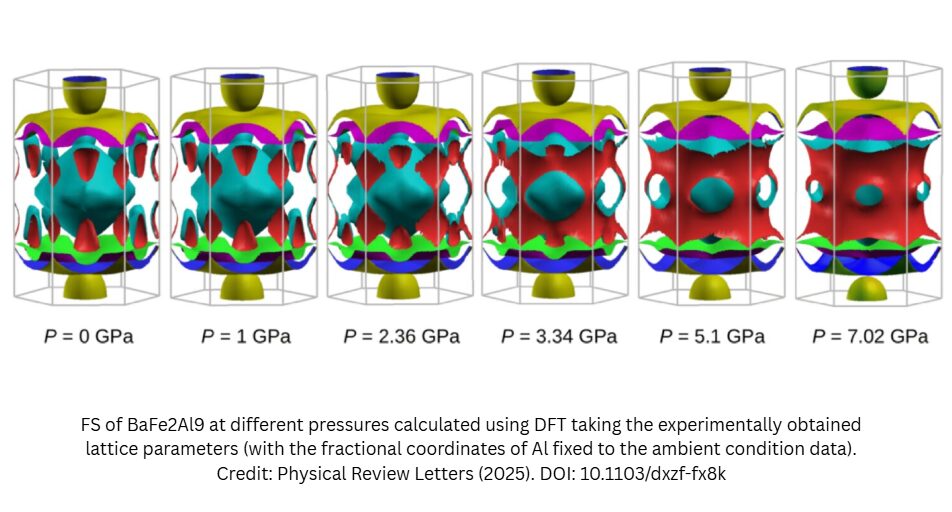
Scientists have discovered a way to efficiently transfer electrical current through specific materials at room temperature, a finding that could revolutionize superconductivity and reshape energy preservation and generation.

The paper is published in the journal Physical Review Letters.

The much-sought-after breakthrough hinges on applying high pressure to certain materials, forcing their electrons closer together and unlocking extraordinary electronic behaviors.

“Our research explores how electrons interact inside solid materials—interactions that give rise to remarkable phenomena such as high-temperature superconductivity and charge-density waves (CDWs),” said Dr. Mahmoud Abdel-Hafiez, associate professor of physics at the University of Sharjah.

“These effects are impo...

Read More

Physicists create Five-Lane Superhighway for Electrons

blue and purple highway

Artist’s rendition of the superhighway for electrons that can occur in rhombohedral graphene, a special kind of graphite (pencil lead).
Credit: Sampson Wilcox, MIT Research Laboratory of Electronics

MIT physicists and colleagues have created a five-lane superhighway for electrons that could allow ultra-efficient electronics and more. The work, reported in the May 9 issue of Science, is one of several important discoveries by the same team over the last year involving a material that is essentially a unique form of pencil lead.

“This discovery has direct implications for low-power electronic devices because no energy is lost during the propagation of electrons, which is not the case in regular materials where the electrons are scattered,” says Long Ju, an assistant professor in the ...

Read More