

Astronomers have discovered a planet that orbits at a 90-degree angle around a rare...
Read More

Astronomers have discovered a planet that orbits at a 90-degree angle around a rare...
Read More
February 20, 2024,
 Uncategorized
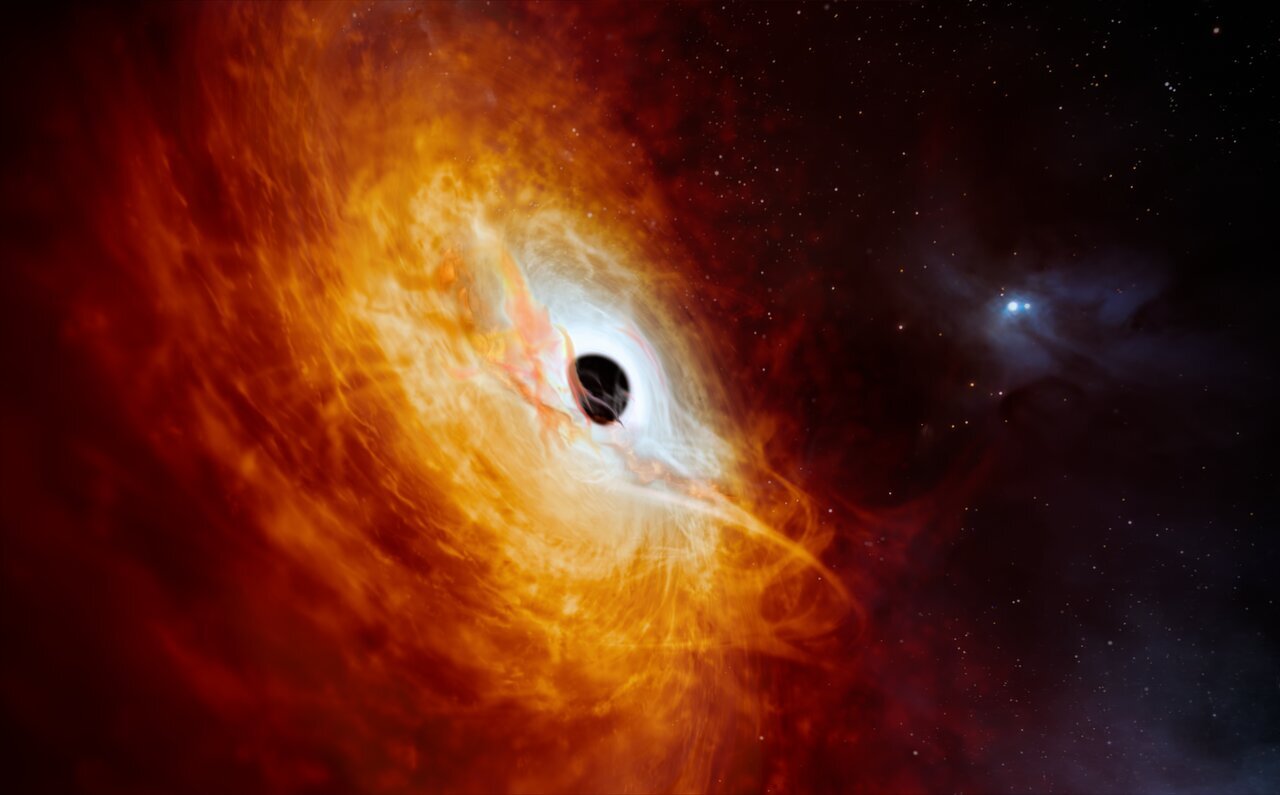
Using the European Southern Observatory’s (ESO) Very Large Telescope (VLT), astronomers have characterized a bright quasar, finding it to be not only the brightest of its kind but also the most luminous object ever observed...
Read More
January 31, 2024,
Astronomy/Space

With the upgraded GRAVITY-instrument at the Very Large Telescope Interferometer of the European Southern Observatory, a team of astronomers led by the Max Planck Institute for Extraterrestrial Physics has determined the mass of a black hole in a galaxy only 2 billion years after the Big Bang...
Read More
August 28, 2023,
Astronomy/Space

Using ESO’s Very Large Telescope (VLT), astronomers have observed a large dark spot in Neptune’s atmosphere, with an unexpected smaller bright spot adjacent to it. This is the first time a dark spot on the planet has ever been observed with a telescope on Earth. These occasional features in the blue background of Neptune’s atmosphere are a mystery to astronomers, and the new results provide further clues as to their nature and origin.
Large spots are common features in the atmospheres of giant planets, the most famous being Jupiter’s Great Red Spot. On Neptune, a dark spot was first discovered by NASA’s Voyager 2 in 1989, before disappearing a few years later...
Read More
Recent Comments