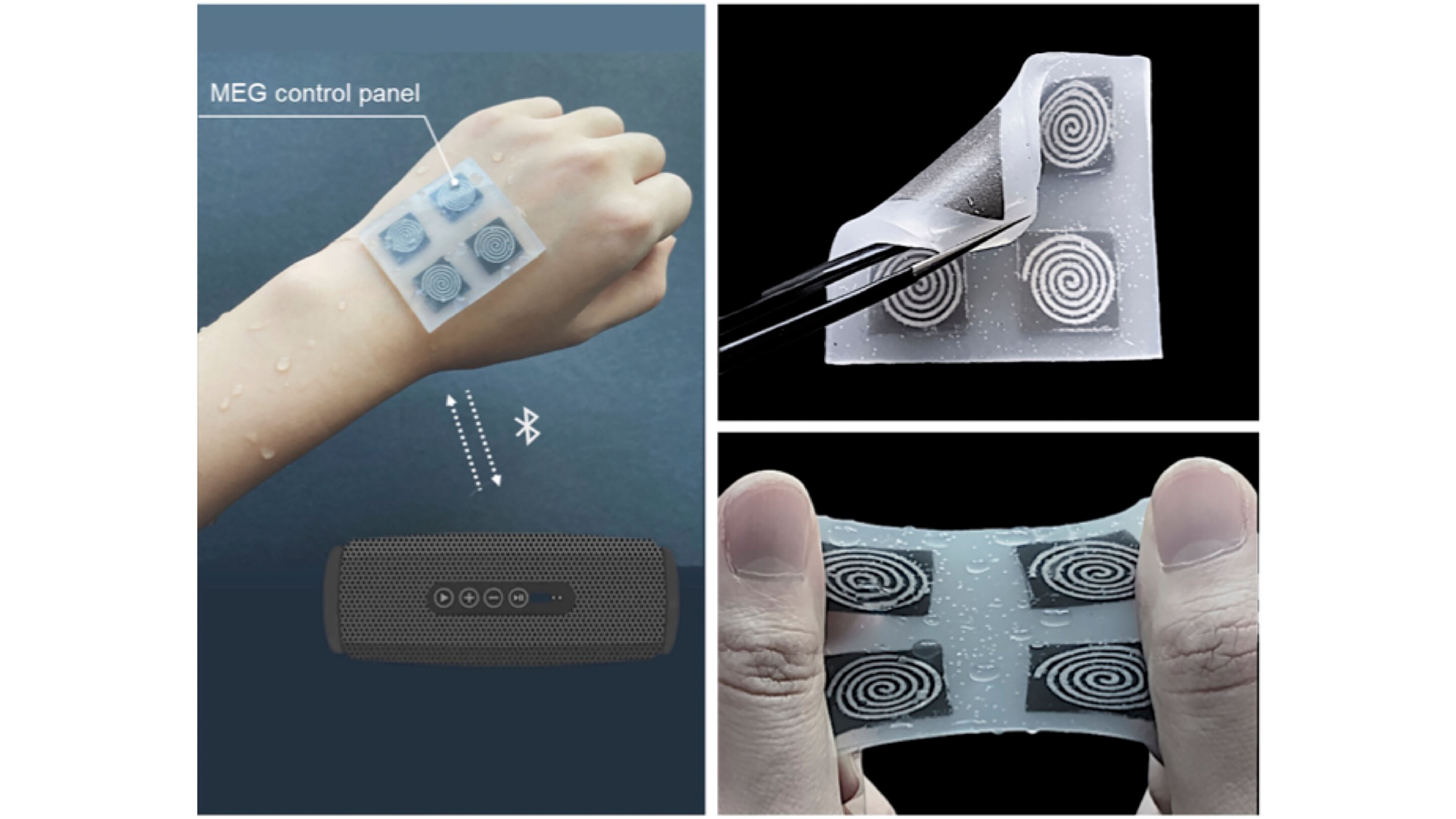
(Left) Photo of the magnetoelastic sensor array, which conforms to human skin and can function even when exposed to liquid. It can interact with a music speaker’s command components: play, pause, next, and previous. (Right two) The self-powered magnetoelastic sensor array is rollable and stretchable. Credit: The Jun Chen Research Group at UCLA: junchenlab.com
Wearable human-machine interface devices, HMIs, can be used to control machines, computers, music players, and other systems. A challenge for conventional HMIs is the presence of sweat on human skin.
In Applied Physics Reviews, scientists at UCLA describe their development of a type of HMI that is stretchable, inexpensive, and waterproof...
A new study found patterns could be identified in patients who wear a special wristwatch monitoring device for six to 12 months, allowing about 30 minutes of warning before a seizure occurred. This worked well most of the time for five of six patients studied.
Despite medications, surgery and neurostimulation devices, many people with epilepsy continue to have seizures. The unpredictable nature of seizures is severely limiting. If seizures could be reliably forecast, people with epilepsy could alter their activities, take a fast-acting medication or turn up their neurostimulator to prevent a seizure or minimize its effects.
A new study in Scientific Reports by Mayo Clinic researchers and international collaborators found patterns could be identified in patients who wear a specia...
Adding a coating of MXene to cotton or linen fabrics gives them the ability to block electromagnetic interference, according to new research out of Drexel’s College of Engineering.
Researchers at Drexel University’s College of Engineering have reported that fabric coated with a conductive, two-dimensional material called MXene, is highly effective at blocking electromagnetic waves and potentially harmful radiation. The discovery is a key development for efforts to weave technological capabilities into clothing and accessories.
Materials that block electromagnetic waves had a commercial moment a handful of years ago when fears that high-tech thieves could scan or copy credit cards, passports or hack into laptops and contactless car keys had people putting them in special wallets, bag...
One day, people could monitor their own health conditions by simply picking up a pencil and drawing a bioelectronic device on their skin. In a new study, University of Missouri engineers demonstrated that the simple combination of pencils and paper could be used to create devices that might be used to monitor personal health.
One day, people could monitor their own health conditions by simply picking up a pencil and drawing a bioelectronic device on their skin. In a new study, University of Missouri engineers demonstrated that the simple combination of pencils and paper could be used to create devices that might be used to monitor personal health.
Their findings are published in the journal Proceedings of the National Academy of Sciences.






Recent Comments