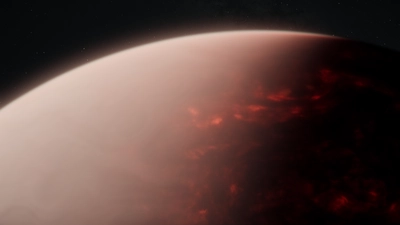
This artist’s concept shows what a thick atmosphere above a vast magma ocean on exoplanet TOI-561 b could look like. Measurements of light captured from the planet’s dayside by NASA’s James Webb Space Telescope suggest that in spite of the intense radiation it receives from its star, TOI-561 b is not a bare rock. Credit: NASA, ESA, CSA, Ralf Crawford (STScI)
A scorching “lava world” once thought barren may actually be wrapped in a thick, mysterious atmosphere. Astronomers have uncovered surprising evidence of a thick atmosphere surrounding TOI-561 b, a scorching, fast-orbiting rocky planet once thought too extreme to hold onto any gas...
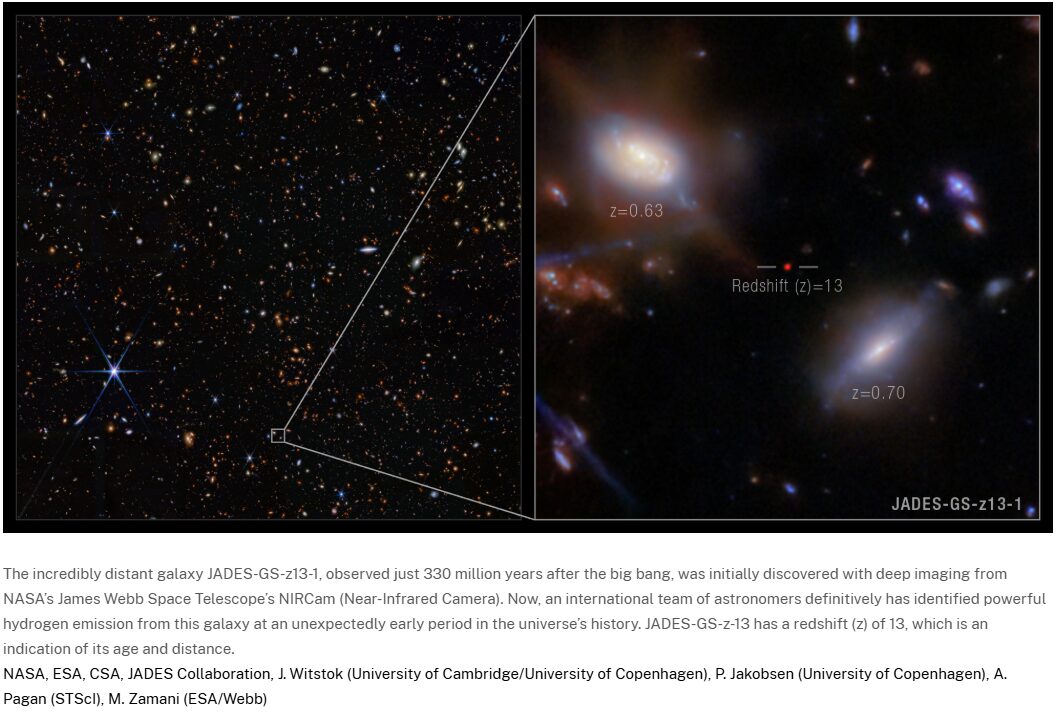
Astronomers have identified a bright hydrogen emission from a galaxy in the very early universe. The surprise finding is challenging researchers to explain how this light could have pierced the thick fog of neutral hydrogen that filled space at that time.
A key goal of the NASA/ESA/CSA James Webb Space Telescope has been to see further than ever before into the distant past of our universe, when the first galaxies were forming after the Big Bang, a period known as cosmic dawn.
Researchers studying one of those very early galaxies have now made a discovery in the spectrum of its light, that challenges our established understanding of the universe’s early history. Their results are reported in the journal Nature.
Webb discovered the incredibly distant galaxy JADES-GS-z13-1, obs...
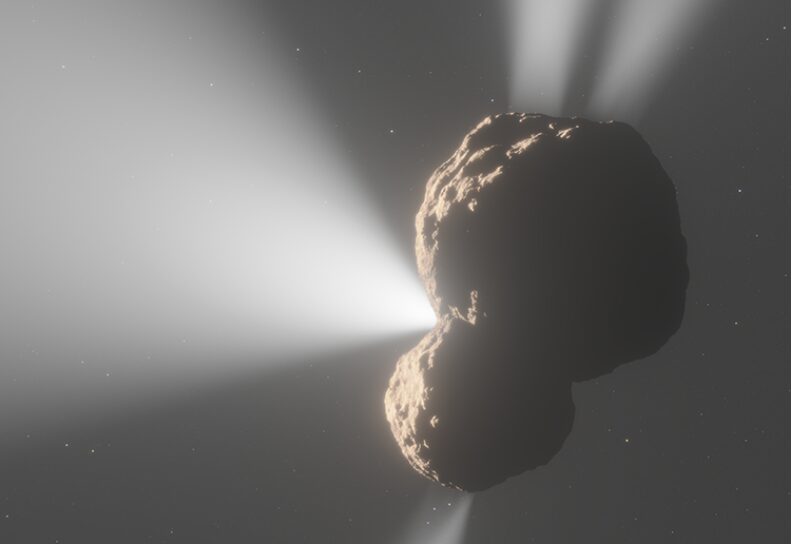
Inspired by the half-human, half-horse creatures that are part of Ancient Greek mythology, the field of astronomy has its own kind of centaurs: distant objects orbiting the sun between Jupiter and Neptune. NASA’s James Webb Space Telescope has mapped the gases spewing from one of these objects, suggesting a varied composition and providing new insights into the formation and evolution of the solar system.
Centaurs are former trans-Neptunian objects that have been moved inside Neptune’s orbit by subtle gravitational influences of the planets in the last few million years, and may eventually become short-period comets...
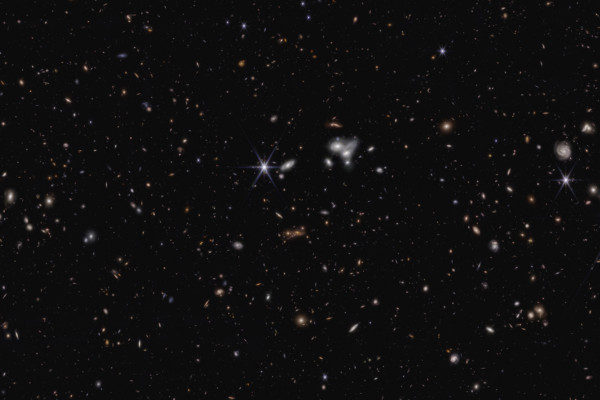
A zoomed-in view of images captured by the James Webb Space Telescope in near-infrared light for the Cosmic Evolution Early Release Science (CEERS) Survey. Image credit: NASA, ESA, CSA, Steve Finkelstein (UT Austin), Micaela Bagley (UT Austin), Rebecca Larson (UT Austin).
Researchers have discovered the most distant active supermassive black hole to date with the James Webb Space Telescope (JWST). The galaxy, CEERS 1019, existed about 570 million years after the big bang, and its black hole is less massive than any other yet identified in the early universe.
In addition to the black hole in CEERS 1019, the researchers identified two more black holes that are on the smaller side and existed 1 billion and 1.1 billion years after the big bang...





Recent Comments