



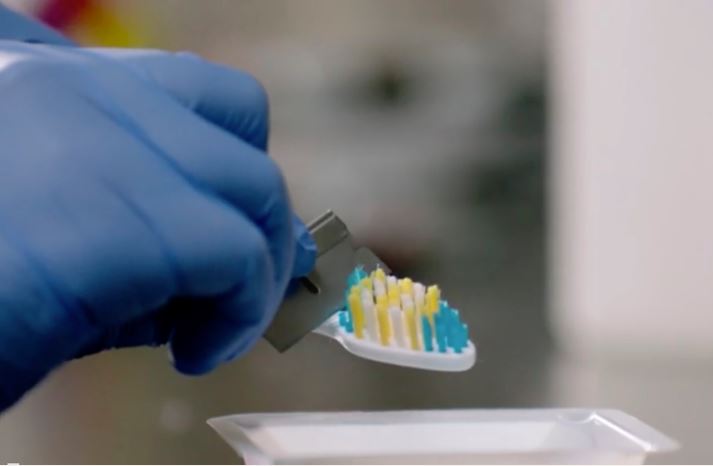
Good news: The bacteria living on your toothbrush reflect your mouth – not your toilet. To obtain toothbrushes for the study, Hartmann’s team launched the Toothbrush Microbiome Project, which asked people to mail in their used toothbrushes along with corresponding metadata. Hartmann’s team then extracted DNA from the bristles to examine the microbial communities found there. They compared these communities to those outlined by the Human Microbiome Project, an NIH initiative that identified and catalogued microbial flora from different areas of the human body.
“Many people contributed samples to the Human Microbiome Project, so we have a general idea of what the human microbiome looks like,” Blaustein said. “We found that the microbes on toothbrushes have a lot in common with the mouth and skin and very little in common with the human gut.”
“Your mouth and your gut are not separate islands,” Hartmann added. “There are some microbes that we find both in the human gut and mouth, and those microbes are found on toothbrushes. But, again, those are probably coming from your mouth.”
During the research, Hartmann’s team examined how many different types of microbes lived on the toothbrushes. They found people with better oral hygiene, who regularly flossed and used mouthwash, had toothbrushes with less diverse microbial communities.
“If you practice good oral hygiene, then your toothbrush also will be relatively clean,” Hartmann said. “But it’s a small difference. It’s not like people who regularly floss, brush and use mouthwash have no microbes and those who don’t have tons. There’s just a bit less diversity on toothbrushes from people who do all those things.”
The researchers also found that microbes from toothbrushes of people with better oral hygiene had slightly more antimicrobial-resistance genes. Hartmann said microbes with these genes did not match the human body and were likely from air or dust in the bathroom.
Hartmann stresses that there’s no need to be alarmed by microbes living on your toothbrush. Unless your dentist recommends otherwise, people should not reach for antimicrobial toothpastes and toothbrushes.
“By using antimicrobials, you aren’t just getting rid of microbes,” Hartmann said. “You are pushing the surviving microbes toward antimicrobial resistance. In general, for most people, regular toothpaste is sufficient.”
“If you practice good oral hygiene, then your toothbrush also will be relatively clean,” Hartmann said. “But it’s a small difference. It’s not like people who regularly floss, brush and use mouthwash have no microbes and those who don’t have tons. There’s just a bit less diversity on toothbrushes from people who do all those things.”
The researchers also found that microbes from toothbrushes of people with better oral hygiene had slightly more antimicrobial-resistance genes. Hartmann said microbes with these genes did not match the human body and were likely from air or dust in the bathroom.
Hartmann stresses that there’s no need to be alarmed by microbes living on your toothbrush. Unless your dentist recommends otherwise, people should not reach for antimicrobial toothpastes and toothbrushes.
“By using antimicrobials, you aren’t just getting rid of microbes,” Hartmann said. “You are pushing the surviving microbes toward antimicrobial resistance. In general, for most people, regular toothpaste is sufficient.” https://news.northwestern.edu/stories/2021/01/your-toothbrush-reflects-you-not-your-toilet/


Recent Comments