



AI data centers are power-hungry. Not only do artificial intelligence computations consume enormous amounts of electricity, but a significant amount of energy is also required to cool the semiconductor chips that heat up during operation. As AI chips continue to deliver higher performance, the amount of heat they generate increases rapidly. As a result, conventional air cooling and external copper heat spreaders are approaching their practical limits. To address this challenge, a KAIST research team has developed an ultra-high-efficiency liquid-cooling technology that cools semiconductor chips from within.
A joint research team led by Professor Sung Jin Kim of the Department of Mechanical Engineering and Professor Ikjin Lee of the School of AI and Computing has developed a highly efficient liquid-cooling technology that directly cools high-heat-flux semiconductor chips using room-temperature water. The researchers achieved this by embedding liquid-cooling channels, thinner than a human hair, directly inside a silicon semiconductor chip. The paper is published in the journal Energy Conversion and Management.
The team successfully maintained the chip temperature below 100° C (212° F) even under extreme heat-generation conditions exceeding 2,000 watts per square centimeter (W/cm2).
How the cooling system works
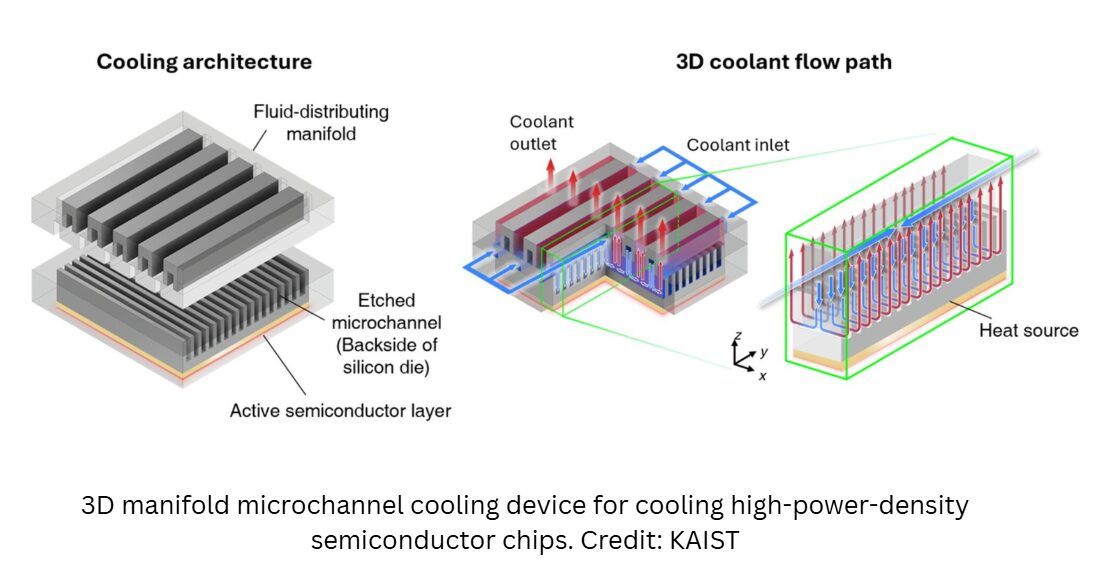
The researchers focused on a manifold microchannel structure embedded directly inside a silicon chip. Microchannel cooling removes heat through microscopic fluid channels that are smaller than a human hair. In conventional designs, coolant must travel through numerous microchannels from one end of the chip to the other. This long-flow path increases flow resistance and requires greater pumping power to circulate the coolant.
The manifold structure developed by the research team distributes coolant through multiple inlet channels and then collects it through multiple outlets. An analogy can be drawn to a logistics network: Instead of shipping all goods from a single origin to a distant destination, multiple distribution centers are strategically placed to shorten transportation distances.
Because the coolant travels only a short distance within each channel, flow resistance is reduced and the required pumping pressure becomes much lower. At the same time, coolant is supplied more uniformly throughout the chip, helping maintain a highly uniform temperature distribution across the entire device.
Optimizing performance and efficiency
The key innovation of this work is not simply making the microchannels smaller. The researchers systematically optimized the channel width, height, number, arrangement and coolant flow rate to maximize cooling performance while minimizing energy loss. To achieve this, they employed a multi-fidelity optimization framework, first using a rapid one-dimensional model to explore a broad design space and then refining selected designs with high-fidelity simulations.
Through this approach, the team simultaneously optimized cooling performance, pressure drop and temperature uniformity. As a result, they identified an optimal design within an enormous design space that had previously been difficult to explore because of computational limitations.
Existing MMC research faced a problem in which the coolant was concentrated in some channels while not being sufficiently supplied to others. The research team optimized the structure so that the coolant flows evenly through all channels. To achieve this, they analyzed numerous design proposals using both a simple computational model and precise simulations, identifying the optimal structure that enhances cooling performance while reducing energy loss.
The optimized structure was then fabricated on an actual silicon semiconductor chip and experimentally validated. Under the same temperature-rise condition, the cooling system achieved a coefficient of performance of 106,000. This is approximately 10 times higher than the previous world-leading result of around 10,000 reported in Nature in 2020. In practical terms, it means that only about one-tenth of the pumping power is required to remove the same amount of heat.
Why it matters for data centers
Notably, this performance was achieved without relying on phase-change cooling, nanoscale surface modifications or expensive materials such as diamond. Ordinary room-temperature water was used as the coolant. In addition, the device was fabricated using a low-temperature process below 350° C (662° F) that is compatible with conventional semiconductor manufacturing. This means the technology could be implemented in existing semiconductor foundries without requiring major additional equipment investments.
The technology is expected to help address thermal management challenges in a wide range of high-heat-flux electronic systems, including AI accelerators, high-performance computing systems, three-dimensional semiconductor packaging, power electronics and defense electronics. In particular, data centers are increasingly constrained not only by computing performance but also by cooling power consumption and cooling infrastructure requirements. Technologies that reduce pumping power at the chip level could therefore play an important role in improving the energy efficiency of next-generation data centers and alleviating thermal bottlenecks.
Professor Kim said, “As the performance of AI semiconductors and advanced electronic packaging becomes increasingly limited by heat, we expect this technology to serve as a foundational cooling solution for future high-performance computing systems.” https://techxplore.com/news/2026-06-liquid-cooling-technology-semiconductor-chips.html



Recent Comments