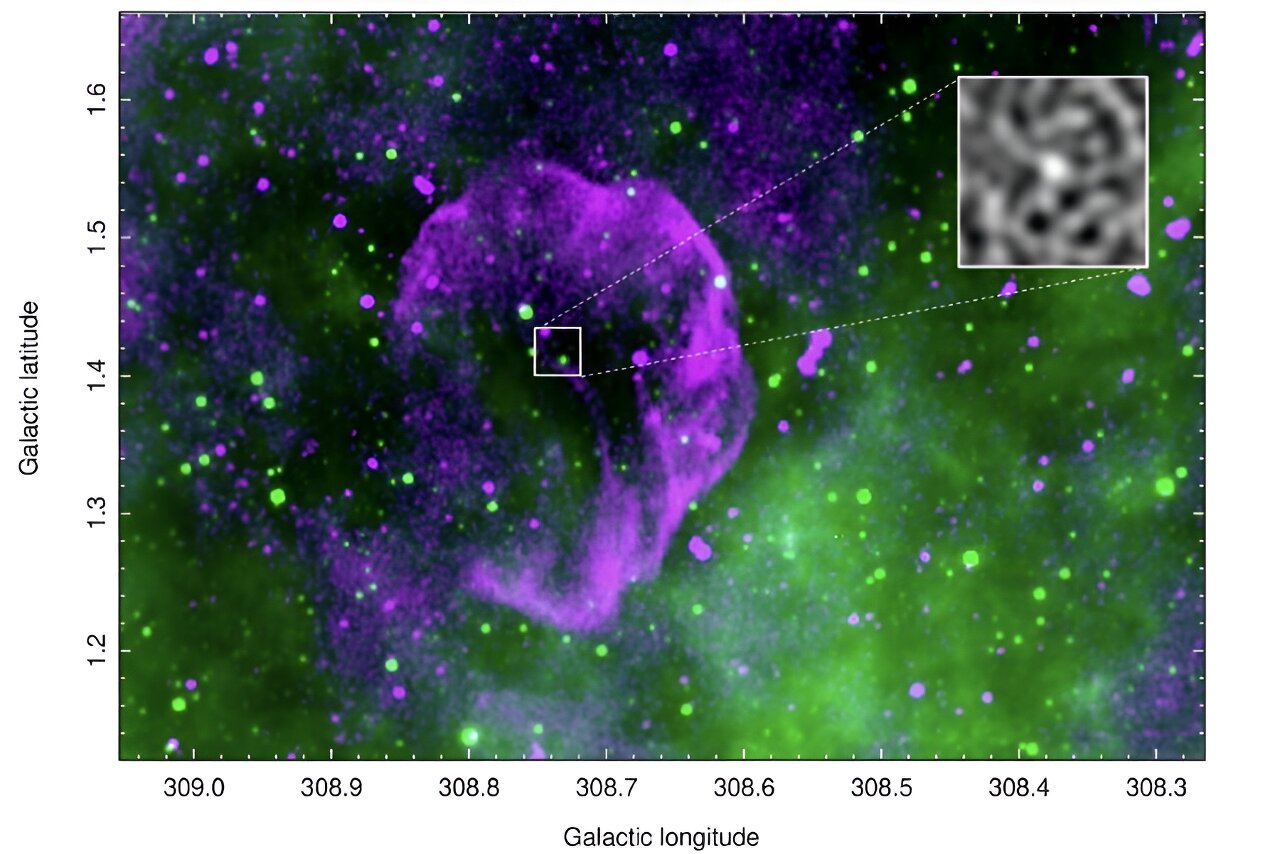
RGB composite image where the total intensity map of Raspberry, observed by ASKAP at ν = 944 MHz, is in red and blue while WISE 12 µm infrared image is in green. To present the structure of Raspberry, different colormaps and adjusted contrast levels were used. A linear scale is applied to all images. The inset is the ASKAP Stokes−V zoomed-in image showing the possible progenitor source. Credit: Lazarević et al., 2024.
Astronomers from the Western Sydney University in Australia and elsewhere report the detection of a new supernova remnant (SNR) candidate. The newfound SNR candidate, dubbed “Raspberry” due to its morphology, was identified in the near side of the Milky Way’s Scutum-Centaurus Arm. The findings were detailed in the Research Notes of the American Astronomical Society.
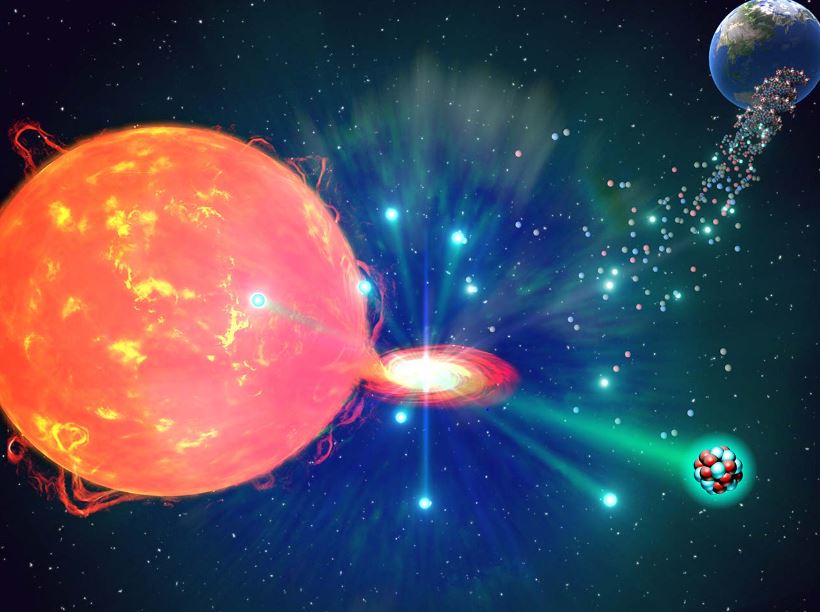
An artist’s impression of this research. (Credit: NAOJ)
Astronomers have proposed a new theory to explain the origin of phosphorus, one of the elements important for life on Earth. The theory suggests a type of stellar explosion known as ONe novae as a major source of phosphorus.
After the Big Bang, almost all of the matter in the Universe was comprised of hydrogen.
Other elements were formed later, by nuclear reactions inside stars or when stars exploded in events known as novae or supernovae.
But there are a variety of stars and a variety of ways they can explode.
Astronomers are still trying to figure out which processes were important in creating the abundances of elements we see in the Universe.
In this study, Kenji Bekki, at The University of Western Australia, an...
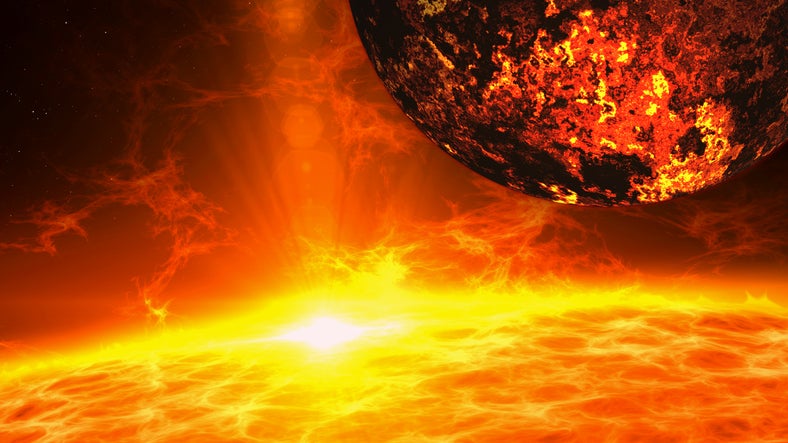
Extreme conditions on rocky planet surprise scientists. UC Riverside astrophysicist Stephen Kane had to double check his calculations. He wasn’t sure the planet he was studying could be as extreme as it seemed.
Kane never expected to learn that a planet in this faraway star system is covered with so many active volcanoes that seen from a distance it would take on a fiery, glowing-red hue.
“It was one of those discovery moments that you think, ‘wow, it’s amazing this can actually exist,” Kane said. A paper detailing the discovery has been published in The Astronomical Journal.
Launched in 2018, NASA’s Transiting Exoplanet Survey Satellite, or TESS, searches for exoplanets — planets outside our solar system — tha...
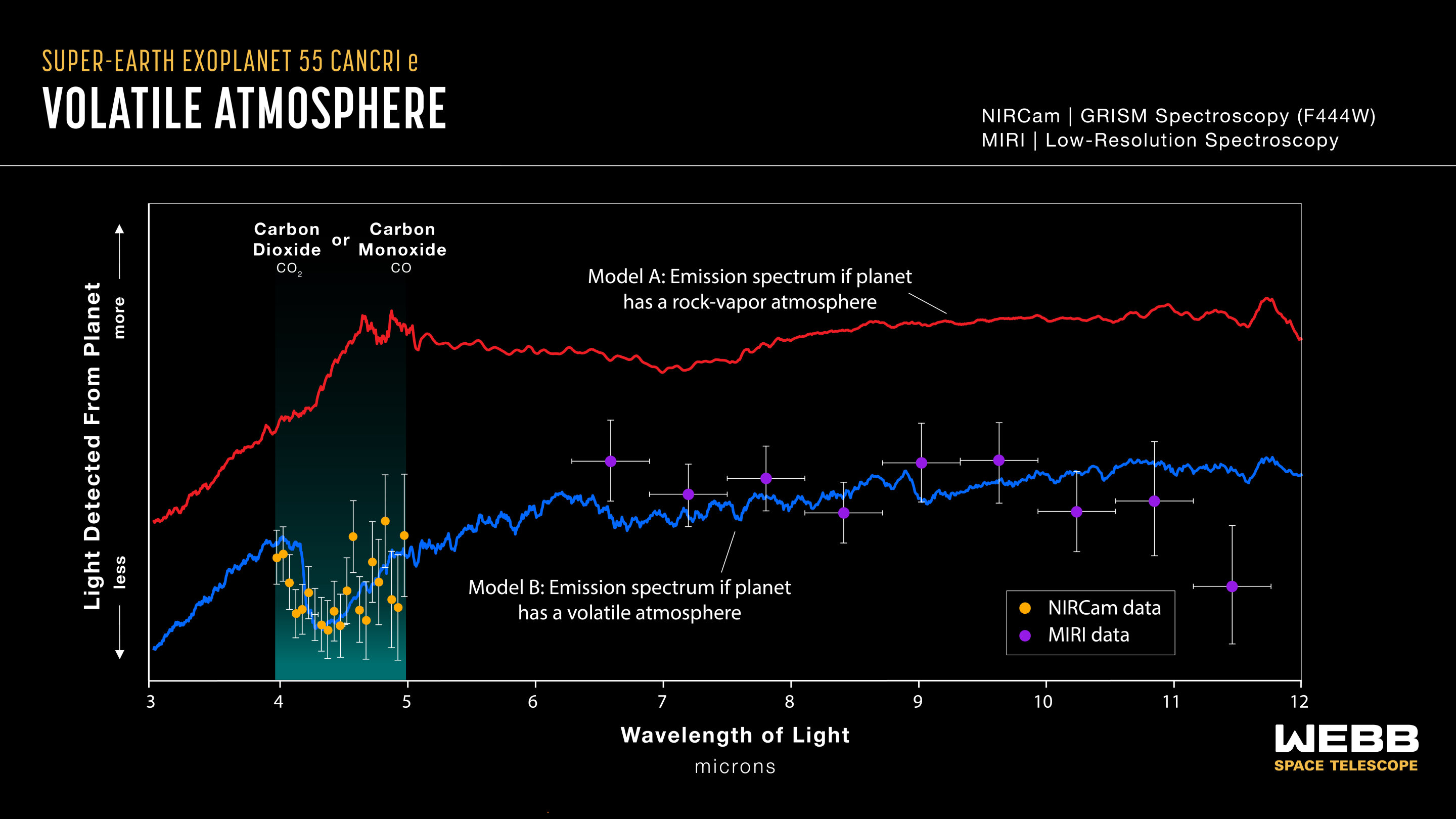
A thermal emission spectrum captured by JWST’s NIRCam (Near-Infrared Camera) in November 2022, and MIRI (MidInfrared Instrument) in March 2023, shows the brightness (y-axis) of different wavelengths of infrared light (x-axis) emitted by the super-Earth exoplanet 55 Cancri e. The spectrum shows that the planet may be surrounded by an atmosphere rich in carbon dioxide or carbon monoxide and other volatiles, not just vaporized rock. The graph compares data collected by NIRCam (orange dots) and MIRI (purple dots) to two different models. Model A, in red, shows what the emission spectrum of 55 Cancri e should look like if it has an atmosphere made of vaporized rock...Read More





Recent Comments